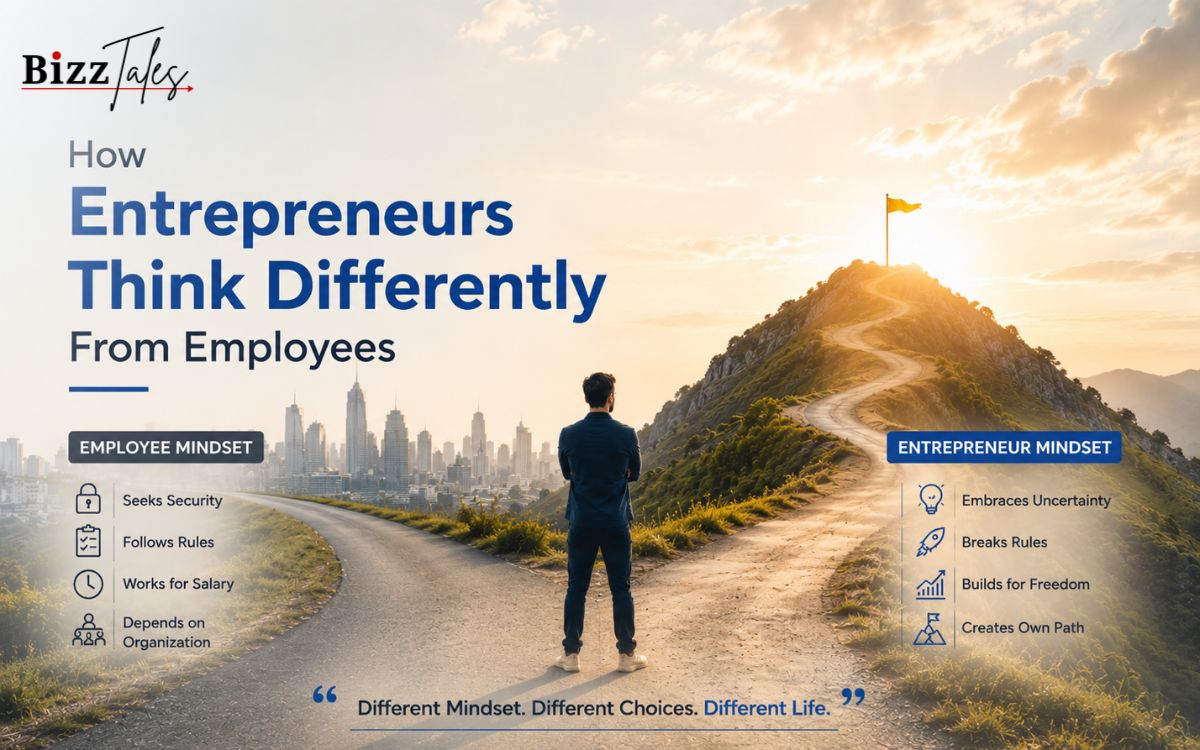
It’s not all about the money, about the work that someone does, about whether you start a business or work for someone else. The main difference between an entrepreneur and an employee is the way they think.
Pure entrepreneurs and pure employee(s) view the same circumstance in divergent ways. The entrepreneur characteristics as a seeker of opportunity and rewards; the employee characteristics as a pursuer of stability and security. The entrepreneur by rule-breaker, the employee by a rule-follower.
Neither way of thinking is wrong. We need both employees and entrepreneurs. But understanding the mindset difference explains why entrepreneurs think they way they do in terms of risk, failure, money, opportunities and challenges.
Most people tend to think that entrepreneurs are born gifted or simply lucky. And in fact, entrepreneurship is very often rooted in a certain mindset.
Entrepreneurs teach themselves to see problems as opportunities. They do this through a focus on value creation, assets building, and a longer-term perspective.
This type of mindset shift is what makes a business builder out of someone looking for a reliable job.
Entrepreneurs Think About Ownership
Perhaps the greatest reason for mindset variation is ownership.
Employees already working in organizations work for other people’s vision. Entrepreneurs work on creating their own vision!
This Ownership Mentality is a different way of envisioning time, money, the customer, and growth.
For example, a worker permanently exchanges time for salary. An entrepreneur constantly seeks to build systems, products or businesses that deliver value.
The first thing most employees do is to concentrate on getting down to their work.
What entrepreneurs are concerned with is the whole business.
Ownership is book keeping for responsibility.
Colleagues leaders, entrepreneurs, cannot use managers or companies as a scapegoat when they make mistakes. They are the only ones who have to sort out troubles.
It improves your decision-making skills continuously.
Entrepreneurs Focus on Opportunities
Most employees are trained to follow processes and stability.
Entrepreneurs acquire experience so that they become able to spot opportunities.
Entrepreneurs see business opportunities where normal people see problems.
For example:
A transportation startup might be borne out of a traffic issue.
It’s all about logistics business, and providing long delivery time!
A virgin company could be created by using bad customer service as an inspiration.
An online learning platform could be born out of limited access to education.
Entrepreneurs are always aware of the gaps in the markets.
This enterprising thinking allows them to build companies which cater to actual needs.
Entrepreneurs Accept Uncertainty
Most employees enjoy consistent settings.
Consistent pay checks, predictable working hours, and the security of a job are reassuring.
Entrepreneurs operate within a daily uncertainty.
They deal with:
- Financial pressure
- Customer changes
- Market competition
- Operational problems
- Business risks
Many people would become very uncomfortable with this kind of uncertainty.
Nevertheless, entrepreneurs slowly become psychologically adapted to an element of turmoil.
Instead of mindlessly fearing the unknown, they learn to deal with it.
That’s where their biggest strength is.
Entrepreneurs Think Long-Term
A lot of employees internally concentrate on certain short term things including monthly salary, yearly, to name a few.
Entrepreneurs tend to plan several steps in the future.
They frequently make choices thinking about where they would like their business to be in five or ten years time.
E.g., entrepreneurs may invest in a project today with no profits because its future growth is assumed to be higher.
This perspective encourages entrepreneurs to practice patience through the testing times.
It takes time to build a business.
Entrepreneurs know that business success doesn’t happen over night.
Entrepreneurs See Failure Differently
So, people worry about mistakes because they are afraid of judgement or failure. Employees don’t like making many mistakes that might result in issues or fall under the ‘blame game’.
However, the entrepreneur will built a different relation with failure.
They still can’t stand failure. But they use it as their teacher.
Business owners know that trial sometimes results in error.
New ideas can fall flat.
The marketing campaigns can be NO!
This leads to the point that things may go wrong.
But in each failure, it highlights lessons that enhance subsequent decision making.
This learning attitude can allow entrepreneurs to bounce back quicker from setbacks.
Entrepreneurs Think About Value Creation
In general, workers prefer to be treated fairly on a task basis.
Entrepreneurs are also more go-orientated to value creation.
They constantly ask questions like:
- What is wrong with this product and how can it be improved?
- What do customers want?
- How can the business solve the problems more efficiently?
- In what ways could operations perform better?
A business becomes successful by providing value to its customers.
Businesspeople get this concept very well.
Therefore, top successful entrepreneurs work tirelessly aroundthe customer experience, innovating, branding, improving the quality of service, etc.
Entrepreneurs Are More Comfortable With Risk
Perhaps the most obvious difference between entrepreneurs and employees is-
People normally dislike ambiguity and prefer stable income.
Risks which entrepreneurs are prepared to take are measured and so can bring significantly greater returns later.
For example:
Leaving stable jobs
Investing savings into startups
Launching new products
Entering competitive markets
Expanding businesses
They, however, involve probabilistically uncertain decisions.
Start-ups acknowledge the need to challenge themselves to grow.
But smart entrepreneurs take calculated risks-not stupid ones.
Entrepreneurs Focus on Building Systems
Employees often operate within current systems established by companies.
For entrepreneurs, system design is about the process.
They think about:
- Hiring teams
- Building operations
- Automating processes
- Improving workflows
- Scaling businesses
Thinking along these lines allows businesses to expand beyond the capabilities of an individual.
What successful entrepreneurs understand is that while hard work is important, it is your systems that determine long term success.
Entrepreneurs Value Time Differently
Most members of staff consider mainly salary and working time.
Discussion on the mind of an entrepreneur is on leverage and productivity.
They ask:
- How to make work more efficient?
- How can we get the system to save time?
- How can technology enhance out put?
- What does it take to scale teams?
All entrepreneurs realize that time is one of the most valuable business resources.
That’s exactly why so many entrepreneurs chase after automation, delegation, and productivity.
Entrepreneurs Continuously Learn
Businesses 21st When companies are in a competitive environment, they are unstable.
Markets are always in flux. Tech is always shifting. Customer patterns are always evolving.
For this reason, entrepreneurs often get obsessed with learning,
They continuously improve skills in:
- Marketing
- Finance
- Leadership
- Communication
- Technology
- Sales
- Management
May sometimes rely on companies for the training of employees.
Most entrepreneurs have a hands-on approach to growth and education.
This kind of learning mentality enables them to keep competitive.
Entrepreneurs Make Decisions Faster
Business environments change rapidly.
Insert examples of how the entrepreneur has to make decisions with incomplete information.
The delay may cause loss of opportunity.
Staff are predominantly engaged in approval processes, making final decisions.
Or the entrepreneurs themselves become decision-makers.
Eventually, they become comfortable with acting in the face of uncertainty.
Decisiveness is quickly becoming the major skill for entrepreneurship.
Entrepreneurs Think About Scalability
Employers are mainly concerned with getting on with the job at hand.
Entrepreneurs consider how scalable it is.
They ask questions like:
- Is it possible for this business to expand to a national scale?
- Can this service be expanded to reach new customers?
- Is operation going global?
- Is it possible for technology to automate growth?
This scaling mentality encourages entrepreneurs to question small daily operations.
They aim to develop companies that can grow.
Entrepreneurs Handle Pressure Differently
Running your own business is incredibly stressful.
Founders are responsible for:
- Employees
- Customers
- Investments
- Operations
- Financial survival
This stress will require entrepreneurs to become strong at heart.
Employees also experience stress, but entrepreneurs tend to have greater levels of responsibility and risk.
As time passes, this cultivates toughness and resilience.
Entrepreneurs Build Networks Actively
They are relationship savvy entrepreneurs.
They actively build networks with:
- Investors
- Mentors
- Customers
- Business communities
- Industry leaders
Networking provides opportunities, partners, knowledge and growth.
Employees also tend to put more emphasis on relationships within the company.
Entrepreneurs grow their external business networks.
Conclusion
Entrepreneurs And Employees Are Different entrepreneur has a mindset; (Employee).
Employees want stability, structure, incremental and predictable growth, whereas entrepreneurs want opportunity, ownership, innovation and creation of value for the long term.
That an entrepreneur’s mind might be different has not entered the aspirations of most business persons and venture capitalists until the theoretical arguments for the differences began to emerge. They have something to do with what business environments call for from individual minds. From an entrepreneurs point of view, for instance, the entrepreneur gains experiences that are turned into business “mental skills”; dealing with uncertainty; trading off between potential reward and probable failure; complex problem solving; rapid adaptation; and learning.
This is not to suggest that entrepreneurship is (or should be) ‘better than’ working for a job, fulltime. Both require brains, commitment and effort.
Yet, it provides insight into why entrepreneurs create businesses and understand entrepreneurial thinking and how individuals think in times of risks and uncertainty.
In essence, entrepreneurship is not merely about making a profit. It is about innovating, adding value, addressing challenges, and constructing something lasting.
FAQs
What is the main difference between entrepreneurs and employees?
The biggest difference is mindset. Entrepreneurs focus on ownership, growth, and opportunities, while employees generally focus on stability and structured roles.
Why do entrepreneurs take more risks?
Entrepreneurs understand that growth and innovation often require calculated risks and stepping outside comfort zones.
Do entrepreneurs fear failure?
Yes, but they usually view failure as a learning experience instead of a permanent defeat.
Why do entrepreneurs think long-term?
Building successful businesses takes time, so entrepreneurs focus on future growth rather than only short-term rewards.
Are entrepreneurs born or made?
Most entrepreneurial skills develop through experience, learning, problem-solving, and continuous improvement.
Why is adaptability important for entrepreneurs?
Markets and customer behavior change constantly, so entrepreneurs must adapt quickly to survive and grow.