
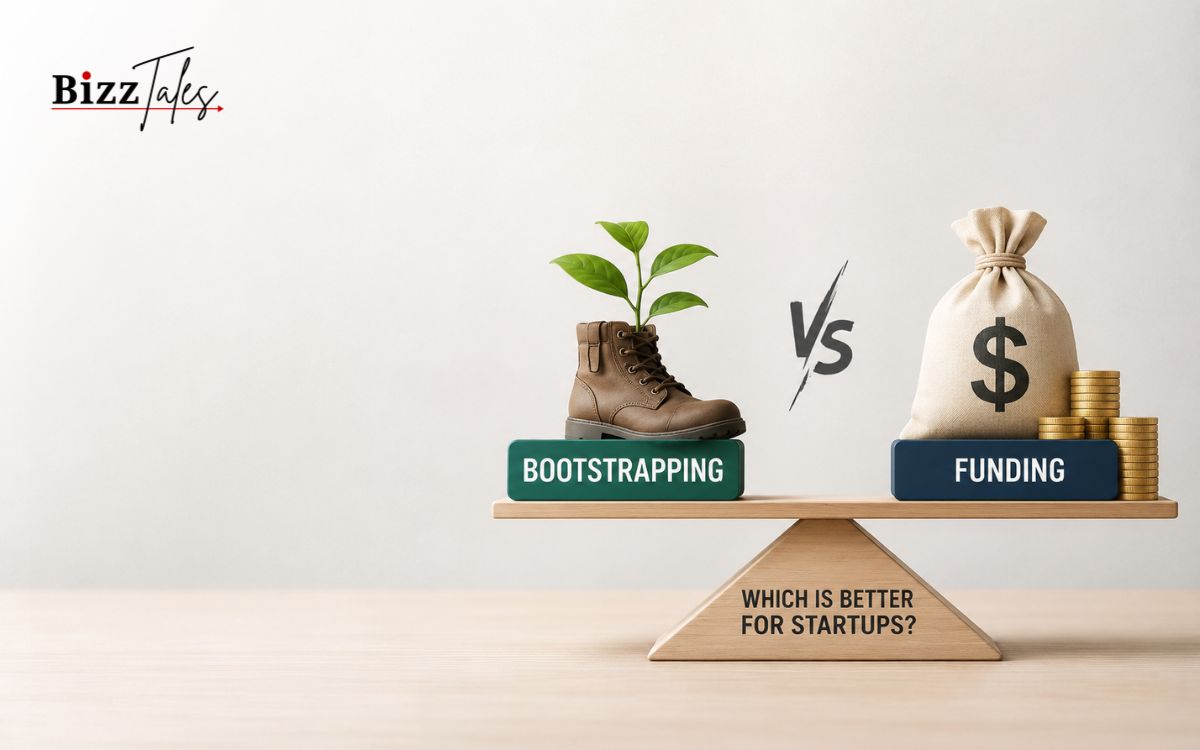
There are many tales of entrepreneurs who managed to build a business from First Principles within the startup ecosystem. It is easy to see the appeal of the boot-strapping approach, where founders rely on little more than their laptop and a good idea, with some working solely on personal finance. Conversely, some have taken millions of dollars of investor funding before they even begin to build their product. These two models-the boot-strapped model and the fundable one-if one can called it that-are undoubtedly the most popular ways of developing a business:
Bootstrapping your startup, starting out without investors is one of the most important decisions a founder of a startup will have to make. In fact it can determine the growth rate of the startup, how much control the founder will have over her startup and even it’s future. While there isn’t a clear cut answer, it is important to recognize the benefits and disadvantages of bootstraping and external funding.
Over the last few years, entrepreneurship has become more sophisticated. Very well-funded startups still show up regularly, as do founders finally realizing they can begin achieving huge revenues without any investor capital. Mailchimp, for example, showed how startups can become very profitable companies without high growth or external investors. Meanwhile, companies like Uber, Airbnb, and Stripe were able to reach huge scale by raising substantial funds.
Myth Conceptualizing the additional distinction between bootstrapping and startup funding is crucial to understanding.
What Is Bootstrapping?
Bootstrapping is the practice of founding and growing a business solely on savings, revenues and the company’s own resources. The entrepreneurs who bootstrap use his own money and the money earned by the business.
Bootstrapping is based on the idea of self-financing. The entrepreneur is the owner of 100% of the company and makes 100% of strategic decisions. All profits are reinvested into the business.
Entrepreneurs with a successful business tend to see that their venture is often funded through bootstrapping as they like to stress caution both financially and in the terms of investment. As resources are constrained, the company is more inclined to bring its project to profit from the outset rather than letting to rely on growth at any price.
A bootstrapped startup is likely to grow more slowly than a venture-backed company but is likely to build a stronger foundation. The business must prove itself to its customers and start earning revenues early on since it cannot rely on a huge investment cushion to cover losses.
Advantages of Bootstrapping
One of the most significant advantages of bootstrapping is ownership. When you build a business through self-funding, you keep 100% of the equity-and you alone determine how to use it.
Another benefit is the control. The entrepreneurs are free to implement their ideas without being under pressure by the investors. Usually, the investors want fast growth and short-term profit, but founder managing by his own can work towards sustainable growth.
Bootstrapping can also instill a greater sense of financial control in entrepreneurs. When capital and other resources are scarce, entrepreneurs tend to cut costs and emphasize areas that affect top line revenue much more than others. This typically translates into a more streamlined approach to how the business is run.
Finally, one more good thing is that it allows more flexibility. The entrepreneurs are only responsible to their self and their customer. They can make decision faster without considering the investors or the board members.
Challenges of Bootstrapping
Though bootstrap has its benefits of independence, there are also drawbacks to it. The most apparent limit is the capital. Building the business itself is an expensive process, which involves the money spent on developing the product, marketing, employing and activities needed to operate the business.
Growth without external funding will be slower. Larger, well financed competitors can usually grow more quickly and commercialize against the existing market more rapidly.
Financial stress something another challenge. Generally, founders put their own saving into the business. In addition, if the business fail, they will be at personal financial danger.
Bootstrapped founders might also struggle to recruit initial top talent, particularly when they’re not in a position to pay high salaries or generous benefits.
What Is Startup Funding?
Startup funding refers to raising capital through outside sources such as angel investors, venture capital funds, crowdfunding or strategic partners.
Funding means supplying investment funds to help startup companies grow rapidly by expanding, developing and launching new products and business segments, and acquire market position quickly.
In return for capital, investors generally get an ownership stake (equity) in the business. So the founders give up some part of ownership and potentially give some voting rights to the investors.
Funding has often become the foundation of the present day startup scene. A large number of technology business axes on investors to enable them to expand rapidly and be able to compete in the market.
Types of Startup Funding
There are different types of funding for startups.
Angel investors are usually the company’s first external investors. They invest for equity and focus mainly on the early stages of a company.
Venture Capital Firms commitment a larger amount of money to start-ups that have a massive growth potential. They normally qualify the invested start-ups with expertise, client portfolio, networking, etc.
Funding so called “B2C 1 ” allows entrepreneurs to gather funding from many people. This can be used to test market’s willingness to buy.
The possibility of government grants and startup incubators should also be kept in mind, as these can be examples of alternative funding that is not secure for the founders to relinquish equity for.
There are argument for every funding sources. In addition, it has its own terms and condition. Therefore, business owners should consider each options carefully.
Advantages of Funding
One of the most important advantages of funding is providing access to capital. With funding, startups can afford to spend on new products, marketing, expanding the team and growing the business, rather than just using the profits.
Funding accelerates growth. Having access to capital allows an enterprise to expand quickly into new markets, hire a greater number of employees, and grow operations at a rate unlikely possible to achieve through self-funding.
Investors add valuable expertise and contacts. Seasoned venture capitalists and angel investors provide advice and help avoid pitfalls.
Funding has other benefits, such as increasing credibility. Having the support and money of a respected business may show confidence in your company that helps attract customers, staff and investors.
Challenges of Funding
However funding will have its own concessions:
The most clear disadvantage is diluting ownership. Founders are giving up piece of ownership in return for funds.
There can be pressure from the investor’s expectations. When a startup is venture-backed, there can be pressure to grow fast and hit goals often. This can have an impact on company culture.
Fundraising-meaning the time needed to raise that money-can be lengthy. It can take entrepreneurs months of running around, pitching investors, building financial documents, and closing deals-rather than building their customer base and product.
Disagreements between founders and investors over the market direction, spending priorities and exit strategies.
Bootstrapping vs Funding: Key Differences
Bootstrap and fundings, there is only one major difference: control and growth speed!
Bootstrapped companies should want to gain independence and grow at a sustainable rate. Funded companies should push to grow quickly and dominate a market.
Bootstrapped founders retain ownership and have limited resources. Funded founders receive capital and have less control.
The “best approach” will depend on the business, the industry and where you want to go.
Shoehorning a local services business, a consulting company or a niche software provider can be achieved by bootstrapping. But industries where cash-intensive Product development is needed (biotech, AI, transportation, etc.) almost always need external capital.
When Should Entrepreneurs Bootstrap?
For entrepreneurs who know how to begin turning a profit right away, bootstrapping is frequently the best option.
If a new company is cheap to set up, it may be especially suitable for bootstrapping. For instance, it might be a digital agency, providing the services of freelancers, a consulting business, a media content site, or software with a fairly modest development cost.
Those who are, by their nature, committed to long-term control and independence through the founding of their venture may be inclined to initiate via bootstrap.
If the market competition is mild and the growth speed is less matter to success, bootstrapping can be a good approach.
When Should Entrepreneurs Seek Funding?
Funding could be needed in encouraging highly demanding market.
The companies that producing advanced technologies or having to invest heavily in infrastructure will tend to bootstrap harder.
The other benefit of funding is in an environment where market opportunities are time-dependent; entrepreneurs might require funding to reach customers rapidly before more fierce competitors have the chance to gain lead.
In general, when a company is pursuing an international expansion, investment becomes time and money demanding because the company must face different markets, different languages, and different cultures.
Examples of Successful Bootstrapped Companies
Some of the most well-known companies around the world were founded without significant outside investment.
Mailchimp became a billion dollar email marketing platform while remaining bootstrapped for most of its history.
Zoho turned themselves into one of the most admired software companies in the world through a profitable self perpetuating model.
Basecamp generated a loyal customer base and a profitable, self-sustaining business entirely without the benefit of large venture capital infusions.
All these companies show how patient growth and customer focused practices can make an excelence.
Examples of Successful Funded Companies
Most of today’s hi-fi’s were financed by outside money.
Uber gathering fresh billions of dollars for its global empire building and competition killing efforts.
August 2009 Airbnb attracted $7.2m for the European launch and exponential global growth of the service in 2009- 2011 aerospace investment was a key enabler.
Stripe used a round of funding to grow the product team and reach the area of online payment.
These CEO examples demonstrate how funding allows startups to rapidly capture sizable market opportunities.
Conclusion
There is no clear victor in the Bootstrapping versus funding debate. Both methods have led to the formation of some of the most successful business entities in the world.
Bootstrapping gives you freedom, that sense of ownership, and–for obvious reasons–dollars for discipline. Money gives youCapital, Knowledge, and the Turbo boost.
A business should be chosen, by entrepreneurs, after considering the industry and business model, and growth aspirations and personal desires. The winning move need not be the most noticed one but rather be the one that best meets the corporate objectives and offers the greatest platform for success.
The best founders know that capital is a means to an end. Whether you do it with your own money or someone else’s, all that really counts is creating a business that actually addresses a real pain point.
FAQs
Is bootstrapping preferable to funding?
Both have their advantages and disadvantages. It ultimately boils down to what the startup is trying to accomplish, in what industry, and the pace of growth the market requires.
Is it possible for a startup to transition from bootstraping to funding down the track?
Yes. Several businesses bootstrap at the beginning to test their business model and are willing to attract funds afterward.
Are investors ever interested in equity?
Although most investors want to own equity some sources of finance like loans and grants do not mean diluting ownership
What well-known businesses were bootstrapped?
Some examples of companies that have a successful bootstrapped history are Mailchimp, Zoho and Basecamp.
What is venture capital? Why do startups seek venture capital?
The reason that startups raise venture capital is to accelerate growth, get talent on board, build their product, and expand to a new market quickly.
In general, bootstrapping seems to be less risky than taking the other ways.
It prevents equity dilution but also puts founders’ personal finances at risk since they may have to use their own money.
Is it possible for a startup funded through bootstrap to reach unicorn status?
Yes. There are numerous companies which were very successful without high external finance.
What should a new entrepreneur opt for?
Determining whether to pursue funding or bootstrap is best done by first-year founders and co-founders, who need to consider their market opportunity, amount of money they require to fund their venture, as well as their personal ambitions in taking either path.