Today, in the increasingly digital world, people will reach out to the individual before reaching out to the companies that they represent. Consumers want to know and trust the face behind the companies, investors want to be able to connect with the people behind the founders that they are investing in, and employees want to work for people they respect. Personal branding has become one of the most valuable assets an entrepreneur can develop.
Building a personal brand is something that traditional marketing cannot achieve. It can help entrepreneurs to find customers, establish authorities in the industry, cooperate with others, get media events and develop lasting trust. Leading a start-up, small business or a global company, people cannot ignore personal branding anymore.
Many of the world’s leading entrepreneurs have used their Personal Brand to complement and support their business activities. Their reputations and their visible expertise have been used as strategic assets, extending their business success. When you associate the words “invention,” “technologies,” “online selling” or “leading,” several entrepreneurs instantly come to mind.
But, personal branding isn’t about being famous. It’s really about developing a reputation that says, “I’m an expert you can trust and I stand for something.” Entrepreneurs have a personal brand no matter what they do, but the question is: Is it working for or against you?
Knowing how to build a personal brand, can bring an otherwise average entrepreneur to become a well established industry leader.
What Is a Personal Brand?
Personal brand is what has been built about an individual by himself and others through his deeds, creates, expertise, style of communication and image projection. It’s the common regard to which an individual is called with!
For entrepreneurs, a personal brand is much more than a trademark or a business name. It represents their story, vision, values and personal view. It influences how customers, investors, staff and partners see them.
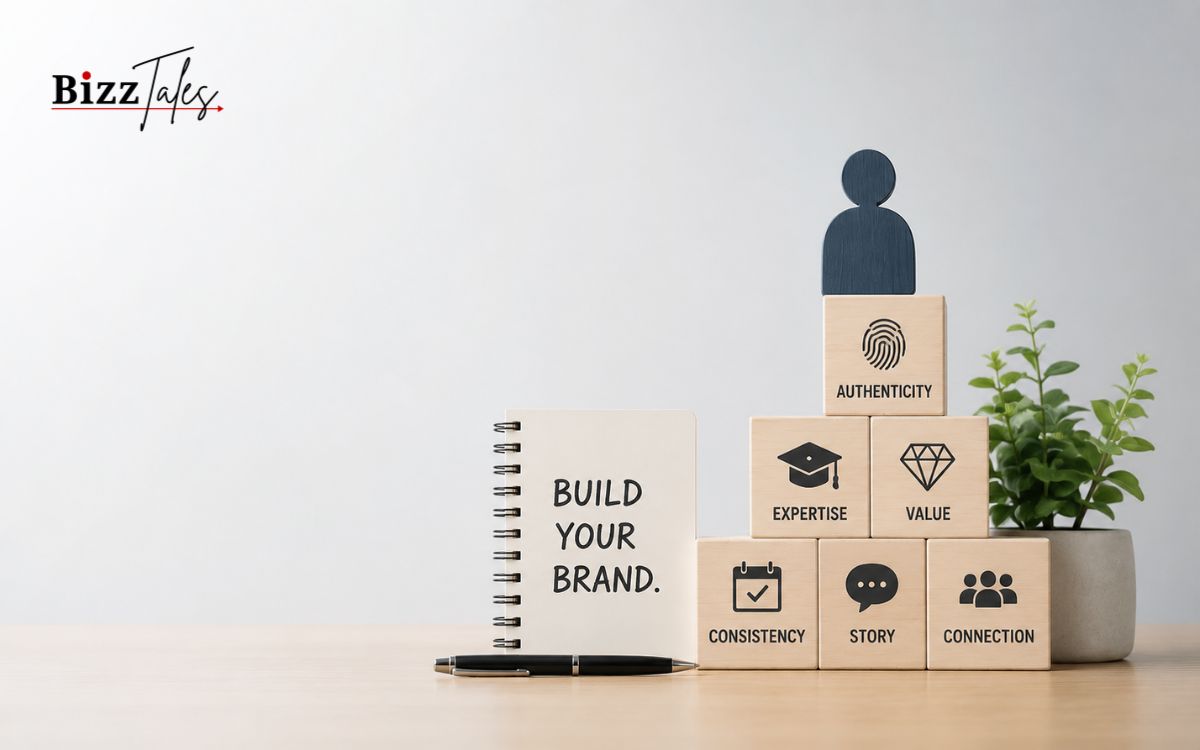
Your personal brand isn’t a facade. The best personal brands are authentic and uniform. They leverage actual expertise, real experiences and genuine value with an audience.
As individuals enduringly link particular qualities, talents or conceptswithentrepreneurship, apersonal brand begins to develop.
Why Personal Branding Matters for Entrepreneurs
It is now more difficult than ever to be a successful entrepreneur or run a successful business. Consumers are bombarded with thousands of products, services and advertisements each day. It is no longer enough just to have a business idea.
A personal brand is about building trust. People buy from people they (know, like, and) trust. When entrepreneurs allow the knowledge and experiences to flow out on a web page, the business is positioned for how it impacts buying decisions.
Personal branding also benefits entrepreneurs by drawing in opportunities. Opportunities such as speaking engagements, podcast appearances, collaborations, and investment opportunities often occur because entrepreneurs are known and respected for their knowledge.
Furthermore, in terms of marketing strategy, a solid personal brand can lower customer acquisition cost. An entrepreneur with a whole committed following, can already reach existing customers with whom you know you align.
Personal branding provide survival in the long run of business. If business directions and products are operating, entrepreneurs’ reputation will never be devalued.
Define Your Purpose and Positioning
All great personal brands are built on… Clarity.
Positioning-No matter what you are trying to do, you need to understand what you want to be known for. Failing to have a position will lead to inconsistent branding and branding will fail.
A useful starting point is identifying three areas:
1-Identify what you are expert of..i.e. Your assets! What are the knowledge, skills, experiences that enable others to gain from you?
Secondly figure out who you intend your target market or audience to be? Who are you trying to help, motivate or communicate with?
Third, clearly state what your mission is. What difference do you hope to make?
Once these six questions are answered by the entrepreneur with clarity he/she can develop the entrepreneur’s personal brand in a focused and unforgettable manner.
Take, for example, entrepreneurs-one is mostly interested in helping start-ups grow, others work on digital marketing, artificial intelligence, leadership, personal finance, etc. Once they are clear with where they want to position themselves, it will be easier for people to understand their messages and define them.
Tell Your Story
People relate to stories more than resumes.
Few entrepreneurs get carried away and only talk about results. Granted that achievements are important but the audience may always be interested to learn about the journey behind those results.
Sharing your experiences, struggles, failures, lessons learned and critical moments humanizes entrepreneurs and allows for emotionally connecting to them.
Honest storytelling creates trust because it offers proof, writes show you that it took hard work and that it requires one to be open and honest.
Founders need to consistently tell stories about their company, such as key moments or debates, challenges they faced, and lessons they learned.
An interesting story is far more likely to stick in people’s memories than the numbers and the figures.
Create Valuable Content Consistently
Content is arguably the most powerful method of developing a personal brand.
Content is proof of knowledge. Blogpost, LinkedIn-post, video, podcast, status update or Newsletter, each piece of content is used by entrepreneurs as a proof of knowledge.
The goal should not always be to showcase products/services,. The entrepreneurs should try to educate, inform, motivate and assist the reader.
Some examples of useful content include industry and business learnings, tips to increase productivity, leadership advice, startup stories, case studies, market and future trends.
Consistency over perfection: the key principle entrepreneurs want to remember is that setting up a steady blog schedule will keep them visible and maintain their relevance.
The positive side to out blog approach is over time as one continues to blog regularly it starts to build in authority and trust.
Choose the Right Platforms
Not all entrepreneurs are meant for all platforms.
Instead of trying to be active everywhere, entrepreneurs should identify the sites or applications where their target audience is present.
How to use LinkedIn? LinkedIn is beneficial for B2B entrepreneurs, startup owners, consultants and professionals because is a perfect tool for enhance than advantages.
YouTube. YouTube is perfect for those entrepreneurs who like to produce informational, long form style, video. This is a good place to gain speed in trust because viewers get to see and hear the entrepreneur directly.
X (Twitter) is a useful platform to share quick thoughts, engaging in industry dialogue, making presence among investors and industry players.
Overall, it’s good for entrepreneurs who want to mix business messages with storytelling and imagery.
The trick is knowing the handful of sites you should be focusing on and working them consistently.
Become Known for a Specific Expertise
The biggest mistake entrepreneurs make-try to be known for everything.
A strong personal brand is often associated with a specific area of competence. It is said that the moment one mentions the name of an entrepreneur, a certain theme should come to mind.
Not that this is an attempt to cut development off. It is just trying to monopolize in one field before picking up in others.
For instance, an entrepreneur might first be recognized as an expert in new venture scaling strategies, online marketing, executive coaching, or AI.
Specialize into one’s expertise, it gave to know who is the expert. It gave to create authority. It ease content creation as the entrepreneur has a clear area of focus for communicates.
Reliably through time, expertise is an advantage.
Build Relationships and Network Strategically
However, personal branding is not only about sending messages out. It is certainly about developing relationships.
Popular ways that entrepreneurs connect with their audiences, businesses and industries include:
HealthNet Pennsylvania believes networking is about building relationships, not self-promotion. Those entrepreneurs who truly support the efforts of others in their personal and professional networks will find that others often support their efforts as well.
Going to industry events, joining webinars, getting involved in communities and collaborating with other creators will, in the end, considerably increase your visibility.
Collaborations and relationships may be a greater catalyst to personal brand development than advertising.
The best personal brands have strong professional networks to back them up.
Develop Thought Leadership
Thought leadership: Entrepreneurship is said to be thought leading when entrepreneurs’ bring forward their own views and opinions to the field.
Thought leaders provide insights that will cause people to think differently instead of just repeating what everyone else has said.
It can mean, for example, researching industry trends, forecasting future developments, sharing personal lessons learned, or questioning existing assumptions.
Through thought leadership, entrepreneurs are perceived as the trailblazers, not the followers.
Our audiences, as industries change and evolve, are apt to find their attention directed to men and women who give clarity, also send direction and insight.
The process of establishing thought leadership can take some time but it can do a great deal to build a personal brand.
Maintain Authenticity
Authenticity-One of the key attributes of personal branding.
Sellers tend to raise red flags with their audiences, who can tell all too well when an entrepreneur is putting on a mask. Drawn out, two-dimensional personas will get you some fleeting attention. If you want long-term loyalty, you’ll need to get real.
Truly the entrepreneurs are genuine: experiencing human faults and imperfections, they don’t pretend.
Authentic does not have to be oversharing your life. It mean that whatever you disclose out to the public, it should reflects who you are and what you uphold.
Trust is fragile and difficult to achive.. And easy to loose. Genuinefulness is how to keep and enhance that trust.
Leverage Social Proof
Provides validation for reputation and expertise
Testimonials, case studies, winning out clients, awards, charts and media features and speaking references can be used by entrepreneurs to top up their personal brand.
Getting positive feedback from others about an entrepreneur’s expertise, when expressed publicly, build confidence and credibility among potential customers, investors or strategic alliance partners.
External validation that reinforces personal branding is called social proof.
Eventually, positive reputation will be one of the most useful entrepreneurial business assets.
Stay Consistent Over Time
The other main thing to remember about personal branding is that it’s a buy and hold kind of thing.
Many entrepreneurs simply expect to see results rapidly, and get discouraged when their growth is slow. But as we all know, solid personal brands don’t happen overnight.
Sharing uniformity in messaging, content, values, and style of communication.
Small steps, when you take them often, can lead to spectacular results.
The entrepreneurs who stay visible and keep delivering value are often the most influential people.
Common Personal Branding Mistakes
However, there are also some mistakes on personal branding success.
Selling not helping is the biggest mistake. All the time talking about yourself drives the customers nuts.
Another mistake is inconsistency. Varying the number of posts randomly breaks your momentum and the momentum of your page.
A lot of entrepreneurs also imitate rather than find their own voice. Inspiration can work but it is authenticity which makes a brand.
One of the most frequently made mistakes is not bothering about audience interaction. Simply put, personal branding is a two-way traffic and not a one-way transmission.
All entrepreneurs is surrender too quickly. It takes much time to do authority. So, be patient.
The Future of Personal Branding
Personal branding will become even more central to my development as the technology continues to evolve.
AI offers smart news and information, generates content for your brand, automates processes and works for you – real, human relationships built on trust are impossible to imitate: people will want to turn to trusted experts and credible information sources.
Is investing in personal branding worth it? As of now-a bet on small business-the net positives of which persists. Whatever the case, when promising entrepreneurs are social capital to spare entrepreneurs as entrepreneurs invested made future brands.
In the next ten years the entrepreneurs that shine won’t necessarily have the biggest marketing budget but they will be the ones that create trust, add value and build relationships.
Conclusion
Developing your personal branding as an entrepreneur no longer excuses in the digital age. It is one of the best strategies to build credibility, get opportunities and drive growth.
A powerful personal brand is developed by being clear about who you are, what you do, why you do it and how you want to be seen. It is about being genuine, providing valuable content and information and working hard at building meaningful relationships. Please note well: it is not about roping others in, chasing followers or making noise.
The best entrepreneurs know that people buy people before they buy from businesses. By developing themselves through branding, entrepreneurs develop an asset to take them through all phases of their business.
The process takes patience, dedication, and sincerity-but the long-term payoff can be incredible. It’s a world where trust is one of our most valuable currencies, and a strong personal brand could be an entrepreneurs biggest differentiator.
FAQs
What does a personal brand mean for an entrepreneur?
A personal brand is the reputation and perception of an entrepreneur that people have based on their knowledge, values, content and public image.
What is the significance of personal branding?
Personal branding allows entrepreneurs to establish credibility, open doors for new opportunities, position themselves as experts, and develop their business.
What is the most effective platform for my personal brand?
It all depends on audience. If reaching up to professionals then of course LinkedIn is the best platform but You Tube, Instagram and X can be helpful to build the personal brand.
What is the duration to create a unique personal branding?
Fortunately, content creators in niche markets will be hard to create their own brand and web enough to build their own brand that takes a year or more.
Is it possible for introverts to actually create a personal brand?
Yes.. Personal branding is not being extroverted, it’s sharing your experience and adding value. There are several introverted entrepreneurs with successful personal brands.
What kind of content should entrepreneurs be publishing?
Entrepreneurs may provide educational content, industry news, lessons learned, case studies, opinions, and tips and tricks.
Personal branding is talked about mostly with regards to startup founders?
Yes. Personal branding helps entrepreneurs, managers, reporters, consultants, freelancers, makery, and all kinds of professionals.
How can entrepreneurs quantify personal brand development?
Indicators of growth include metrics like engagement, visitor numbers, invitations to speak, mentions through PR, collaborations/partnerships and inbound enquiries.