
Technology is seldom a disruptive factor in a business all at once. Rather, it alters the economics that sit underneath it: the way we deliver value, the way our customers pay us, and the rate at which a business can grow. This transition is becoming even more apparent as the role of AI evolves from experimentation to deployment, the power shift shifts in customer expectations, and businesses seek new sources of revenue during a period of turbulence.
These forces imply that the business models that 2027 prefers will not be completely different. Instead, many will be familiar models, just enhanced by improved technology, more data and changing customer behavior. A 2025 McKinsey study showed that 88% of surveyed organizations were already using AI in at least one business function, but most were still figuring out how to scale it. At the same time, subscription businesses are consolidating their traditional recurring revenue models with usage-based pricing and onetime sales.
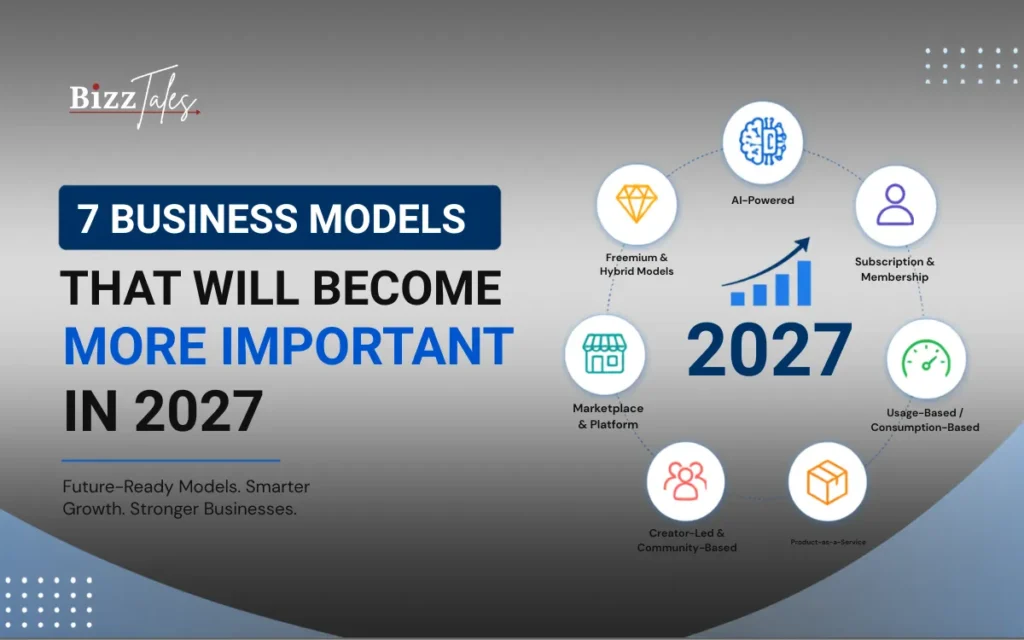
Here are seven future business models worth watching as entrepreneurs and established companies plan for 2027.
1. AI-Powered Business Models
AI is no longer just a productivity tool, but it’s becoming a product itself. An AI business model is a way to use artificial intelligence to make work more efficient, provide a tailored experience, develop content, process data, or provide an experience-something that would otherwise take a lot of time or effort.
The opportunity becomes especially compelling when AI alters the economics of an entire service. A tiny legal-information provider, for example, could deploy AI to perform document analysis at a tenth the cost; a broad-based e-commerce site could deliver personal shopping advisory to each and every customer, instead of only its most valuable ones.
This trend is also reflected in the growing adoption of AI agents: in 2025, McKinsey reported that 62 percent of surveyed organizations had at least “begun experimenting” with AI agents. The key takeaway for 2027 may be that overlaying an existing offering with an AI feature is unlikely to be a durable strategy; organizations that reconfigure their products, operations and prices to optimize for AI technology could generate far more value.
2. Subscription and Membership Models
A subscription business model substitutes a continuous service for a series of individual transactions. Customers pay monthly or annually for software, entertainment, education, professional services, tangible products, or access to a community.
Its relevance for companies is clear: subscription revenue can add predictability to demand and unlock potential for greater value over the customers’ lifetime. For customers, subscriptions can offer convenience, ongoing upgrades, unique perks or lower initial prices.
However, the next stage is probably going to be even more intelligent than providing a monthly price on an existing product. Zuora found that subscription businesses in its 2025 subscription economy index had grown revenues 11% faster than the wider economy in the two years prior, while its research also identified increasing salience of hybrid and flexible monetisation.
In 2027, a fitness company might combine a physical product, personalized coaching, an app, and a members-only community into one recurring relationship. The opportunity is to build an ongoing service customers continue to value—not merely a recurring bill.
3. Usage-Based and Consumption-Based Models
In a usage-based pricing scheme, customers are billed by their actual consumption of the service. Instead of subscribing for a fixed access fee, they are billed per action by using APIs, transactions, or for each Gigabyte, seat-hour, delivery, or some other unit processed.
This model is very appealing to a customer whose consumption varies widely. Perhaps a startup with uncertain computing needs would like to pay for the cloud resources in accordance with their use rather than entering into a large pre-booked contract.
The model also allows for the price to be better aligned with the value to the customer. In general, we should expect a business that handles twice the number of transactions to have twice the reason to pay twice as much.
But for providers, usage-based models have a downside: they are less predictable, leading to unpredictable revenue. As such, one of the most promising new business models could be the hybrid: a predictable, flat-rate subscription tariff coupled with a usage charge for anything beyond a specific level. Currently, one of the most prevalent and profitable combinations is the mix of subscriptions, usage, and a one-time charge.
4. Marketplace and Platform Models
Marketplace businesses link two or more sets of people who depend on each other: buyers and sellers, freelancers and clients, drivers and passengers, content creators and viewers, and businesses and on-demand experts.
The draw is the scalable. It is not about owning all the assets or working with every service provider but creating the infrastructure, the rules, discovery mechanisms, payment systems and confi dence mechanisms through which all will be going on.
A niche market might link, say, independent industrial designers with small scale manufacturing firms. As we get a critical mass of buyers and suppliers, network effects can make the market increasingly valuable for each group.
The challenge is getting scale and maintaining trust. The platform must handle fraud, quality, customer service, and sometimes regulations. But for an entrepreneur that model can create powerful economics because you can grow by adding transactions, not inventory or people.
In 2027 we will see more highly targeted sites for professional niches, local services, expert networks and more AI-assisted workflows.
5. Product-as-a-Service Models
Product-as-a-service changes the traditional relationship between a company and a physical product. Instead of simply selling equipment once, the provider charges for ongoing access, maintenance, performance, or outcomes.
Think of industrial equipment leased with predictive maintenance, office hardware bundled with support, or energy systems sold through long-term service agreements. The customer gets a working solution rather than simply taking ownership of an asset.
This model can make expensive products easier to adopt because customers avoid large upfront payments. It can also create recurring revenue for the provider and strengthen the customer relationship.
Technology makes the model more practical. Connected products can report usage, detect maintenance requirements, and provide data about performance. A commercial refrigeration company, for example, could charge restaurants for reliable cooling capacity while remotely monitoring equipment and handling maintenance.
The opportunity is particularly strong for manufacturers willing to think beyond the initial sale. Instead of asking, “How many units can we sell?” businesses can ask, “What ongoing outcome can we deliver?”
6. Creator-Led and Community-Based Models
The creator economy is transitioning from an audience-building phenomenon into a new type of business. Creators, authorities, teachers and specialists of niche areas can monetize one-on-one relationships through memberships, courses, events, digital goods, sponsorships, consulting, ecommerce and paid communities.
The key change is ownership of the customer. Instead of all traffic coming through platforms like advertising or mainstream media companies, an individual or small team can establish a niche community and profit from it through multiple streams:
Another example is a cybersecurity guru who might assemble a free newsletter with a premium community of pros, training courses, corporate gigs and consulting. Or a fitness guru who might assemblage training, coaching, memberships and physical products.
The chances for brands are not just about individual influencers. It is about creating communities of like-minded people, and offering consumers incentives that are not just based on buying something. By 2027, trust, authority and communities could be even more important distinguishing factors as the creation of digital content becomes more accessible.
7. Freemium and Hybrid Revenue Models
Freemium offers a valuable free access to customers, then charges for additional functionality. Hybrid models push the concept to the limit, by blending a mix of revenue streams- like subscriptions, advertising, transactions, premium features or usage tariffs.
That model works because it alleviates the friction of trying something before paying. Users get to actually experience the product to determine if it’s worth paying for. Which can work pretty well for software, media, education, consumer apps, and digital communities.
For instance, a project-management app could give away free tools for small groups, charge larger ones for sophisticated collaboration options, and tack on some usage fees for AI. A media company could mix free content, advertising, premium subscriptions, and paid events.
The trick is to set the right boundaries. An overly free free product will lead to poor conversion; an overly restrictive free product will deprive the customer of enough value to upgrade.
Still, hybrid monetization is likely to be among the most profitable business models for companies capable of matching each revenue stream to a distinct form of customer value.
Conclusion
The most important business-model trend for 2027 may not be the rise of any single model. It may be the growing willingness of companies to combine them.
An AI company might use a subscription for its core product and usage-based pricing for intensive workloads. A manufacturer might combine product-as-a-service contracts with a customer community. A creator might use freemium content to acquire an audience before converting its most engaged members into subscribers.
That flexibility matters because customers increasingly expect pricing to reflect how they use products and the value they receive. At the same time, technology is making it possible for smaller companies to deliver sophisticated services at greater scale.
For entrepreneurs evaluating business trends 2027, the practical question is therefore not simply which model is fashionable. It is: Which combination of pricing, technology, customer relationships, and delivery can create the most durable value? Businesses that keep experimenting with that question—and adapt before their markets force them to—may be best positioned for the next phase of growth.
FAQs
1. What are the most promising business models for 2027?
AI-powered, subscription, usage-based, marketplace, product-as-a-service, creator-led, and hybrid models are likely to gain importance.
2. Why will AI business models become more important in 2027?
AI can help businesses automate operations, personalize customer experiences, lower costs, and create new products.
3. Are subscription business models still profitable?
Yes, subscriptions can provide predictable recurring revenue when businesses consistently deliver value customers want to retain.
4. What is a hybrid business model?
A hybrid model combines multiple revenue streams, such as subscriptions, advertising, usage fees, transactions, or premium services.
5. How can a business prepare for future business models?
Companies can test flexible pricing, adopt useful technology, strengthen customer relationships, and experiment with complementary revenue streams.