
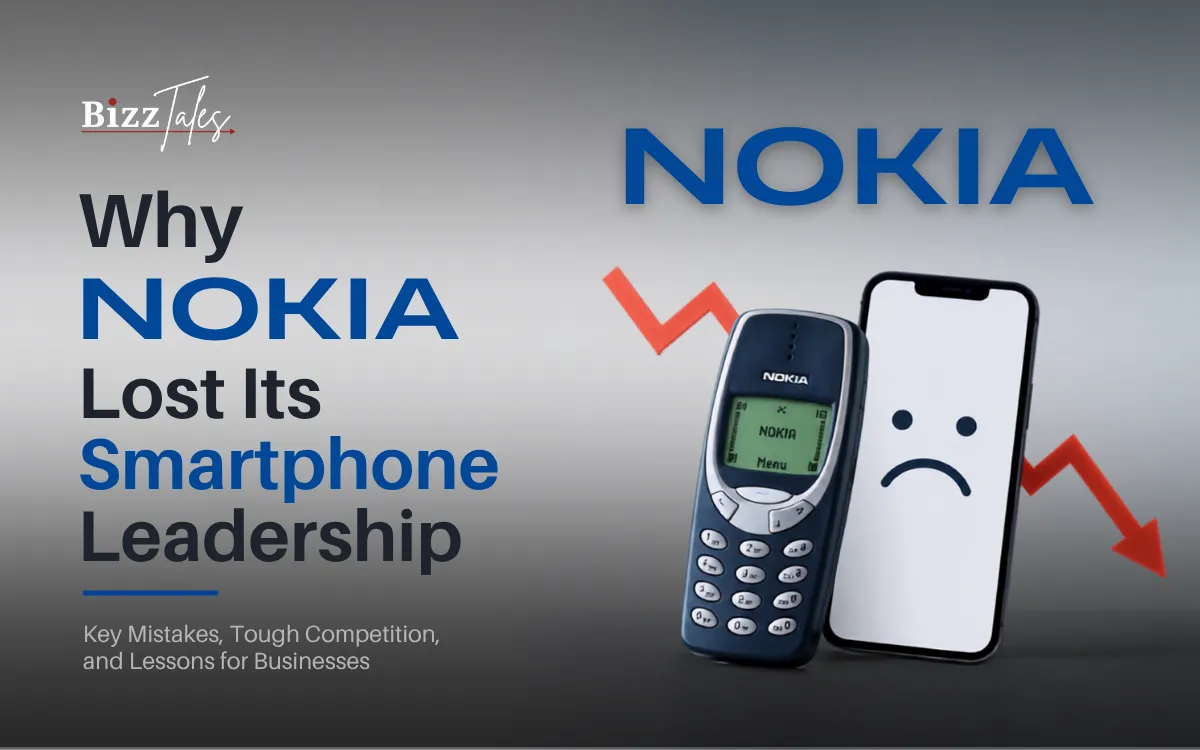
For much of the late 1990s and early 2000s, Nokia was the undisputed king of mobile phones. The Finnish company was not simply one of the world’s largest phone manufacturers; it was one of the most recognizable and trusted technology brands on the planet. Nokia phones were known for their durability, long battery life, simple design, and reliability. From Europe and North America to Asia, Africa, and Latin America, millions of people carried a Nokia device.
At its peak in the late 2000s, Nokia controlled a remarkable share of the global mobile phone market. Its famous slogan, “Connecting People,” reflected its position at the center of the mobile communications industry. However, within only a few years, the company that had once defined the mobile phone business lost its leadership in the rapidly growing smartphone market.
Nokia’s decline was not caused by one bad decision. Instead, it resulted from a combination of technological disruption, strategic mistakes, organizational challenges, and increasingly powerful competitors. The story of why Nokia lost its smartphone leadership remains one of the most important business lessons about innovation and the danger of failing to adapt quickly enough.
Nokia’s Golden Era
Before the smartphone revolution, Nokia had several major advantages. The company had a powerful global distribution network, strong relationships with mobile operators and retailers, and a reputation for producing dependable phones at many different price levels.
Popular models such as the Nokia 3310 became cultural icons because they were affordable, durable, and easy to use. Nokia also produced successful premium and business-oriented devices, including phones with cameras, advanced messaging features, and early internet capabilities.
Nokia’s success was built on its ability to understand the mobile phone market of its time. Consumers wanted devices that could make calls, send text messages, and operate reliably for days without charging. Nokia was exceptionally good at delivering these features. Its manufacturing scale also allowed it to serve customers across both developed and emerging markets.
Importantly, Nokia was not completely unaware of smartphones. The company introduced advanced devices long before the iPhone became popular and played an important role in the early development of mobile computing. However, Nokia’s understanding of what a smartphone would eventually become was shaped by the older mobile phone industry. That became a major weakness when the market changed.
The Rise of Smartphones
The mobile industry changed dramatically after Apple introduced the iPhone in 2007. The iPhone was not the first smartphone, but it presented a new vision of what a mobile device could be. Its large touchscreen, simplified interface, full web browsing experience, and focus on software created new consumer expectations.
The launch of the App Store in 2008 made the change even more significant. A smartphone was no longer just a device with built-in features. It became a platform that could continuously gain new capabilities through applications.
At the same time, Google’s Android operating system created another major shift. Unlike Apple’s tightly controlled hardware and software model, Android was adopted by multiple manufacturers. Companies such as Samsung could use Android to build smartphones quickly and compete across different price categories.
Consumers increasingly expected touchscreens, mobile apps, fast internet access, regular software improvements, and seamless digital services. The competition was no longer mainly about producing better phone hardware. It was increasingly about creating the best software and ecosystem.
This shift challenged Nokia’s traditional strengths.
Nokia’s Biggest Strategic Mistakes
One of Nokia’s biggest problems was its slow and inconsistent response to the touchscreen revolution. The company did introduce touchscreen devices, but its products often failed to match the smoothness and simplicity of the iPhone experience. Nokia had extensive engineering expertise, yet it struggled to transform that expertise into a modern software experience that consumers loved.
A major issue was Nokia’s continued dependence on Symbian. Symbian had been successful in the earlier smartphone era and was widely used on Nokia devices. However, it was originally designed for a different generation of mobile hardware and software.
As touchscreen interfaces and mobile applications became more sophisticated, Symbian became increasingly difficult to develop and improve. Its user experience appeared complicated compared with newer operating systems, while software developers often found it more challenging to create applications for.
This contributed to another critical weakness: Nokia failed to build a strong app ecosystem. Apple’s App Store attracted developers and consumers, creating a powerful cycle. More users attracted more developers, while more apps made the platform more attractive to users. Android quickly developed a similar advantage.
Nokia could not create the same momentum. Even though it had a large global customer base, developers increasingly focused on iOS and Android, where the future of the smartphone market appeared stronger.
Internal management also contributed to the problem. Nokia was a large and complex organization with multiple teams, competing priorities, and slow decision-making processes. Reports and later business analyses have suggested that internal disagreements and organizational pressures made it difficult to respond quickly to changing market conditions.
The Microsoft Partnership
In 2011, Nokia made one of the most important strategic decisions in its history: it partnered with Microsoft and chose Windows Phone as its primary smartphone platform.
The decision made strategic sense in some ways. Nokia needed a modern operating system and a stronger software strategy, while Microsoft needed a major hardware partner capable of competing with Apple and Android manufacturers. Together, they hoped to create a credible third smartphone ecosystem.
Nokia’s Lumia smartphones were often praised for their distinctive design and camera technology. However, Windows Phone faced a fundamental problem: the market was already moving strongly toward Android and iOS.
The platform had fewer applications than its competitors, and many popular services either arrived late or offered limited versions. Consumers were reluctant to choose a phone that lacked apps available to their friends and family, while developers had little incentive to invest heavily in a platform with a relatively small user base.
Nokia also gave up much of its control over the software direction of its smartphones. Instead of developing a platform around its own strengths, the company became dependent on Microsoft’s ability to make Windows Phone competitive.
The partnership did not fail because Nokia’s hardware was poor. Rather, the combined strategy struggled to overcome the powerful network effects already established by Apple and Android.
Competition from Apple and Android Manufacturers
Apple transformed the premium smartphone market by creating a tightly integrated ecosystem of hardware, software, applications, and services. The iPhone was connected to the App Store and other Apple products, making the overall experience increasingly valuable to customers.
Android manufacturers took a different approach. Samsung, in particular, moved aggressively and released smartphones across premium, mid-range, and lower-cost categories. Other manufacturers expanded rapidly as well, giving consumers a wide variety of choices.
Nokia found itself trapped between these two powerful strategies. Apple offered a highly controlled premium ecosystem, while Android manufacturers benefited from Google’s software and competed rapidly on hardware, features, and price.
Nokia’s Windows Phone strategy provided fewer choices and a smaller ecosystem. By the time the company had established the Lumia brand, consumer habits and developer priorities had already shifted heavily toward iOS and Android.
Why Nokia Failed to Adapt Quickly
The deeper reason behind Nokia’s decline was that the company underestimated how completely the basis of competition was changing.
Nokia had succeeded in an industry where hardware engineering, manufacturing, distribution, and telecommunications expertise were central advantages. The smartphone era placed far greater importance on software, user experience, online services, developers, and digital ecosystems.
The company’s previous success may also have made adaptation more difficult. Market leaders often see disruption through the lens of their existing strengths. Nokia was accustomed to competing against other phone manufacturers, not against software ecosystems capable of transforming consumer behavior.
This did not mean Nokia lacked innovation. The company had talented engineers and advanced technology. Its problem was that innovation was not always converted into fast, coordinated strategic action. In a rapidly changing market, being technically capable is not enough if a company cannot make decisions quickly and build products that match changing customer expectations.
The Fall of Nokia’s Smartphone Business
As Apple and Android manufacturers expanded, Nokia’s smartphone market share declined sharply. The company eventually lost the dominant position it had enjoyed for years.
In 2013, Microsoft announced plans to acquire Nokia’s Devices & Services business, and the transaction was completed in 2014. Microsoft took control of Nokia’s phone business and continued producing Lumia devices under the Microsoft brand.
However, Windows Phone failed to gain sufficient market share. Microsoft later reduced its involvement in the smartphone hardware business, effectively ending the attempt to build a major third mobile ecosystem around Windows Phone.
Nokia eventually returned to the consumer phone market through brand licensing arrangements, but it never regained the smartphone leadership it once held.
Key Lessons for Businesses
Nokia’s decline offers important lessons for businesses in every industry. First, past success can become dangerous when it creates too much confidence in an existing business model. Market leaders must continuously question whether their assumptions remain valid.
Second, companies must adapt quickly to technological disruption. Waiting until a new trend is clearly dominant can mean entering the market after competitors have already built strong advantages.
Third, businesses must understand changing customer expectations. Nokia remained highly capable at making mobile phones, but consumers increasingly wanted something more than a phone. They wanted a software platform connected to apps, services, entertainment, and the internet.
The story also demonstrates the importance of ecosystems. In modern technology markets, a product can no longer be evaluated only as an individual device. Its value may depend on developers, software, services, accessories, and other connected products.
Finally, strategic decision-making must be fast enough to match the speed of market change. Large organizations need systems that allow them to identify disruption, challenge internal assumptions, and act decisively.
Conclusion
Nokia lost its smartphone leadership because it was unable to adapt quickly enough to a fundamental change in the mobile industry. Its slow response to touchscreen smartphones, dependence on the aging Symbian platform, weak app ecosystem, organizational challenges, and ultimately unsuccessful Windows Phone strategy all contributed to its decline.
At the same time, Apple redefined the premium smartphone experience, while Samsung and other Android manufacturers moved rapidly to offer consumers a wide range of devices and software choices.
Nokia’s story is not simply a story of failure or one bad decision. It is a story about how even the strongest companies can struggle when technology changes the rules of competition. Nokia once mastered the mobile phone market, but the smartphone revolution demanded new strengths: software, ecosystems, speed, and a deeper understanding of changing consumer behavior.
That is why Nokia remains one of the most powerful business case studies of innovation and disruption. Its rise proves how successful execution can create global leadership, while its decline demonstrates that no market leader can afford to become comfortable with yesterday’s success.
FAQs
1. Why did Nokia lose its smartphone leadership?
Nokia lost its leadership because it responded slowly to touchscreens, struggled with Symbian and apps, and failed to compete effectively with iOS and Android.
2. Did the iPhone cause Nokia’s decline?
The iPhone accelerated Nokia’s decline by changing consumer expectations, but Nokia’s strategic and software challenges also played a major role.
3. Why did Nokia choose Windows Phone?
Nokia partnered with Microsoft to gain a modern smartphone operating system and build a strong alternative to Android and iOS.
4. Why did the Nokia-Microsoft partnership fail?
The partnership struggled because Windows Phone had too few apps, weak consumer adoption, and could not overcome the dominance of Android and iOS.
5. What is the biggest lesson from Nokia’s decline?
Nokia’s story shows that even successful companies must adapt quickly to technological disruption and changing customer expectations.