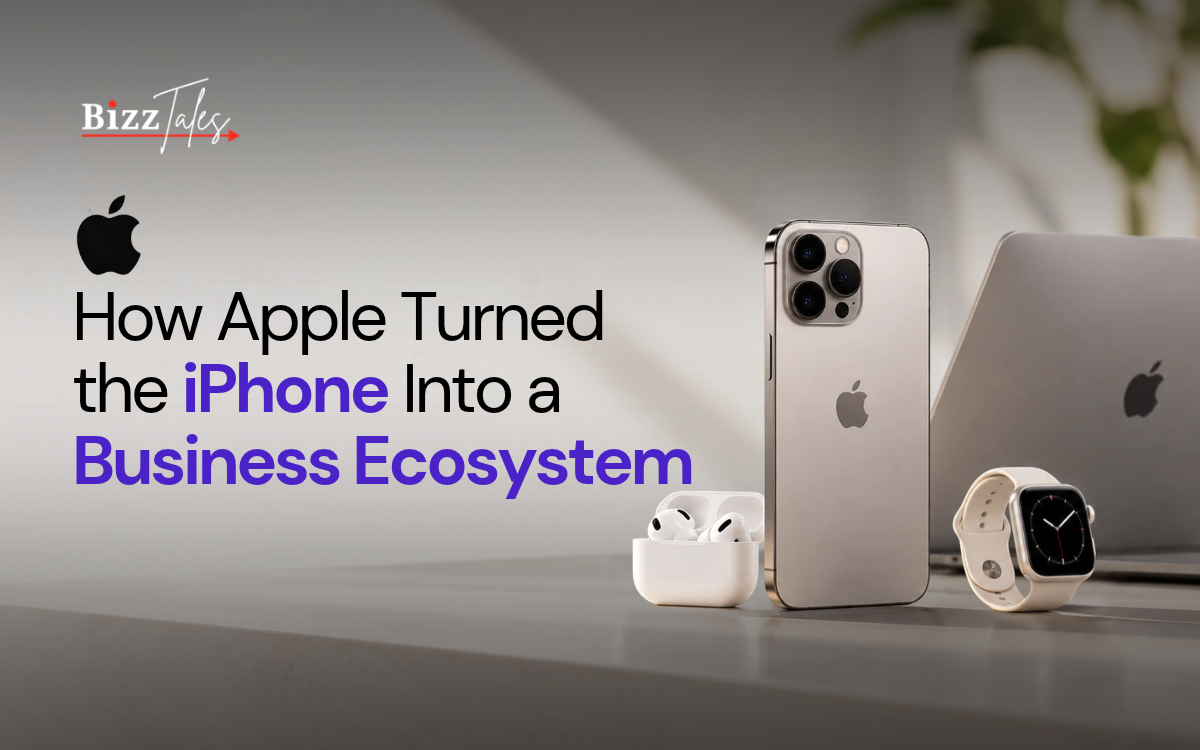
The iPhone started as a revolutionary smartphone, but Apple did not stop at selling hardware. Over the years, the company transformed the iPhone into the center of a powerful business ecosystem connecting hardware, software, digital services, accessories, developers, and subscriptions.
This strategy helped Apple build a business model that goes far beyond smartphone sales. Today, the iPhone acts as an entry point into a broader ecosystem where products and services reinforce one another.
So, how did Apple turn the iPhone into a business ecosystem? The answer lies in ecosystem integration, recurring revenue, customer loyalty, and Apple’s control over both hardware and software.
What Is Apple’s iPhone Ecosystem?
Apple’s iPhone ecosystem is a network of interconnected products and services designed to work together seamlessly.
It includes:
- iPhone
- Apple Watch
- AirPods
- Mac
- iPad
- Apple TV
- iCloud
- Apple Music
- Apple TV+
- Apple Arcade
- Apple Pay
- App Store
- AppleCare
- Developer services and APIs
Instead of treating each product as an isolated purchase, Apple connects them so that owning one device can make other Apple products more useful.
For example, an iPhone can automatically connect with AirPods, sync photos through iCloud, unlock features on an Apple Watch, and continue tasks across a Mac or iPad.
This creates what is commonly called the Apple ecosystem.
1. The iPhone Became the Ecosystem’s Entry Point
Apple’s biggest strategic advantage is that the iPhone sits at the center of many of its consumer experiences.
A customer may initially purchase an iPhone because of its camera, design, performance, or software. But after entering the ecosystem, additional Apple products and services become increasingly convenient.
The result is a powerful network effect:
iPhone → Apps → iCloud → AirPods → Apple Watch → Mac → Apple Services
Each addition can increase the usefulness of the others.
This is fundamentally different from relying on a single product category. Apple can generate value across multiple parts of a customer’s digital life.
2. Hardware and Software Work Together
One of Apple’s most important competitive advantages is its control over both hardware and software.
Apple designs the iPhone hardware and develops iOS. This allows the company to optimize the operating system around its devices and create tightly integrated experiences.
Features such as AirDrop, Handoff, Continuity, iCloud synchronization, and device pairing demonstrate how Apple’s products communicate with one another.
This integration can also increase customer switching costs. Once users store photos, files, subscriptions, passwords, and other information within Apple’s services, moving to a different ecosystem may require additional effort.
3. The App Store Created a Developer Economy
The iPhone ecosystem became significantly more powerful when Apple opened the platform to third-party developers.
The App Store turned the iPhone from a hardware product into a software marketplace.
Millions of developers have built apps for Apple’s platforms, covering areas such as:
- Finance
- Education
- Gaming
- Productivity
- Entertainment
- Shopping
- Health and fitness
- Business
This created a two-sided marketplace.
Developers want access to iPhone users, while users want access to useful apps. More users can attract more developers, and more apps can make the platform more attractive to users.
Apple also participates economically in transactions involving digital goods and services distributed through its platforms.
4. Apple Services Added Recurring Revenue
Another major shift in Apple’s business strategy was the expansion of services.
Instead of relying primarily on customers buying new hardware, Apple developed recurring and transaction-based revenue streams.
These include services such as:
- iCloud+
- Apple Music
- Apple TV+
- Apple Arcade
- Apple Fitness+
- AppleCare
- Apple Pay-related services
The strategic importance of services is that they can generate revenue after the initial iPhone purchase.
For consumers, subscriptions may feel like small individual expenses. At Apple’s scale, however, recurring payments across a large installed base can become a significant part of the business.
5. Accessories Expanded the Ecosystem
Apple also turned accessories into important ecosystem products.
AirPods are a good example. Their value is not simply that they are wireless earbuds. Their integration with Apple devices makes them particularly convenient for existing Apple customers.
The same principle applies to the Apple Watch.
An iPhone user can add an Apple Watch for notifications, fitness tracking, communication, payments, and other features.
This creates a halo effect: owning one Apple product can increase interest in purchasing another.
6. Apple Created a Strong Brand Experience
Technology companies compete on specifications, but Apple has historically placed significant emphasis on the overall user experience.
The company controls product design, operating systems, retail experiences, packaging, software interfaces, and many services.
That consistency contributes to Apple’s brand identity.
For businesses, the lesson is important: an ecosystem does not have to be built only through technology. It can also be built through consistent customer experience.
When every interaction feels connected, customers may perceive the brand as one integrated product rather than a collection of separate products.
7. Privacy Became Part of the Value Proposition
Privacy has also become an important component of Apple’s product positioning.
Apple has promoted privacy as a core feature of its products and services, including features related to app tracking, data permissions, and on-device processing.
Whether customers choose Apple primarily because of privacy, design, performance, or ecosystem integration, the broader strategy is the same: add multiple reasons for customers to remain within the platform.
8. Apple Benefits From a Large Installed Base
The iPhone ecosystem becomes more powerful as its installed base grows.
A large number of iPhone users creates opportunities for:
- Developers to reach customers
- Services to gain subscribers
- Accessories to find buyers
- Apple to introduce new products
- Businesses to build mobile experiences
This creates a reinforcing cycle.
More iPhone users → More developers and services → More ecosystem value → Stronger customer engagement → More opportunities for Apple
That is the foundation of Apple’s ecosystem strategy.
9. The Business Model Is Bigger Than the iPhone
One of the most important lessons from Apple’s strategy is that the iPhone is no longer simply a smartphone.
It functions as a gateway to a broader digital platform.
Apple can earn money from the initial hardware sale and potentially from services, accessories, apps, subscriptions, and other ecosystem interactions that follow.
This gives Apple multiple ways to monetize a customer over time.
The strategy also helps diversify the company’s business beyond one-time hardware purchases.
Why Apple’s Ecosystem Strategy Works
Apple’s ecosystem works because its components reinforce one another.
A simple example looks like this:
Buy an iPhone → Use iCloud → Purchase AirPods → Add Apple Watch → Subscribe to services → Buy a Mac
Every additional product can increase the convenience of remaining within the ecosystem.
This does not mean every Apple customer owns every product. Rather, Apple has built a platform where different combinations of products and services can work together.
What Businesses Can Learn From Apple
Apple’s strategy offers several lessons for companies in other industries.
1. Build connected products
Products should create additional value when used together.
2. Create recurring revenue
Subscriptions and ongoing services can complement one-time purchases.
3. Build a platform
Allowing third-party developers, partners, or sellers to participate can expand an ecosystem beyond what one company can create alone.
4. Reduce customer friction
Seamless onboarding, payments, synchronization, and support can improve customer retention.
5. Make the ecosystem valuable, not merely restrictive
Customers are more likely to stay when the ecosystem continuously provides useful benefits.
Conclusion
Apple transformed the iPhone from a standalone smartphone into the foundation of a broader business ecosystem.
Through hardware-software integration, the App Store, digital services, accessories, subscriptions, and a consistent customer experience, Apple created multiple connections between its products and its customers.
The biggest lesson is that Apple’s competitive advantage does not come from the iPhone alone. It comes from the network of products, services, developers, and experiences surrounding the iPhone.
That ecosystem approach has helped Apple build a business model where one customer relationship can extend across many products and services—and where each new addition can strengthen the overall platform.