
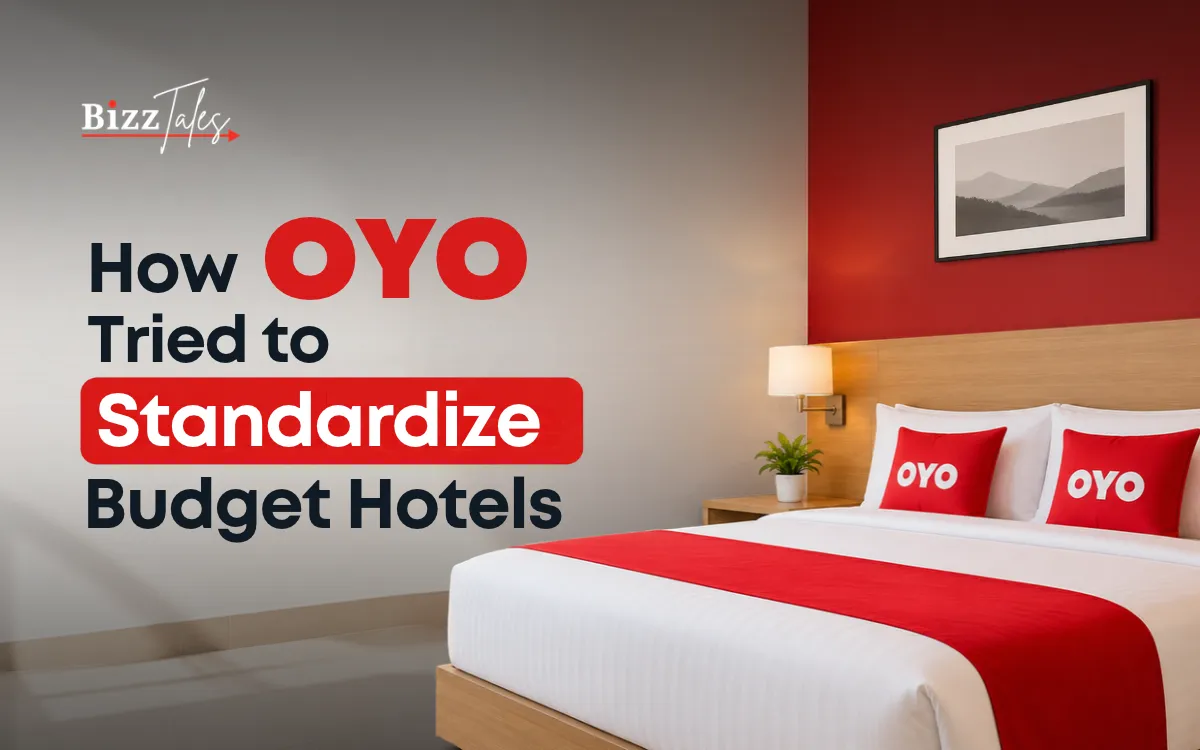
Finding a clean, affordable, and reliable hotel has historically been difficult in India’s highly fragmented budget-hotel market. Two hotels at the same price could offer completely different experiences. OYO tried to solve this problem by bringing standardization, technology, branding, and centralized distribution to budget hotels.
Founded by Ritesh Agarwal, OYO began by partnering with existing small and independent hotels rather than building thousands of properties itself. Its goal was to make budget accommodation more predictable for travelers while helping hotel owners improve occupancy and revenue.
But how exactly did OYO attempt to standardize budget hotels, and what made its model different?
Also Read: Ritesh Agarwal Net Worth & Success Story
What Was the Problem With Budget Hotels?
India’s hotel industry has traditionally been highly fragmented, particularly at the budget end of the market. Independent hotel owners often operated without the technology, branding, marketing capabilities, and operational systems available to large hotel chains.
This created a major problem for travelers.
A customer might book a budget hotel online expecting certain amenities but discover that the actual experience differed significantly from the listing. Cleanliness, Wi-Fi, room quality, service, and even basic facilities could vary from property to property.
OYO identified this consistency gap as a business opportunity.
Instead of creating an entirely new hotel chain from scratch, the company focused on transforming existing budget hotels into standardized, technology-enabled properties.
OYO’s Standardization Model
OYO’s basic strategy was relatively straightforward:
Find independent hotels → improve selected aspects of the property → provide technology and distribution → apply brand standards → generate bookings.
OYO partnered with existing hotel owners and offered services around technology, marketing, pricing, reservations, and operational standards.
According to Forbes, OYO’s early model included monitoring parameters such as cleanliness and Wi-Fi availability while using its app to drive bookings.
This approach allowed OYO to expand much faster than a traditional hotel company that had to acquire land, construct buildings, and operate every property itself.
1. Creating a Consistent Guest Experience
One of OYO’s biggest objectives was to make the budget-hotel experience more predictable.
The idea wasn’t necessarily to turn every property into a luxury hotel. Instead, OYO focused on standardizing essential amenities and service expectations.
These could include:
- Clean rooms
- Basic toiletries
- Wi-Fi
- Air conditioning where applicable
- Television
- Standardized room presentation
- Digital booking
- Defined service expectations
This created an important distinction between standardization and luxury.
OYO wasn’t trying to make budget hotels expensive. It was attempting to make the basic experience more consistent.
2. Using Technology to Connect Thousands of Hotels
Technology was central to OYO’s business model.
Traditional independent hotels often had limited access to sophisticated reservation systems, online marketing, revenue-management tools, and customer acquisition channels.
OYO brought these functions into a centralized platform.
Its technology helped connect properties with customers searching for rooms online. It also enabled OYO to manage information such as inventory, pricing, reservations, and demand.
The broader hospitality industry has increasingly relied on centralized reservation systems, real-time pricing, channel management, and digital distribution to improve hotel operations.
For OYO, technology effectively became the infrastructure connecting thousands of individual properties.
3. Standardizing the Brand Instead of Building Every Hotel
A major advantage of OYO’s model was that it did not need to own every building.
Instead, it could partner with existing hotel owners and bring them under the OYO brand or platform.
This resembles the logic behind franchise and asset-light hospitality models: the property owner supplies the physical hotel while the brand or platform contributes demand, technology, marketing, and operating systems.
This allowed OYO to expand rapidly.
By 2018, OYO reported that its global room nights had increased from around 6 million in 2016 to 75 million in 2018, illustrating the scale of its early expansion.
4. Centralized Pricing and Revenue Management
Another important part of OYO’s approach was revenue management.
Independent hotel owners may traditionally set room prices based on local knowledge and intuition. A technology-driven platform can instead use booking patterns, demand, seasonality, location, and availability to adjust pricing.
This matters because hotel rooms are perishable inventory.
If a room remains empty tonight, the opportunity to sell that night’s inventory disappears permanently.
OYO’s centralized technology and distribution model therefore attempted to help properties increase occupancy while making rooms easier for customers to discover and book.
5. Bringing Small Hotels Online
OYO also addressed another major challenge: online visibility.
An independent hotel might have a physical property but limited digital marketing capabilities. OYO could aggregate these properties under one recognizable platform.
Customers could search, compare and book rooms through OYO’s digital channels rather than discovering each hotel individually.
This created a two-sided network:
Hotel owners → OYO’s technology and distribution → Travelers
The more hotels OYO added, the larger its inventory became. More inventory could attract more customers, while increased customer demand could make the platform more valuable to hotel owners.
Why OYO’s Model Was Attractive to Hotel Owners
For many independent hotel operators, joining a large hospitality platform offered potential advantages.
These included:
- Access to online customers
- Marketing support
- Technology infrastructure
- Revenue-management capabilities
- Centralized booking
- Brand recognition
- Operational guidance
OYO positioned itself as a way for smaller hotels to compete using capabilities that were traditionally associated with larger hotel chains.
This was particularly relevant in a market where independent hotels represented a large portion of budget accommodation.
The Challenges of Standardizing Budget Hotels
Standardizing thousands of independently operated hotels is much harder than standardizing a product manufactured in a factory.
Every property has different:
- Buildings
- Owners
- Employees
- Local markets
- Maintenance standards
- Customer expectations
- Operating practices
This created an important challenge for OYO: how do you maintain consistent standards when the underlying properties are not identical?
Rapid expansion also created operational complexity.
OYO faced criticism from some hotel operators over issues involving its technology and business relationships, illustrating the difficulty of maintaining consistency across a rapidly expanding network.
In other words, the same model that allowed OYO to scale quickly also made quality control and partner management more complicated.
What OYO Changed About Budget Hotels
Regardless of the challenges, OYO helped popularize an important idea in hospitality: budget hotels could be treated as a standardized, technology-enabled product rather than simply a collection of independent properties.
Its model combined several concepts:
Standardization + Technology + Branding + Distribution + Revenue Management
That combination allowed OYO to approach the budget-hotel market more like a technology platform while still operating within the physical hospitality industry.
The company’s later evolution also shows how its strategy has changed. In 2025, OYO’s parent company, PRISM, described its model around standardized guest essentials, software-driven distribution, and dynamic pricing, reflecting the continued importance of technology and consistency in budget lodging.
The Bigger Lesson From OYO
OYO’s story is ultimately about solving a trust and consistency problem.
Travelers want to know what they are getting before they pay. Hotel owners want customers without having to build sophisticated technology and marketing systems themselves.
OYO attempted to sit between both sides.
For customers, the promise was:
“Book an affordable room with more predictable basics.”
For hotel owners, the proposition was:
“Use our technology, brand, and distribution to reach more customers.”
That approach helped turn fragmented budget accommodation into a more recognizable and digitally searchable category.
Conclusion
How OYO tried to standardize budget hotels can be summarized in one idea: it attempted to create consistency without owning every hotel.
By partnering with independent properties, establishing operating standards, providing technology, centralizing bookings and pricing, and building a recognizable brand, OYO sought to make budget accommodation more predictable and scalable.
Its journey also demonstrates the difficulty of standardizing a highly fragmented industry. Technology can connect thousands of properties, but maintaining consistent service across independently operated hotels requires strong execution, partner management, quality control, and continuous monitoring.
OYO’s experiment therefore offers a broader business lesson: standardization does not always require owning the underlying assets. Sometimes, the bigger opportunity lies in building the technology, brand, and operating system that connects them.