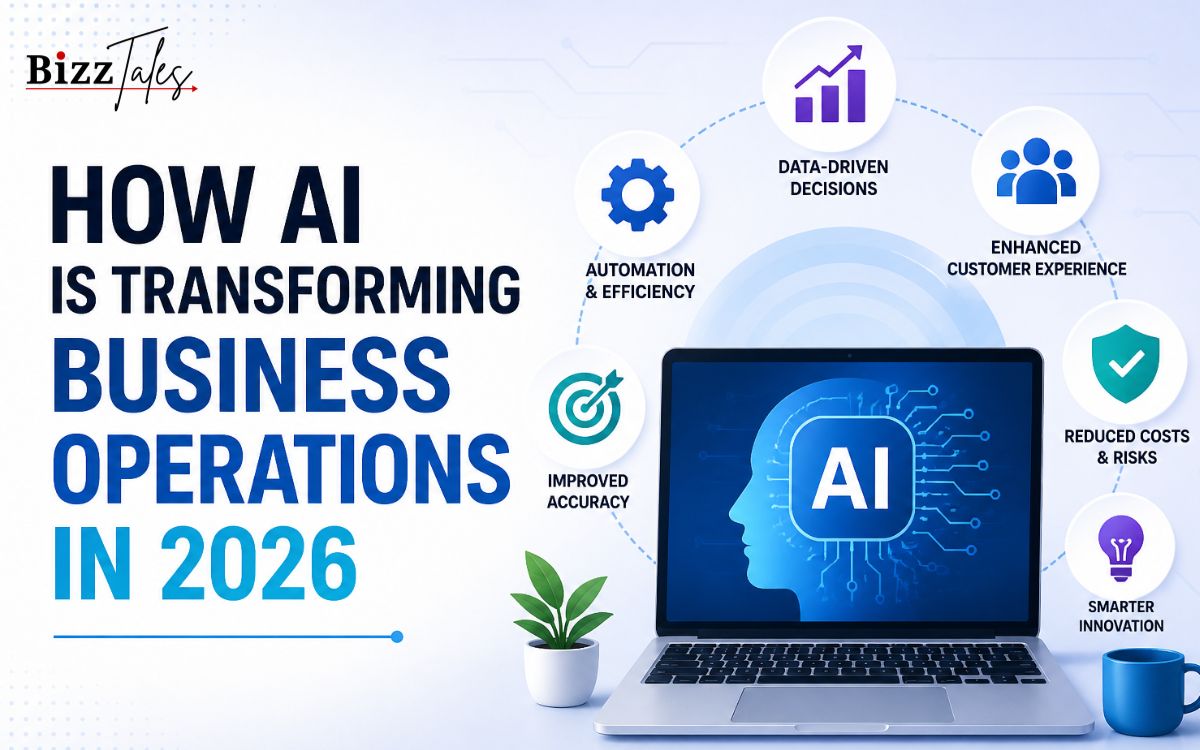
AI is no longer something of the future nor is it something of tech seminars to be locked behind four walls. AI in 2026 is what drives business, it’s how businesses will survive, and how they will prosper. Where it was once based on intuition and human-powered, it is now business expansion, efficiency and intelligence all driven by automated data based systems. It is not just large enterprises adopting these practices, the small and medium sized enterprises have eagerly embraced AI and is what drives their business efficiencies, and scale in levels unimaginable in earlier times. The adoption is not just of the system but of the change of paradigm. AI is now integrated into daily business operations such as customer service, sales and marketing, supply chain, finance, HR etc. It is no longer a choice but a necessity.
- The Transition from Human Power to intelligent system driven operation
- AI for Customer Experience and Support
- Data Driven Decision Making
- Automation of Routine Business Processes
- AI in Marketing and Sales
- AI in HR and Talent Management
- Challenges and Limitations in the Adoption of AI
- The Future Role of AI in Business
- Conclusion
The Transition from Human Power to intelligent system driven operation
Traditionally business has primarily comprised of manual and tedious labor, and many of the resources were wasted doing such routine and mundane tasks like data management and response to inquiries or general business operations in itself. These operations not only took time, they were prone to error as well. In 2026 AI is now overcoming these bottlenecks by analysing vast quantities of data, performing repetitive tasks and identifying patterns in order to facilitate better and faster decision making than before. For example in inventory management an automated, AI based system can identify current stock levels and then predict how many will be needed, and hence generate orders for stock when levels are getting low to avoid overstocking or stock-outs at the same time enhancing overall operational efficiencies and customer experience. It is not about substituting people, but augmenting them.
AI for Customer Experience and Support
This is one area where AI has proven its impact considerably. The expectation in the current market is for real-time service coupled with a human like touch and a seamlessly across-channel experience. Smart AI based chatbots and virtual agents have become an answer to many business woes today, since they have been able to serve customers in real-time and provide their needs instantaneously. AI further enhances customer experience and makes personalization at large scale a possibility. Tailored advertisements, content, and promotions specifically based on customers’ purchasing history, and buying behavior. This is expected to enhance overall satisfaction levels, engagement and eventually retention.
Data Driven Decision Making
Businesses have an enormous amount of data available to them but the problem is not having access to the data, but efficiently utilizing and making use of it. AI is the answer to these data based problems where the raw data can be transformed into meaningful and usable information which allows businesses to base their decisions on data. It helps identify trends, analyze patterns and forecast future outcomes using the historical data to make well-informed decisions, instead of guesswork. These may range from marketing campaigns suggesting and altering campaign structures dynamically based on analytics, fraud and anomaly detection in finances to operational forecasts.
Automation of Routine Business Processes
Automation of some tasks has always been considered as a primary benefit for any enterprise embracing AI.Businesses have now the capability to perform monotonous and time consuming tasks such as data entry, sending and managing emails, and handling routine scheduling with automation. It enables employees to use their time on critical aspects, creative activities and problem solving rather than tedious labor. In manufacturing industries and in logistics, the level of automation powered by AI is also playing an important role in bringing about complex automated tasks. This automation is not just within the physical environment but in the digital space too allowing the enterprise to become more adaptive.
AI in Marketing and Sales
This aspect has surely revolutionized from the once traditional and often unsuccessful to smart data-driven and personalized methods thanks to AI. Businesses can reach out to the target audiences and provide customized messages with relevant content which drastically increases marketing campaign effectiveness. It also significantly reduces overall marketing expenses. Identifying leads and predicting sales potential for a lead based on past behavior and transactional information, closing sales in greater numbers for sales professionals is one of the more practical applications of AI in marketing and sales. It is also providing for dynamic pricing options.
AI in HR and Talent Management
The management of human resources or talent has also been given an extreme facelift by the AI system. Employee recruitment processes now can be made efficient with the use of AI tools to analyze candidates and compare their profiles and CVs with job descriptions and business requirements. Monitoring employee performance and analysis of trends and patterns therein can assist managers to take effective decisions and understand areas of development, hence enabling efficient talent management.
Challenges and Limitations in the Adoption of AI
Along with its immense advantages, AI also poses some serious concerns. Data privacy and security still remain major concerns for businesses, as there is much uncertainty over how the customer’s data is handled. The costs associated with implementation need also be taken into consideration. Though many AI based tools have now dropped significantly in price, implementation of the technology in existing infrastructure may still be costly. Lack of trained personnel who can handle the systems can also be considered an issue; hence need for training employees in specific skills to develop required human capital is imperative. There is also a strong concern over ethical considerations when using AI, so as not to cause any biases in operations.
The Future Role of AI in Business
The influence of AI in business will surely be an ever-growing one, with continuous innovation and sophisticated tools making AI more precise, more advanced, and more available than before. There is no doubt that businesses who fail to adapt and embrace AI in their operational practices are only sure to be left behind by their technologically enhanced competitors, as AI can not only provide the advantages for business efficiency but also improved decision-making, better customer experience and a sustainable competitive edge.
Conclusion
AI in 2026 is not just impacting businesses, it is shaping them in fundamental ways. The impact can be observed in the automation of many tedious and mundane operational tasks to more precise decision making and personalized customer experiences. The secret to success with AI is not just in the integration of the technology, but rather integrating the system in an appropriate way that would allow it to be leveraged for maximum potential, which would involve identifying objectives, planning rigorously, and being adaptive to change.