
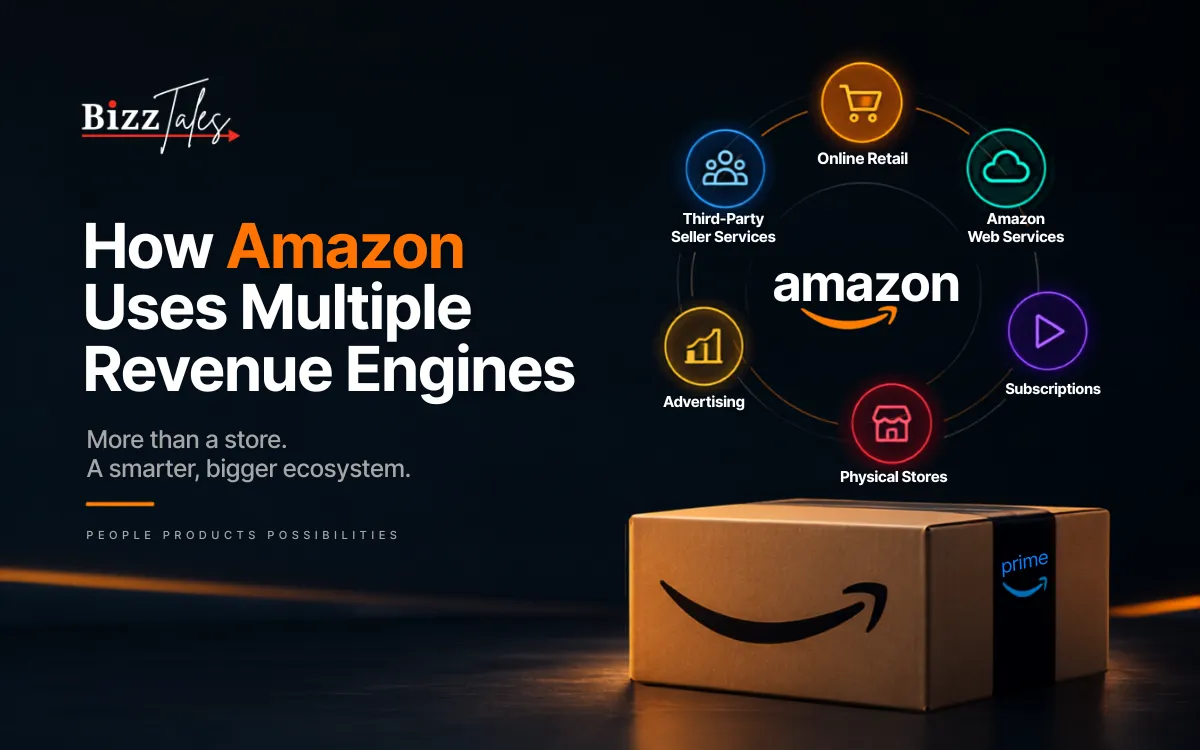
Amazon is one of the world’s most successful examples of a company that has built multiple revenue engines around a single ecosystem. While many people still associate Amazon primarily with online shopping, e-commerce is only one part of the company’s business model.
Amazon generates revenue from online retail, third-party sellers, advertising, subscriptions, cloud computing, physical stores, digital content, and other services. This diversified approach allows Amazon to serve different customer groups while creating multiple ways to monetize the same ecosystem.
According to Amazon’s 2025 annual report, the company generated $716.9 billion in total net sales. Its major revenue streams included online stores, third-party seller services, advertising, subscriptions, and Amazon Web Services (AWS).
1. Online Retail: Amazon’s Core Revenue Engine
Online retail remains Amazon’s largest revenue stream. The company sells millions of products through its e-commerce platform, including electronics, household products, clothing, groceries, books, and digital goods.
In 2025, Amazon generated approximately $269.3 billion from online stores, compared with $247 billion in 2024.
Amazon’s retail strategy focuses on three major advantages: selection, price, and convenience. Its extensive product catalog attracts customers, while fast delivery and competitive pricing encourage repeat purchases.
However, retail is more than simply a source of sales. Amazon uses its huge customer base and fulfillment infrastructure to support other revenue engines.
2. Third-Party Seller Services
Another major component of Amazon’s business model is its marketplace for third-party sellers.
Instead of purchasing and owning every product it sells, Amazon allows independent businesses to list products on its platform. Amazon earns money through commissions, fulfillment fees, shipping-related fees, and other seller services.
Third-party seller services generated approximately $172.2 billion in 2025, up from $156.1 billion in 2024.
This model is strategically important because Amazon can expand product selection without having to purchase all the inventory itself. At the same time, sellers gain access to Amazon’s enormous customer base and fulfillment network.
This creates a powerful network effect: more sellers create more product selection, which attracts more customers, which in turn makes Amazon more attractive to sellers.
3. Amazon Advertising
Amazon has also transformed its enormous shopping platform into a major advertising business.
Sellers, brands, publishers, and other businesses can pay for sponsored product ads, display advertising, video advertising, and other promotional services.
Advertising revenue reached approximately $68.6 billion in 2025, compared with $56.2 billion in 2024.
The strength of Amazon’s advertising model comes from purchase intent. People visiting Amazon are often already searching for products, which gives advertisers an opportunity to reach consumers close to the point of purchase.
This makes advertising a particularly valuable revenue engine because Amazon can monetize traffic generated by its retail marketplace without necessarily selling another product itself.
4. Amazon Web Services (AWS)
AWS is perhaps the clearest example of Amazon building a major business outside traditional retail.
Amazon Web Services provides cloud infrastructure and technology services such as computing, storage, databases, analytics, artificial intelligence, and machine learning to businesses and organizations.
AWS generated $128.7 billion in revenue in 2025, compared with $107.6 billion in 2024.
The AWS business demonstrates Amazon’s ability to turn technology developed for its own operations into a commercial product.
It also gives Amazon exposure to enterprise technology spending rather than relying entirely on consumer spending.
5. Subscription Revenue
Amazon has developed recurring revenue through subscription services, most notably Amazon Prime.
Prime combines benefits such as fast shipping, entertainment, and other services into a membership program. Amazon also generates subscription revenue from digital video, audiobooks, music, e-books, and other services.
Subscription services generated approximately $49.6 billion in 2025, up from $44.4 billion in 2024.
The importance of subscriptions goes beyond membership fees. Prime can encourage customers to shop more frequently on Amazon because members receive additional benefits from using the platform.
In other words, Amazon uses subscriptions to strengthen customer loyalty while creating recurring revenue.
6. Physical Stores and Other Businesses
Although Amazon is primarily known as a digital company, it also operates physical stores and other businesses.
Physical store revenue reached approximately $22.6 billion in 2025.
Amazon also generates revenue from areas such as healthcare services, content licensing and distribution, shipping services, and co-branded credit card agreements.
These businesses may be smaller than retail or AWS, but they contribute to Amazon’s broader ecosystem and provide additional opportunities for growth.
The Power of Amazon’s Revenue Flywheel
What makes Amazon’s business model particularly powerful is that these revenue engines are not completely independent.
They reinforce one another.
For example, more customers attract more third-party sellers. More sellers increase product selection. Greater selection can attract more customers. Increased customer activity creates valuable advertising opportunities for brands. Prime encourages customer loyalty and repeat purchases, while AWS provides a separate technology business serving enterprises.
This creates an interconnected Amazon revenue flywheel.
Rather than depending on one product or one customer segment, Amazon monetizes different parts of the ecosystem.
Why Amazon’s Diversified Revenue Model Works
Amazon’s multiple revenue streams provide several strategic advantages.
First, diversification reduces dependence on a single business. If growth slows in one area, other businesses can continue expanding.
Second, Amazon can monetize the same ecosystem multiple times. A single customer can generate retail revenue, subscription revenue, advertising value, and potentially revenue for third-party sellers.
Third, the company benefits from economies of scale. Its technology, logistics, data, customer base, and infrastructure can support multiple businesses.
Finally, Amazon can move into adjacent markets more efficiently. Its existing customer relationships and technological capabilities provide a foundation for launching new products and services.
Conclusion
Amazon’s success is not based on e-commerce alone. The company has created a diversified business model built around multiple revenue engines, including online retail, third-party seller services, advertising, subscriptions, AWS, physical stores, and other services.
In 2025, Amazon generated $716.9 billion in total net sales, demonstrating the scale that can be achieved when multiple complementary businesses operate within one ecosystem.
The biggest lesson from Amazon’s strategy is simple: a powerful platform can create multiple ways to generate revenue. Instead of relying on a single source of income, Amazon continuously finds new ways to monetize its customers, sellers, technology, infrastructure, and digital ecosystem.
That combination of diversification, recurring revenue, marketplace effects, and ecosystem monetization is what makes Amazon’s business model one of the most powerful in the global economy.