
India’s B2B commerce market is undergoing a major transformation. Traditional wholesale networks have long depended on distributors, sales representatives, physical markets, and fragmented supply chains. But digital platforms are changing how retailers discover products, place orders, access credit, and manage inventory.
Among the companies at the center of this shift is Udaan, the Indian B2B e-commerce platform focused on connecting manufacturers, brands, wholesalers, and retailers.
The bigger question is no longer simply whether Udaan is an online wholesale marketplace. Is Udaan building a fundamentally new model for B2B commerce in India?
What Is Udaan’s B2B Commerce Model?
Udaan was created around a relatively simple proposition: bring different participants in the wholesale ecosystem onto a digital platform.
Instead of retailers relying entirely on local distributors or traveling to wholesale markets, Udaan enables businesses to discover products, compare options, place orders, and manage procurement digitally.
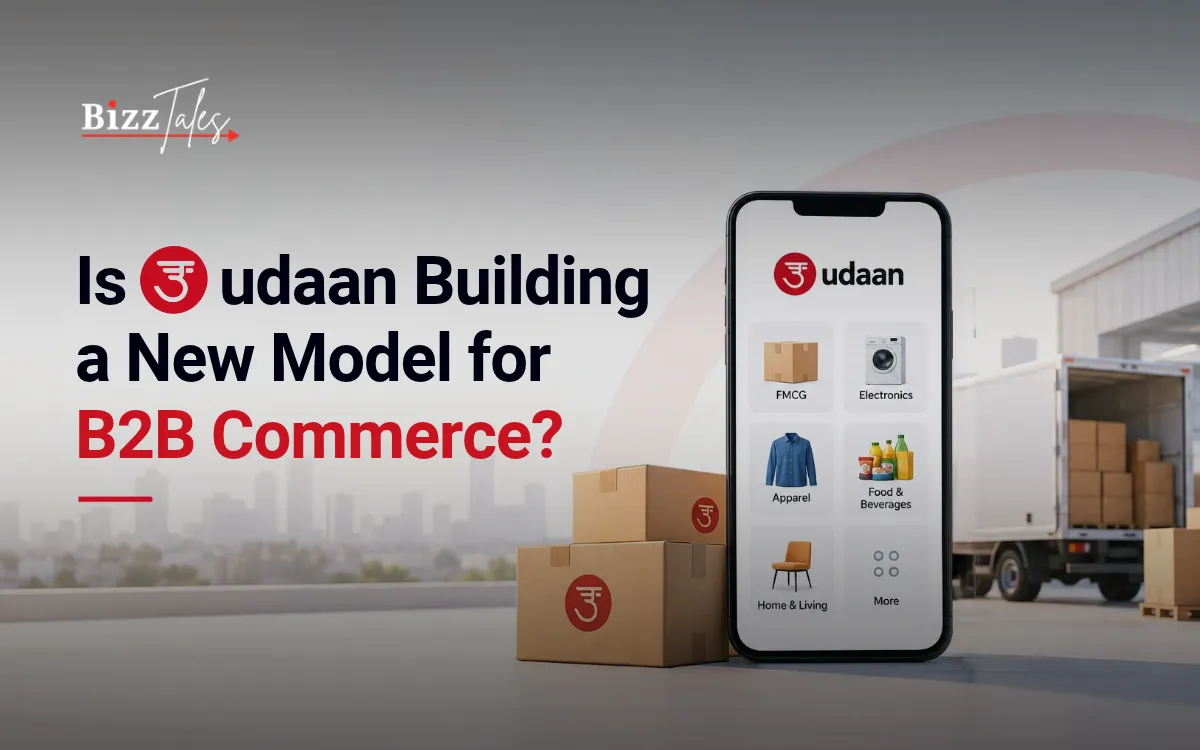
Its B2B commerce ecosystem has historically focused on categories such as:
- FMCG and consumer products
- Electronics
- General merchandise
- Lifestyle products
- Food and beverages
- Other products purchased by small and medium-sized businesses
The model goes beyond simply listing products online. B2B commerce requires reliable fulfilment, pricing, payments, credit, logistics, and repeat purchasing. This makes the operating model significantly more complex than conventional consumer e-commerce.
Why B2B Commerce Is Different From Consumer E-Commerce
Consumer e-commerce is largely driven by individual purchases, convenience, discounts, and delivery speed.
B2B commerce works differently.
A retailer may order products repeatedly, purchase in larger quantities, negotiate prices, require credit, and prioritize product availability over a one-time discount.
This creates several challenges for digital B2B platforms:
- Fragmented buyers and sellers
- Complex pricing structures
- Working-capital requirements
- Inventory and fulfilment challenges
- High customer acquisition costs
- The importance of repeat purchases
Udaan’s opportunity comes from addressing several of these problems through one technology-enabled ecosystem.
From Marketplace to B2B Commerce Infrastructure
One of the most interesting aspects of Udaan’s evolution is the potential shift from being viewed simply as a marketplace to becoming B2B commerce infrastructure.
A marketplace primarily connects buyers and sellers.
An infrastructure-oriented B2B platform can potentially become part of the retailer’s daily operating workflow.
That means helping businesses with:
Product discovery → Procurement → Payments → Credit → Logistics → Reordering
The more steps a platform can integrate, the more useful it becomes to its customers.
This is particularly relevant in India’s fragmented retail economy, where millions of small businesses still operate with relatively limited digital infrastructure.
The Role of Technology in Udaan’s Strategy
Technology can create significant advantages in B2B commerce when it is used to improve operational efficiency rather than simply provide an online storefront.
For a platform such as Udaan, data can potentially help improve:
- Product recommendations
- Demand forecasting
- Inventory planning
- Credit assessment
- Pricing
- Order fulfilment
- Customer retention
- Supply-chain efficiency
Over time, transaction data can also provide insights into purchasing patterns across retailers, brands, products, and regions.
That creates the possibility of a feedback loop: more transactions generate more data, better data can improve operations, and better operations can potentially encourage more transactions.
Udaan and the Small Retailer Opportunity
India’s small retailers represent a huge but fragmented B2B market.
Many retailers need frequent access to inventory but may not have the purchasing power, technology, or logistics capabilities of larger businesses.
A digital B2B platform can potentially reduce some of the friction involved in sourcing products.
For retailers, the value proposition can include:
- Wider product selection
- Digital ordering
- Greater price transparency
- Convenient procurement
- Access to multiple suppliers
- Potential credit solutions
- More efficient inventory replenishment
The real test, however, is whether these benefits translate into high-frequency repeat purchasing and sustainable unit economics.
Why Credit Could Be a Critical Part of B2B Commerce
One of the biggest differences between B2B and consumer commerce is working capital.
Retailers often purchase inventory before selling it to end customers. Access to financing can therefore directly influence how much inventory a business can purchase and how quickly it can grow.
This makes embedded financial services potentially important for B2B platforms.
If a platform understands a retailer’s transaction history and purchasing behavior, it may be able to use that information as part of a broader credit ecosystem, subject to appropriate risk controls and regulatory requirements.
In this model, commerce and financial services become interconnected rather than operating as completely separate products.
Can Udaan Create a More Efficient Wholesale Network?
The long-term opportunity for Udaan is potentially larger than moving wholesale transactions online.
It is about changing how goods move through the B2B supply chain.
Traditional wholesale can involve multiple intermediaries between manufacturers and retailers. A technology-driven model may be able to reduce inefficiencies in areas such as sourcing, inventory visibility, order management, and logistics.
However, digital transformation does not automatically eliminate intermediaries.
In many markets, distributors provide important functions including local relationships, credit, inventory holding, merchandising, and last-mile reach.
Therefore, the successful B2B model may not be about completely replacing the existing ecosystem. It could instead involve digitizing and reorganizing parts of it.
The Road Ahead for Udaan
The B2B commerce opportunity in India remains significant, but the sector is also highly competitive and operationally demanding.
For Udaan, the key questions are likely to revolve around:
- Can it achieve sustainable unit economics?
- Can it retain retailers over the long term?
- Can it efficiently manage logistics and fulfilment?
- Can it build strong relationships with brands and suppliers?
- Can technology reduce operating costs?
- Can financial products be offered responsibly?
- Can it expand digital procurement beyond early adopters?
These factors will determine whether Udaan becomes simply another B2B marketplace or something more deeply integrated into India’s commercial infrastructure.
Conclusion: A New Model for B2B Commerce?
Udaan represents an important experiment in India’s transition from traditional wholesale to technology-enabled B2B commerce.
Its potential model combines digital procurement, supplier access, logistics, data, payments, and financial services into a single ecosystem.
That makes the company’s journey worth watching—not simply because of its position in B2B e-commerce, but because it illustrates how technology could reshape the relationship between brands, distributors, wholesalers, and India’s millions of retailers.
The future of B2B commerce may not be about putting wholesale catalogs online. It could be about building digital infrastructure around the entire buying journey.
If Udaan can make that ecosystem efficient and economically sustainable, it could help define what the next generation of B2B commerce in India looks like.