
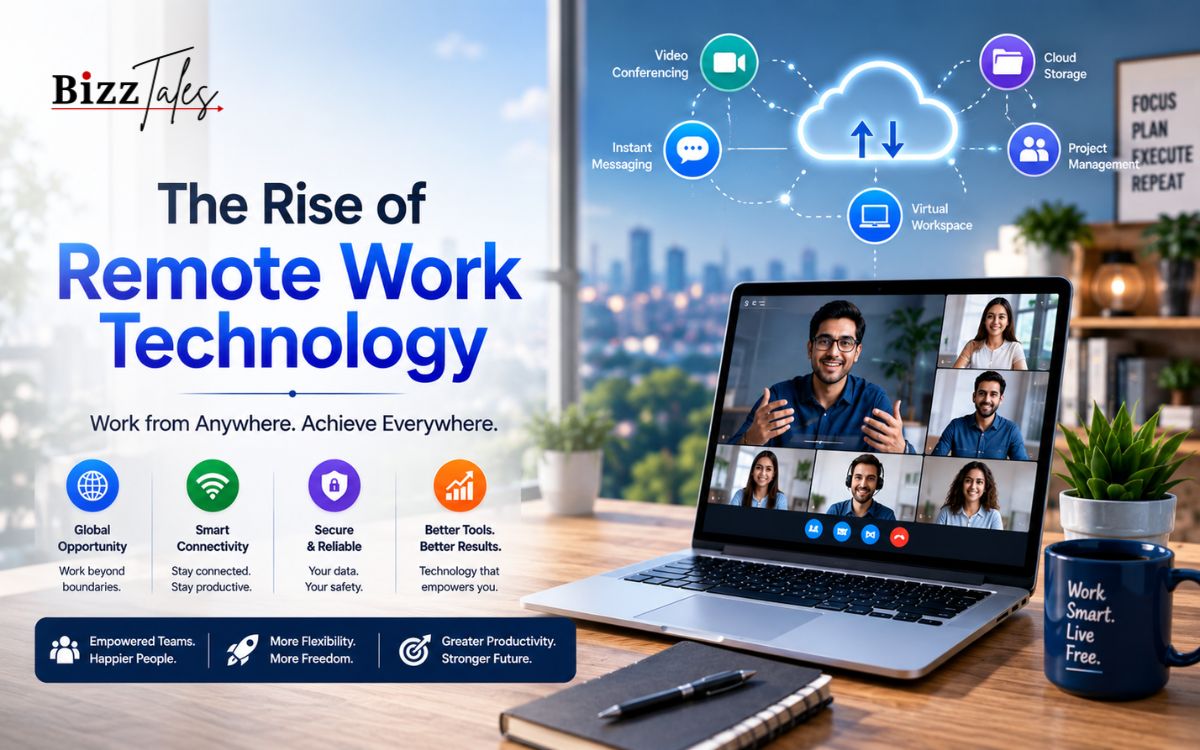
The manner in which people work has undergone a dramatic transformation since the recent past. Offices were the epitome of work, where people used to go everyday, meet others physically, work in cabin or corporate offices. Only a handful of companies thought that the same work could be accomplished by employees even without coming to office.
But with technology, this attitude changed forever.
Nowadays, telecommuting is an essential part of contemporary business. Thanks to numerous digital solutions and various internet platforms, businesses are managing their employees, communication, and operations remotely.
The primary factor behind this transformation is telecommuting technology.
All the things that contribute to your remote work experience-from video conferencing and cloud storage, to project management programs and everything else in between-have been made faster and more convenient thanks to technology.
Originally a temporary measure during a difficult time, has become an established long term business practice for many companies.
What Is Remote Work Technology?
Working from home technology deals withthe internet-enabled devices and systems that help employees and companies work remotely.
Teams communicate, exchange documents, participate in meetings, carry out projects, and work together remotely.
In the past, organizations were pretty dependent on bricks and mortar. Today, technology enables more options to be conducted electronically.
Nowadays, companies rely on video conferencing, cloud services, instant messaging, collaborative applications, and digital workspaces for their daily activities.
Technological change has altered company attitudes toward productivity and workplace culture.
The Pandemic Accelerated Remote Work
Even though remote work was already in existence, the worldwide pandemic caused a sharp increase in its implementation.
During lockdown, businesses had to go virtual. Firms that never thought about work-from-home environment had no choice but to rely on internet and collaboration tools.
Initially, most organizations faced difficulties.
Productivity, communication, people management and operations were the issues being raised. However gradually companies realized that working from home actually reduced costs and did not hinder productivity.
Most employees liked remote work more for saving their travel time and offering more flexibility.
The technology supporting remote work became more powerful and sophisticated as companies became more accustomed to digital systems.
Video Conferencing Changed Communication
Furthermore, none of twenty-first century innovations in the work place has had a bigger impact on working out of the home than teleconferencing technology.
The new bussiness trend: video conferencing Business communication has been totally revolutioned by virtual conferencing platforms like ZOOM, Google meet or Skype even. Online video conferencing existing over many years can now occur in seconds online.
Companies now conduct:
- Team meetings
- Client presentations
- Interviews
- Training sessions
- International conferences
- Via video calls.
All of this has made communication more efficient and cheaper.
Now Companies don’t have to launch frequent international flights for each meeting. Clients from different countries can work with one another immediately by means of virtual technology.
Video communication is not just an occasional convenience, now it is a ubiquitous and essential element of daily business life.
Cloud Technology Made Remote Work Possible
Cloud computing is perhaps the greatest catalyst for the ability to work remotely.
Previously, business critical documents and business systems were stored mostly on computer in office or physical servers. To work on company’s data, all employees required offices.
The game changer was cloud technology.
Businesses can now also keep their files, applications and systems on line, where employees can VPN into the network securely from home or anywhere.
This is one reason for the already increased efficiency achieved.
Employees enable to work from home, cafes, co-working space, other countries and still be able to log into company systems without problem.
Cloud technology has enabled businesses to become flexible and scalable.
Remote Work Reduced Business Costs
The biggest benefit of the technology for remote work is a reduction in costs.
Traditional office operations require expenses such as:
- Office rent
- Electricity
- Furniture
- Maintenance
- Travel costs
By working remotely, companies can cut down many of these costs.
Today most startups and digital businesses are fully remote, which allows them to cut a lot of costs during the initial early growth stages.
Certain companies have experimented with or have alreadyimplemented hybrid workplaces, where some workers are in the office for just a few days.
This transition is altering office culture and commercial real estate.
Employees Prefer Flexibility
Employees many employees require now more flexibility.
Working remotely helps people spend less time on commuting, better organize their personal lives, and has favorable effects on their work-life balance.
The second reason granted that remote work is beneficial for those who live in large cities with massive traffic is everyday stress.
This level of flexibility has been a large draw for many workers seeking employers that offer remote and/or hybrid working arrangements.
Highly tuned in. Companies that offer flexible working arrangements tend to develop a stronger talent pool.
Remote work technology has become a productivity tool as well as an advantage in the hiring process.
Global Hiring Has Become Easier
I think remote work technology has really eliminated federal or regional boundaries from hiring-making it more of a global market.
Prior to the preference of public sector hiring, companies would typically have employees that were drawn from the same city or location as their offices.
Now with the remote workforce, companies are able to hire top talent from any location.
This offers tremendous benefits for companies and employees alike.
Freelancers, developers, designer, marketers, consultants in India are now working directly from home for their global clients.
In the same way, companies are now able to develop global teams without guaranteeing having an office in each country.
The ability to work from anywhere has led to a world of people who work anywhere in the world.
Productivity Debate Continues
One of the most widely discussed topic regarding remote work is productivity.
Some companies prefer remote workers, thinking they are more productive at home (fewer distractions), while others favor a physical office (better teamwork and discipline).
The reality varies according to business type, style of management and employee culture.
Several remote-first companies claimed high productivity because there is no time spent commuting and employees have a flexible work schedule.
But, some employees face issues of isolation, distractions or disconnect when working remotely.
This is where a lot of companies are experimenting now by offering hybrid work where businesses can be both in-and-out of the office.
AI Is Improving Remote Work
Artificial intelligence is making working from home smarter.
Currently, businesses use AI tools to assist with scheduling meetings, automating workflows, inspecting employee productivity, producing reports and optimizing communication.
Automation tools and AI chatbots are taking out repetitive tasks for teams.
With an ever-growing development of AI, even the remote work systems are going to be time-saving and intelligent in upcoming future.
Tools are continually making online collaboration more effective for teams.
Cybersecurity Became More Important
Since we’re mostly browsing the internet now, the concern for cyber security have become very high.
Remote work increased risks related to:
- Data breaches
- Hacking
- Phishing attacks
- Unauthorized access
This led to investment in digital security systems by firms, 8.
The priorities are now in particular stand-alone VPNs, security in the cloud, staff training in cybersecurity and data security.
As remote working becomes the new norm, security is now one of the most critical business priorities.
Remote Work Is Changing Office Culture
The days of the ordinary office are changing fast.
In the past, success was defined by presence in the office and set hours. Now many businesses define success by results instead.
The change is altering the style of leadership and management systems in companies.
Today. Managers rely more on communication, trust and performance monitoring rather than direct physical supervision.
Workers are more and more independent and self- managed.
The modern work world is what is recognised as a digital, flexible work world.
The Future of Remote Work Looks Strong
Remote job has become no longer a passing fad.
Company has considered the telecommuting an integral part of the long term strategy.
Remote work will become easier and more effective with upcoming advancements in technology.
Could virtual reality meetings, workplaces managed by AI, enhanced cloud infrastructure, and upgraded communication facilities lead to remote work that feels more real and efficient?
It is certain that traditional employee settings will not entirely go away but it is clear that the future of work will be more hybridized and virtualized.
The first company that adjusts may gain a huge benefit.
Conclusion
The modern business world has been completely revolutionized by remote working technology.
Video conferencing, cloud computing, AI tools, digital collaboration platforms, online communication systems have empowered companies to function from virtually any location.
Availability of knowledge and information has standardised the everyday.
Everyone is tightening their belt; employees are working more flexibly; businesses are creating dedicated teams across the world by implementing remote working systems.
While some problems such as cyber security and communication issues still remain, the prospects for remote working is very positive.
Technology will influence how people work, interact, and do business for years to come.
The jobs of the future are a more digital, flexible and connected place to work.
FAQs
What defines remote work technology?
The technology used for remote working: Technologies that enable individuals and companies to work via electronic means from various places.
Why has telecommuting gained so much attention?
It’s undeniably booming because companies began working online during the pandemic and saw the flexibility and saving money if working at home.
In what way is cloud Computing involved in remote working?
Employees can securely access content, apps and systems from anywhere with an internet connection thanks to cloud technology.
What are some advantages of telecommuting?
Enables to save operational costs, provide greater flexibility and reach out to new locations to hire workforce any country in the world.
Do workers perform better in a virtual setting?
Productivity is a function of the company and its employees. However a number of companies have found that introducing flexible working arrangements have lead to increase productivity.
What will the outlook be for working from home?
Remote working is expected to remain secure as enterprises continue to develop hybrid working methods and very good digital technologies.