The application of Customer Relationship Management (CRM) software is today a vital business tool in the digital economy. No matter whether the business being run is a startup, a small scale enterprise or an internationally operating corporation, an efficient maintenance of customer relationships means a growth in revenue, customer loyalty and sustainable development.
With a greater focus on information, CRM tools have moved well beyond contact management. Sophisticated CRM solutions today include features such as automation, customer analytics, sales forecasting, marketing automation, reporting and customer service management.
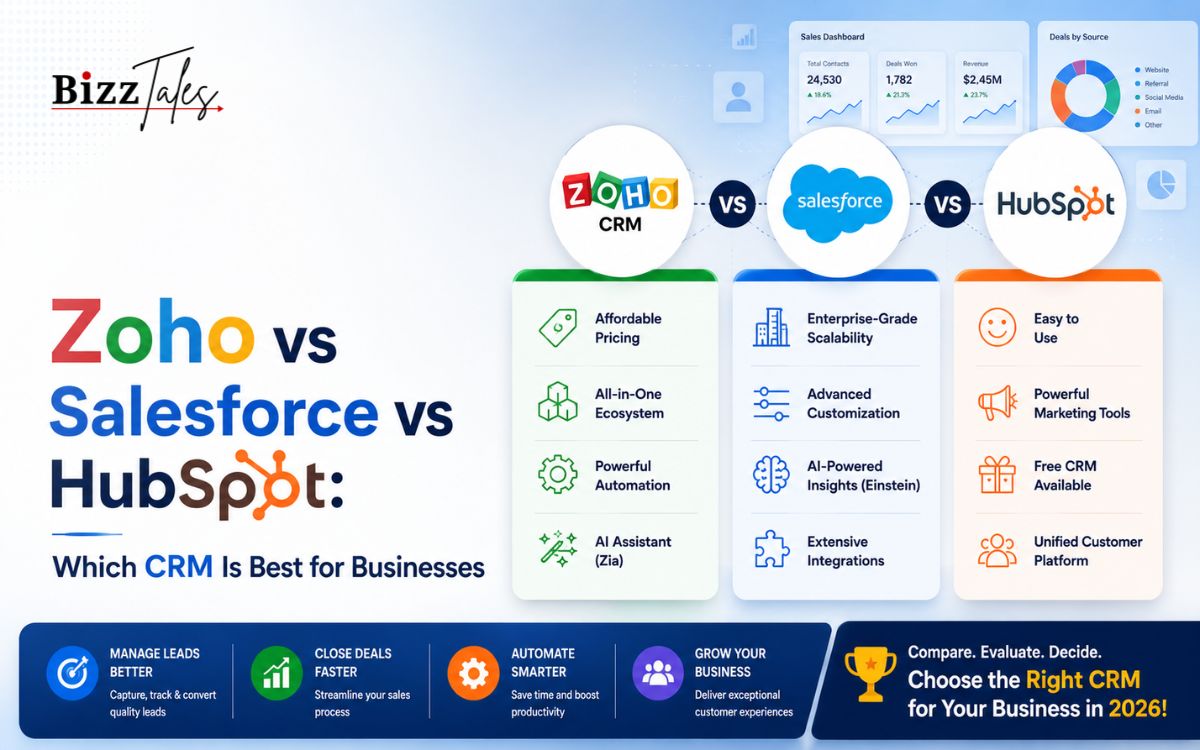
Of the countless number of CRM providers out there in the business world, certain three names (Zoho CRM, Salesforce, and Hubspot) keep occurring again and again. They each have established themselves with a reputation and are used by millions of businesses.
Then, the difficulty is how to pick the perfect CRM. Although Salesforce is recognized as the Industry leader, Zoho would be more favorited for cost effectiveness and an extensive ecosystem, whereas Hubspot wins customers for its ease of use and marketing features.
Looking ahead to 2026, the race for top CRM software is hotter than ever. The future of CRM software is a combination of price, growth potential, automation, AI features, ease of implementation, level of customization and ROI.
Below is a detailed comparison looking at Zoho, Salesforce and Hubspot to see which CRM is perfect for a certain type of business in 2026.
Why CRM Software Matters More Than Ever
The business environment has been transformed over the last decade.
People now want customized services and experiences, quick replies and multi-channel interactions.
These needs are now so complex, that manually managing them has become nigh impossible.
CRM focuses on consolidating customer related information, recording customer interactions, automating the working processes and supporting the decision of a business.
A modern CRM allows organizations to:
- Manage leads efficiently
- Improve customer engagement
- Automate repetitive tasks
- Increase sales productivity
- Enhance marketing performance
- Strengthen customer retention
- Generate valuable business insights
With artificial intelligence being built into many CRM systems businesses now have access to predictive analytics, automated recommendations and improved customer engagement strategies.
The right CRM can grow to be a tremendous competitive advantage.
Understanding Zoho CRM
Zoho CRM has become the world’s fastest growing CRM available.
Created by Zoho Corporation, this platform caters to startups as well as large businesses.
One of the big advantages of Zoho is the tight integrations with rest of Zoho. Customers can link CRM with accounting, HR, project management, customer support, email, analytics and many other business applications.
This establishes a consistent operating environment for businesses.
Small and medium size businesses find Zoho CRM to be the most affordable and practical solution available.
The platform offers:
- Sales automation
- Workflow automation
- AI assistant capabilities
- Lead management
- Multi-channel communication
- Analytics and reporting
- Custom modules
- Mobile accessibility
Zoho CRM is one of the best available options for businesses seeking high value for money.
Understanding Salesforce CRM
As we all know Salesforce is the largest CRM provider at the moment in the world.
Salesforce was established in 1999 and played a pioneering role into the creation of applications hosted in the cloud and spreading the concept of SaaS.
Today, Salesforce is used by every size of organization including some of the largest companies in the world.
There is unparalleled flexibility and customizability.
Salesforce provides:
- Advanced automation
- Enterprise-level customization
- Extensive integrations
- AI-powered insights
- Customer service tools
- Marketing solutions
- App ecosystem support
- Industry-specific solutions
Scalability is one of Salesforce most powerful attributes.
Organizations can even begin with a few basic capabilities and go on from there.
On the other hand, the intricacy of Salesforce and its relatively higher prices may pose problems for smaller companies with a restricted budget.
Understanding HubSpot CRM
It is clear that they are the most popular CRM companies amongst startups and GrowingBusinesses.
Although previously focused on inbound marketing services, over time HubSpot moved into sales, service, operations and CRM software.
First and foremost, it’s ease of use is the greatest benefit of the platform.
Open range unlike some enterprise level systems, the system is easy to use and doesn’t take ages to integrate.
Ease of Use Businesses often like Hubspot because users can be up and running quickly.
Key features include:
- Contact management
- Marketing automation
- Email tracking
- Lead nurturing
- Sales pipeline management
- Customer service tools
- AI-powered assistance
- Reporting dashboards
Our solution will appeal to marketing-oriented businesses who are serious about lead generation.
Comparing Pricing in 2026
Pricing is among one of the top considerations to look at when choosing a CRM.
Zoho CRM tends to have the lowest cost out of the three when comparing pricing.
Its plans offer much functionality without requiring significant investment.
This low cost has made Zoho particularly appealing to startups as well as small businesses.
Salesforce is at the high end of the market.
It does many things but requires a higher subscription fee, implementation cost, customization fee and training.
Many large organization compaign points out that it is expensive to custom build, and says that “large organizations often justify the added development costs with Salesforce scalability and enterprise-grade features.”
Hubspot is being positioned somewhere between Zoho and Salesforce.
Startups are drawn in by this free and entry level option.
Yet the costs tend to rise considerably as business adds more sophisticated marketing, automation and customer service features.
Zoho is provides the strongest value proposition for budget-focused organizations.
Ease of Use and Implementation
CRM can have no adopters.
The most advanced CRM is useless if your users haven’t learn to use it.
HubSpot, being the most user friendly, is by far the most simple platform to get accustomed to.
Is easy to use, neat and beginner-friendly.
The competitiveness could be achieved by teams that could become productive for short times scale (days).
The customization facility of CR is quite good.
Although it has a lot of advanced features, this interface is quite simple.
In terms of Zoho, most businesses will be able to use Zoho without a full knowledge of technology.
Whether we thrive with Salesforce is a question of patience and if we’re ready to endure it’s complex and mighty to master.
You might also need consultants, administration, or specific training to make your implementation happen.
If simplicity is paramount for the organization, then SolutionHub, in most cases, would be the winner.
AI and Automation Capabilities
One of the main players in the playing field of CRM software is the application of artificial intelligence.
More and more businesses expect CRM systems to automate activities and to offer predictive capabilities.
Zoho is providing help by Zia the AI assistant, which helps in examining sales trends, spotting opportunities, and predicting trends, and automating tasks.
Zia is on the up with more adoption of AI.
Salesforce, with a world leading CRM intelligence system, Einstein AI.
You are provided with predictive analytics, customer behavior analysis, automation recommendations, sophisticated forecasting.
Additionally, Hubspot has upgraded its AI features by adding content creation, automatic customer engagement recommendations, and workflow automation.
Salesforce is still a serious leader in enterprise class AI powered functionality.
Successful & affordable AI use case adoption with Zoho.
Customization and Flexibility
Priority of business needs to be customized for special work as follows:
This is where Salesforce really shines.
The flexibility of customizing the platform is extensive providing support for highly complex business needs.
Large enterprises could use Salesforce because of how it reflects almost any stake holder or business model.
Additionally, the CRM of Zoho is highly customizable.
Users are able to create fields, modules, workflows, dashboards and automation rules with almost zero technical experience.
Really, hubspot is less about customization more about simple governance.
Although there are customization options, but they are not as much as in Salesforce and Zoho.
Businesses with very specialized processes will generally lean towards the likes of Salesforce or Zoho.
Integration Ecosystem
The technology we use today involves many software tools for working and accounting.
This therefore makes the integration ability with CRM an important factor when choosing a platform.
Salesforce built one of the largest software ecosystems via it AppExchange marketplace.
Apart from Salesforce, there are several third-party applications that are easily integratable with the platform.
Another thing, Hubspot has a LOT of integration on a lot of aspect of marketing, sales, support and productivity tools.
The greatest strength of Zoho is obviously in the ecosystem itself.
Excellent native integration of various Zoho products.
Existing businesses enrolled into the Zoho Universe benefit the most from the remarkable connectivity that makes business operations so much more effective.
Which CRM Is Best for Small Businesses?
Where the priorities are cost and straightforwardness,10[] a small business may be the typical user of it.
Zoho CRM is considered to be lagging only on price..z has a lot more features than pricier products.
Small business owners have no problem gaining access to automation, analytics, AI capabilities, and integrations.
In addition is another great tool, you can use for Online Inbound Marketing and lead generations.
Easily accessible; easier to implement.
In general, salesforce can be used effectively in smaller companies but it may be too complex and costly for many smaller companies.
Coming in at number one, for most small businesses.
Which CRM Is Best for Medium-Sized Businesses?
Largely seen of medium-sized organizations, they can be thought of consumers of the specifications, in terms of scalability, automation, reporting and customization.
Zoho is great in this admin segment where quality is a compromise with budget as we do a good job of delivering advanced capabilities at a reduced cost.
Marketing organizations still find HubSpot an attractive option.
The more operationally complex an organization, the more attractive Salesforce(tm).
Business expecting or willing to grow fast might see Salesforce as a long-term solution.
Which CRM Is Best for Large Enterprises?
Heavy enterprise customers are interested in: scalability, security, extensibility/ customizable, compliancees, and ecosystem support.
Salesforce clearly leads this section.
Its vast level of customization and enterprise infrastructure makes it a good choice for enterprise companies.
Zoho has established a much broader Enterprise suite and is still adopted by larger firms.
But for enterprise CRM deployments, Salesforce is still by far the absolute leader.
CRM in the year 2026 and beyond.
The CRM industry is developing at an increasingly fast pace.
The emergence of artificial intelligence, predictive analytics, conversational interfaces, automation and customer intelligence are developing into nothing other than basic marketing tools.
Future CRM platforms will increasingly focus on:
- AI-driven sales forecasting
- Personalized customer experiences
- Predictive customer behavior analysis
- Automated decision-making
- Intelligent workflow automation
- Unified customer data platforms
All three platforms: Zoho, salesforce and hubspot are investing huge in these technologies.
As markets develop demands for more intelligent and efficient CRM solutions and the competition between these platforms will surely escalate.
Final Verdict
Depends on how big is the business and what are the other needs and budgets of the business. Your answer to “Which CRM is best?” would lie on the business goals and budgets.
Zoho CRM provides most value, making it the best choice for startups, small companies, and growing organizations that want all the power without the price tag.
The enterprise CRM vendor of choice continues to be Salesforce-leader in functionality, scalability, customization and AI capability.
Hubspot is very easy to use and its marketing integration Is what makes it an appealing product for many businesses, especially those focused on acquiring customers and on inbound marketing.
In 2026, for most businesses has the best suite of tools which bundle cheap, tools, automation, and cloud integration.
Salesforce might be more appropriate for organizations with the complex needs of the Enterprise, while marketing people will probably go for HubSpot.
In the end, the best CRM for you is the one most fits into your organization’s growth plan and needs.
FAQs
What is the most suitable CRM for small businesses in 2026?
Many believe that the best CRM for small business is Zoho CRM, noting that it offers good value for money, has a high level of automation and a feature set packed with tools.
Is Salesforce superior to Zoho?
Brands like Salesforce tend to be more tailored and scalable at an enterprise level, whereas organizations would find Zoho greater value for money and a way easier system to implement.
So which CRM offers the most comprehensive AI capabilities?
Salesforce eyes it is claimed by many experts that the Einstein AI is the world’s most advanced CRM AI. However, Zia from Zoho and the AI tooling from HubSpot are catching up fast.
Is it possible for startups to utilize Salesforce?
Yes, however most startups find Salesforce costly and complicated when compared to alternatives such as Zoho or HubSpot.
Which CRM is most Cost effective?
Most SMBs will find Zoho CRM to hit the sweet spot for features, automation, large/small business scalability and costs.