Artificial intelligence has arguably become the most popular technology of the last decade. What was at first a science fiction-like reality only being discussed by researchers is now one of the most common tools used by students, businessmen, business enterprises, and governments accross the globe. Everything from content creation and programming to research, customer service, and business automation.
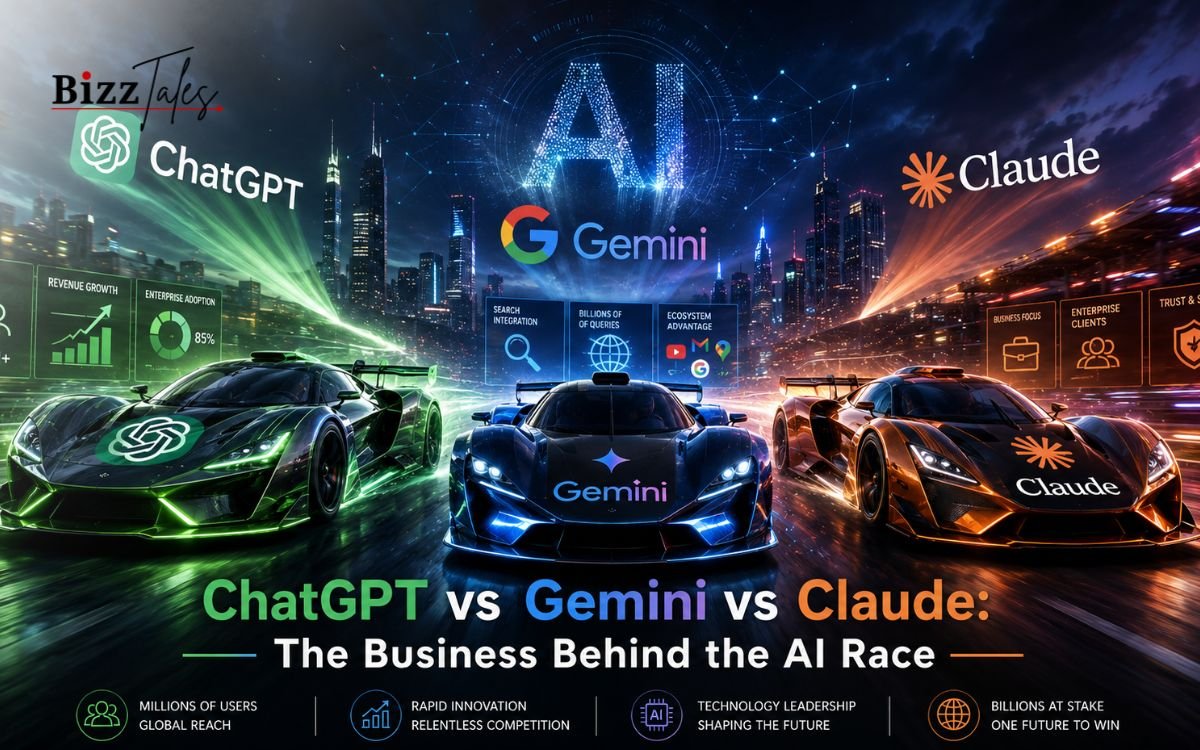
Leading this change are three heavyweights: ChatGPT, Gemini and Claude. While millions of people around the world use these AI assistants everyday, few truly understand the huge business race going on under the hood. It’s not just a competition between pieces of software, but a contest involving some of the largest tech firms on earth, billions of dollars in funding, advanced research and the direction of how humans will interact with computers in the future.
The rivalry of ChatGPT by OpenAI, Gemini by Google, and Claude by Anthropic has become immediately one of the most defining technology competitions in today’s world. There are differences in each of the platform’s capabilities, how these companies plan to monetize these rivals, and the future of each platform. The winner of this contest can change the future of many many industries including schooling, healthcare, software development and world productivity.
Getting to know the business that stands behind all this “AI run” brings some light into the direction that technology is taking us and why the rivalry is getting uglier and uglier.
How the AI Race Began
Artificial intelligence has been around for a long time, but the current AI boom didn’t begin until recent language models showed they could process and produce human-like language. Computers and programs improved dramatically thanks to major advances in machine learning, neural networks, and huge computing power, allowing AI to do things that would have been inconceivable years ago.
The defining moment occurred when ChatGPT was made available to the general public. This allowed for virtually everyone to have direct access to an AI platform capable of engaging in conversation while answering questions, creating content, addressing issues, and providing support for their creative processes. The product experienced rapid growth during this period.
This led to the big technology firms rushing to get their AI projects off the ground. Google placed a greater emphasis on Gemini and Anthropic became notorious for its AI system called Claude. It prompted a race for AI dominance hard to remember in the tech world.
Today, artificial intelligence is not considered as niche technology anymore. It is now a strategic issue for the companies, attracting huge amount of investments as well as indeed changing the markets.
ChatGPT and OpenAI’s Vision for the Future
The advent of ChatGPT was significant in popularising generative AIl. ChatGPT is a platform by OpenAI which showcases a conversational AI in an everyday setting. Once released, the AI quickly became known for its applications in writing, coding, brainstorming, research, and productivity.
OpenAI’s plan is much more ambitious than simply making a chatbot. The company’s ultimate goal is to continually invent more intelligent AI systems that can work alongside humans in every industry. By allowing members of the public and businesses to have access to AI, OpenAI has established itself as one of the most powerful technology brands in the world.
The rapid pace of innovation is one of the most significant advantages of the company. The continuous release of new functionalities, features and improvements capture the attention of consumers and appeal to business clients interested in adopting AI technology. It also maintains good relationships with enterprise users that use AI intensively.
ChatGPT’s business model for monetization opened up to substantial revenue streams from subscriptions, enterprise offerings, and API access. This ensured that OpenAI can keep investing aggressively in research as well as infrastructure while increasing its international footprint.
Google’s Gemini and the Search Giant’s AI Strategy
Google was born into the AI competition having a distinct advantage after spending the last several decades working with the largest collection of information in the world. As the largest search engine in the world, they have the largest knowledge base, largest compute resources and some of the the most experienced researchers in the world.
Gemini is Google’s return to infuse artificial intelligence into its entire stack. I believe that they were designing Gemini not to be a chatbot but to plug into products that Billions of users are already using every day. A few of those areas include search, productivity tools, cloud computing tools, and mobile hardware.
Google’s most important objective is maintaining its dominance in search and digital information. The advent of conversational AI opens up new forms of information retrieval for users, which could shift user behaviors on the internet. Gemini enables Google to be ahead of the game.
Financial resources. With the money that makes up the billions, Google can afford to run calculations on the hardware that uses that capital, scale up infrastructure and put billions into research and product development without the constraints smaller organizations face. The speed which this can be achieved puts Gemini as one of the strongest competitors.
Given its ongoing partnership between Google and AI, Gemini may become the most used artificial intelligence platform in the world.
Claude and Anthropic’s Focus on AI Safety
Although most headlines are about OpenAI and Google, Anthropics Awhat We’ve Built a trusted AI company, Anonymous, that was d by former leaders in the field. The company has a strong emphasis on creating safe and trustworthy AI software.
Claude appeals to companies, developers, and other users who need helpful answers, logic, and prioritize responsible AI behavior. Compared to many of its competitors, Anthropic has a slightly different methodology given their focus on long-term safety in addition to optimizing capabilities.
This emphasis has helped the firm win big capital investments and forming key strategic alliances. The various organizations see Anthropic as a significant contributor to the shaping the future of artificial intelligence because of its focus on developing AI systems that are in line with human priorities.
His crowd-watching popularity shows that narrow success in the artificial intelligence marketplace does not come only for large and branded companies with well-known names. Companies that bring unusual strengths can establish compelling niches in a fierce industry.
As AI adoption grows, trust and reliability may be just as critical as basic performance, further opening the door for Claude to grow in the years ahead.
Why Artificial Intelligence Has Become a Multi-Billion-Dollar Industry
The battle between ChatGPT, Gemini, and Claude is there because Alhas become one of the biggest business opportunities in recent history. Companies in practically all sectors are seeking ways to utilize Alto increase productivity, reduce expenses and design new offerings.
Organizations deploy AI across a range of functions including customer service, content creation, data analysis, software development, marketing, and automation. Educational organizations utilize AI to improve education outcomes. Organizations offering healthcare services use AI for diagnostics and research activities. Financial firms use AI and machine learning for fraud detection and analysis of market trends.
There is a great economic opportunity. By pioneering the development of such AI systems, firms stand to capture revenue streams from subscription software, enterprise licenses, cloud, and access via APIs-these will become very lucrative as adoption accelerates.
The AI industry is still in the early stages, meaning we can expect competition to get even more fierce when more entrants enter the space or existing companies start building out their own capabilities.
The Infrastructure War Behind AI
While most users interact with chatbot features, the true war takes place on the back-end. Powering sophisticated AI models is an enormous amount of compute including large data centers, high-end chips and large cloud environments.
Training big language models is a multibillion dollar task and requires access to tremendous infrastructure. Continual investments in infrastructure are needed to keep pace with increasing user demand and build ahead of new developments in the models.
Inhibition of entry. The barrier to entry is very high in the infrastructure race and only few organization can provide the resources to compete in the game top of the industry. Therefore, those with strong financial resources and technological skills had tremendous advantages.
[All of these companies are][spending enormous resources on infrastructure]. Software will be important, but what really matters in the long term is computational power.
Business Models: How These AI Platforms Make Money
While these three companies all compete for the same “market” of artificial intelligence, the nature of their businesses varies substantially.
OpenAI monetizes its service through paid subscriptions, enterprise licenses, and a developer API. This not only gives businesses and individuals access to advanced AI capabilities but also funds research to further improve the underlying models.
Google has a larger ecosystem to rely on. Gemini can add value to Google advertising, search, cloud and office products and strengthen the already dominant Google ecosystem. Instead of building upon subscriptions alone, Google can tap into multiple streams of revenue.
While researches into general or specific human knowledge remain a long-term pursuit, Anthropic concentrates on enterprise adoption and business partnerships, providing AI products that can deliver workable solutions to businesses for many years after the initial knowledge investment.
Overall, these different methodologies demonstrate the various paths to success that firms face in the rapidly expanding AI industry.
Challenges Facing the AI Industry
In the face of high expectations about machine learning, high quality machine learning applications are yet to be developed. Also worries around fake news, privacy, Intellectual Property, and ethical development of AI is still a hot discussion among policy makers, researchers and business executives.
Regulation another significant obstacle. Governments are creating regulations and guidelines to support innovation, yet have strict controls to ensure safe piloting of AI across the globe. By the same token, private companies have to adapt to dynamism of these legal demands and keep their edge.
Furthermore, costs of creating more powerful AIs are steadily increasing; as models grow, so does infrastructure expenditure, and balancing between profitable business and research/future growth becomes more and more difficult.
The competition itself adds stress. More startups, technology companies and research bodies are coming into the market.
Who Is Leading the AI Race?
It is hard to pick a clear winner as each of the products has its hits and misses. ChatGPT currently has unrivalled brand recognition and widespread use across consumers and enterprises. Gemini is entrenched within Google’s giant ecosystem and worldwide presence. Claude is known for its safety, reliability and thoughtfulness.
It is also possible that the future AI market will not be dominated by one firm, but instead, will be a multi-platform ecosystem with different partners optimizing for different use cases and different customer use cases. An example could be, an AI for coding, for research, and for enterprise workflows.
As AI develops, your place of leadership may change due to technological loss, changes in the business model, user adoption and regulation.
Conclusion
This race for ChatGPT, Gemini and Claude is much more about technology than just chatbots. This is a race with significant implications for the future of technology, business, education and the world. At the end of the day, each one of these companies has different strengths in the space, whether it is OpenAI’s innovation, Google’s scale or Anthropic’s safety.
With more than $billions pouring into AI development, the field is likely to move even faster. Advances in capabilities, performance and customers will foster more opportunities to grow but also increase competition.
There is no way to know which platform will eventually dominate the market, but at the end of day there is one firm that is sure to be a significant player in the development of artificial intelligence: it is the companies that are pushing forward this new technology. They are shaping our future as people in how we will have access to information and technology.
FAQs
In what way does ChatGPT differ most from Gemini and Claude?
ChatGPT is centered around general AI features and innovation, Gemini is about Google’s platform and the search magic, and Claude is more about security, dependability, and business-oriented AI tools.
Trough AI platform standard is used?
The most recognized uses of AI are through ChatGPT, Gemini, and Claude. While ChatGPT remains one of the most used AI platforms in the world, Gemini and Claude continue to accelerate their userbase.
What is the revenue model for AI companies?
AI companies make money from subscriptions, enterprise services, cloud integrations, API access, licensing agreements, or through strategic partnerships.
What is causing the rapid growth in the AI industry?
Organizations in various industries are integrating AI in to their operations to increase productivity, automate processes, derive cost savings and innovate products and services fueling explosive growth in the market place.
Could just one company control the AI market?
Not necessarily. The field of AI is so broad that it will be possible for several companies to prosper by fulfilling different customer requirements.