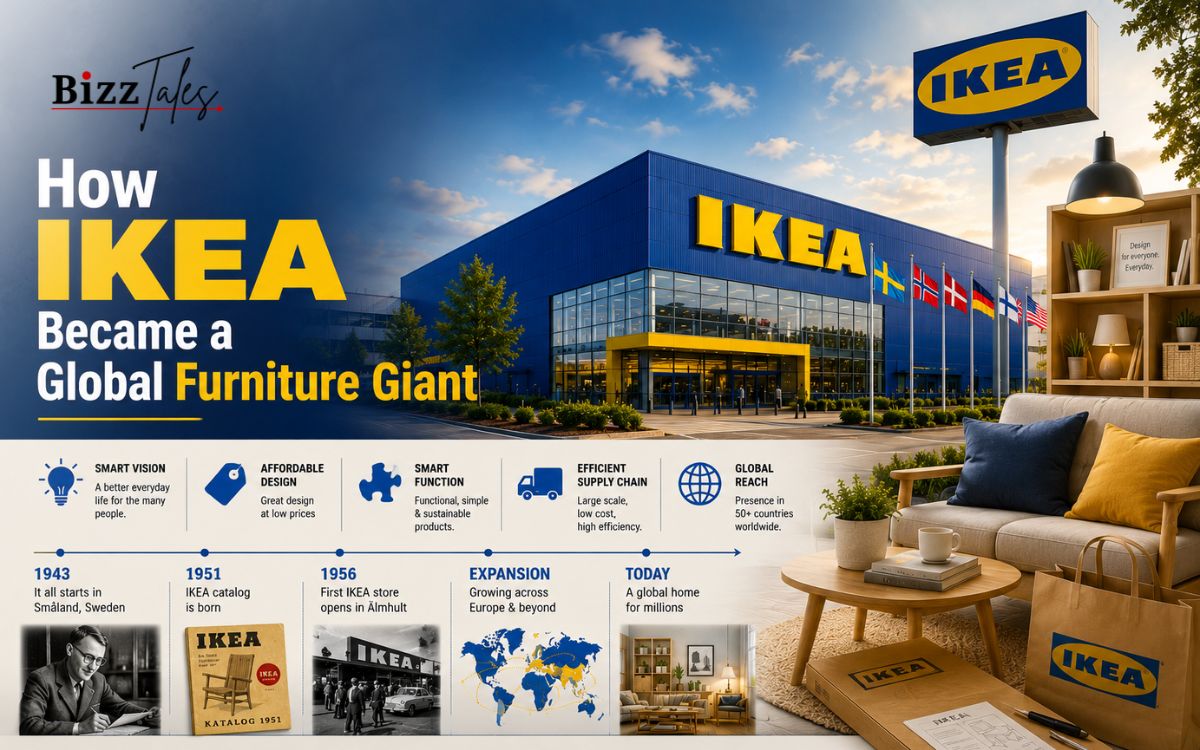
If you step inside almost any major city somewhere in the world today, it is very likely that IKEA will be just around the corner. From Europe and North America to Asia and the Middle East, IKEA has become one of the most famous global retail brands. Customers all over the world are attracted to its outlets in search of cheap furniture, homeware and décor tips. Starting as a small firm in Sweden, it has now developed into a global retail giant that is redefining the way we shop for furniture.
Today, IKEA is much more than a furniture retailer. It is a bestseller business case study that’s studied at universities; a champion in global supply chain management; and simply one of the best retail brands that has ever been created. Its outstanding design stores in blue-and-yellow color, flat-pack furniture and its self-service shopping experience have become a trademark. However, IKEA’s rise was not merely a product of selling sofas, tables and wardrobes. It achieved success by breaking all the rules, having deep consumer insight and constantly seeking ways to cut cost and add value to the customer.
The success of IKEA is a reflection of inspiration, hard work and innovative thinking. It shows the way in which a company can turn a mundane product into the biggest success story of all time through the unique approach to providing economical, efficient and a value driven consumer experience. Exploring the history of IKEA to find out how it became the worlds largest furniture retailer offers many useful insights for entrepreneurs, business owners and anyone else aspiring to start a successful business of their own.
The Humble Beginnings of IKEA
The story of IKEA started way back in 1943 when a small-time mail order business was founded by a young entrepreneur called ’Ingvaar Kamprad’ in Sweden. He was just 17 years of age at that time. Kamprad started by selling some ordinary stuff like pencils, wallets, wooden frames and things of that sort. Early in his life, Kamprad displayed the need for creating values at minimum costs.:
The name IKEA (which is the company name) has a very interesting history. The name consists of the initials of Ingvar Kamprads, plus the name of the farm and village in Switzerland where he was born. When the company was first established they sold a lot of different types of goods and then later on it sold only furniture. Ingvar Kamprad realized that people wanted furniture that was both cheap and nice, yet there was far too much expensive furniture on the market. This idea was the beginning of misfortune.
The demand for low cost furnishings for the home sky rocketed post the second world war. With many families having to decorate homes on a strict budget, this was a prime opportunity for companies who could provide quality items at the right price. Kamprad took a keen interest in furniture sales.
What distinguished his style was his fascination with cost reduction. He would not accept existing retail standards but continuously pursued opportunities for cost-cutting. The approach eventually stood as one of the biggest competitive edges of IKEA.
The Birth of the Flat-Pack Revolution
Among the most significant innovations in the history of the company was the development of flat-pack furniture. At the present time a product being flat-packed can be easily confused with the IKEA name, but it was a groundbreaking idea when it was introduced.
This concept based on a basic problem. Transporting completely assembled furniture was expensive. Large items took up a lot of space both in the warehouse and in the delivery trucks. This grew the cost of logistics and cut down on PROFITS. IKEA saw the potential in being able to transport items in flat packs.
This relatively simple idea revolutionized the whole of the furniture market. Flat pack increased the number of units they could effectively store and deliver. Consequently, this meant that the operating costs for Flat Pack were reduced and these savings were passed on directly to the consumer.
At first, many classic furniture retailers turned down the idea. Nonetheless, consumers found the pricing and convenient package very attractive. Gradually, flat pack was successful and made the main feature of IKEA and contributed to the worldwide expansion.
How this invention achieved success is as follows: the very challenge of transportation posed by launching huge home furnishing items from far away is in fact a real business opportunity. Instead of considering this as a “cost to be borne”, IKEA made efficiency its strength.
Creating Affordable Design for Everyone
Before IKEA’s success, a consumer had to make a choice between beautiful design and price, as beautiful pieces were often a luxury. IKEA revolutionized the idea by developing democratic design.
IKEA’ philosophy was not to design high-end expensive goods for selected wealthy consumers. It was to formulate a complete range of well-designed, functional home furnishing products at prices so low that as many people as possible could afford them.
Which encompasses:
- Design
- Innovation
- Environmental sustainability
- Cost
- quality
This was a delicate balancing act. The designers collaborated with the manufacturers on using existing resources to make the products look amazing, cost-effectively. Customer satisfaction was kept in mind at all stages of product development.
Most of this strategy struck a chord with consumers. Consumers desired homes that looked updated and attractive, but wanted products that were more affordable too. IKEA was able to fulfill both of these desires, helping to develop a loyal customer group in a number of different markets.
IKEA widened the overall market because fashionable furniture become affordable. By attracting people who would never buy modern furniture, because it was too dear.
The Unique IKEA Store Experience
The fourth and final factor that I believe plays a major role in IKEA’s success is the experience that customers feel when shopping there. The experience shopping at an IKEA is in many respects completely different to going shopping at most other furniture retailers.
Pre-sell room settings: Rather than just showing individual products, IKEA presents fully furnished room settings that give customers an idea of what the products would look like in their own homes. Customers can allow their imaginations to “run wild” by looking at the room and thinking up new suggestions.
IKEA has managed to design their shop floors so that people naturally move in a certain pattern through various displays in the shop and stands in front of a variety of the products before ultimately moving towards the cash desk.
Cost effectiveness is also achieved through self-service. By allowing customers to retrieve then transport their own products from warehouse sections, the efficiency of the workforce is increased without threatening the comfort of having the products catered for you.
Even having restaurants and food courts is surely significant. In fact, by urging customers to stay in their stores longer, IKEA makes their shopping more fun and increases the chance to buy.
The outcome is a shopping experience that feels far more like a destination than a furniture store.
Mastering Global Supply Chains
One factor allowing IKEA to keep prices low is that of its efficient supply chain. Every item sold in an IKEA store has a network of suppliers, manufacturers, logistics firms, distribution centers located throughout many countries.
They buy the materials and produce the items as far as they are able with optimum “cost to quality” ratio.
Another component of the strategy is maintaining long-term relationships with suppliers. Working with suppliers to increase efficiency also helps them to lower their costs of production, that are then transferred to the customer.
As one of the most renowned companies in terms of supply chain, it is CLEARLY diverse for anyone who visits IKEA. Although purchase customers might come into contact with the fashionable furniture, the inviting and amusing showrooms, it would be the internal-operations, logistics and operational competence that enact the business life.
IKEA benefits as well from this focus on supply chain management; it is able to serve millions of customers around the world and yet stay competitive in many different national markets.
Expanding Across the World
IKEA has always practiced an ambitious growth strategy. Instead of focusing on a single area, the firm expanded into new markets quickly and widely. Over a period of several years, it explored markets in Europe, North America, Asia and the Middle East.
Nonetheless, ‘expansion’ was never solely about the number of outlets. IKEA made large investments in investigating regional cultures, client needs and buying habits. Accordingly, while sticking to its fundamental philosophy, the company modified some items of its array accordingly.
IKEA’s means of achieving this balance contributed to their triumph in international markets. Sales by customers in various countries could still identify the ikea brand but also find a lifestyle tailored to their geographical location.
Furthermore, IKEA’s internationalization increased its purchasing power. The bigger size IKEA was able to buy at a lower price and manufacturer at a very efficient level.
In turn, the world economy entered a self-sustaining expansion and became a fundamental aspect of the company’s sustainability.
Sustainability and the Future of IKEA
Sustainability has grown to become an essential strategy for the company in the recent years. Consumers nowadays are much more concerned with global warming, and the total amount of pressure for reduction in people’s carbon effect over the world has increased for business companies.
IKEA has been taking measures to invest in the renewable energy projects, practices of ethical and sustainable sourcing as well as a movement towards a circular economy. It has been working towards the reduction of waste along with improving the efficiency of resources and producing a product with less harmful impact on environment.
These measures are not just good for the planet-they also meet the evolving expectations of consumers. Today’s consumers want brands to show that they care for society and the environment.
IKEA has thus made it its ethical responsibility and business strategy to go green by becoming a eco-friendly company.
As environmental factors increasingly play a part in consumers’ relative purchase decisions, the firm’s investment in sustainability could support it in being competitive in the future.
Challenges Facing IKEA
Despite, its significant achievements, the organization is encountering many kinds of challenges. It includes the increase of competitions by online out comes, it also includes the change in consumers demand in needs, and economic instability.
The Internet revolution has affected mass retail by creating a new level of competition. Consumers are now demanding for more convenient shopping experience online and short delivery lead times. IKEA invested a lot in its digital offering and omni-channel retail.
Rising prices of materials and disruptions in the supply chains are additional issues that could have an impact on profit margins. Keep the prices low and ensure cost efficiency in the operations continue to be a challenge.
Further, other aging consumers will prefer to have the flexibility along with minimalist living style rather than to own furniture. Under such circumstance, IKEA should keep sustained innovation to cater such an evolving living trend while maintain its viability.
The company’s adaptability will also be an important factor in its future success.
Why IKEA Continues to Dominate
The reason why IKEA is still the world’s biggest furniture retailer is not because it sells the most furniture. It is because the company has developed a whole business system that is built on the principles of efficiency, low costs and customer value.
And what this means for IKEA is in all its business elements-from flat-pack innovation and cost-efficient sourcing to international presence and retail experience-there is significance toward realizing this mission of providing affordable, high-quality home furniture.
Very few have kept such a steady course for such a long time. And this is something we have achieved, thanks to the combination of innovation and bureaucratic discipline-an unusual, perhaps unique mixture-so we are constantly up to date with the market.
One of the main reasons why it has managed to stay on top of the world furniture scene is its capacity to change over the years without loosing its essential values.
Conclusion
For a small Swedish organization selling by mail, this is indeed the most amazing business success story ever. A company which was idea driven rather than customer driven with a concept which was not a mind-blowing one to start with-low cost-how it delivered this concept to customers was how it won:
In addition to flat-pack, democratic design, efficiency in supply chains and a special shopping experience, these features built the competitive advantages of the company that few of its competitors have reached. Besides being successful nowadays, IKEA is expected to keep developing and competing intensively through revolutionary works.
To entrepreneurs and companies, the story of IKEA is an evolution story. To achievers and innovators, it is sometimes these marginal innovation that fuel their amazing success by doing things even better.
FAQs
What is it about IKEA that’s made them as successful as they are?
The brilliant success of IKEA hard war thought it might be can be summarized as: cheap, effective supply chains, flat packs, raving brands and a distinct shopping trip.
So, what’s flat-pack furniture?
The product that is offered by the trade, ie. The furniture, has to be as “flat” and take as little space in the shipment as possible. Then customers would put it together. Meaning that direct estimation of costs can be minimized.
The maker of this home furniture was the Swedish company whose founders “Ingvar Kamprad, the founder of IKEA”.
Kamprad, founder of IKEA, was born in Sweden to a farming family in (1943).
How does IKEA manage to stay so cheap?
It minimizes costs by excellent manufacturing, bulk buying, optimized logistics, flat-pack packaging, and self-service retailing.
IKEA world largest furniture retailer?
Yes, IKEA today is known as the world’s largest furniture retailer, it has hundreds of stores in dozens of countries.