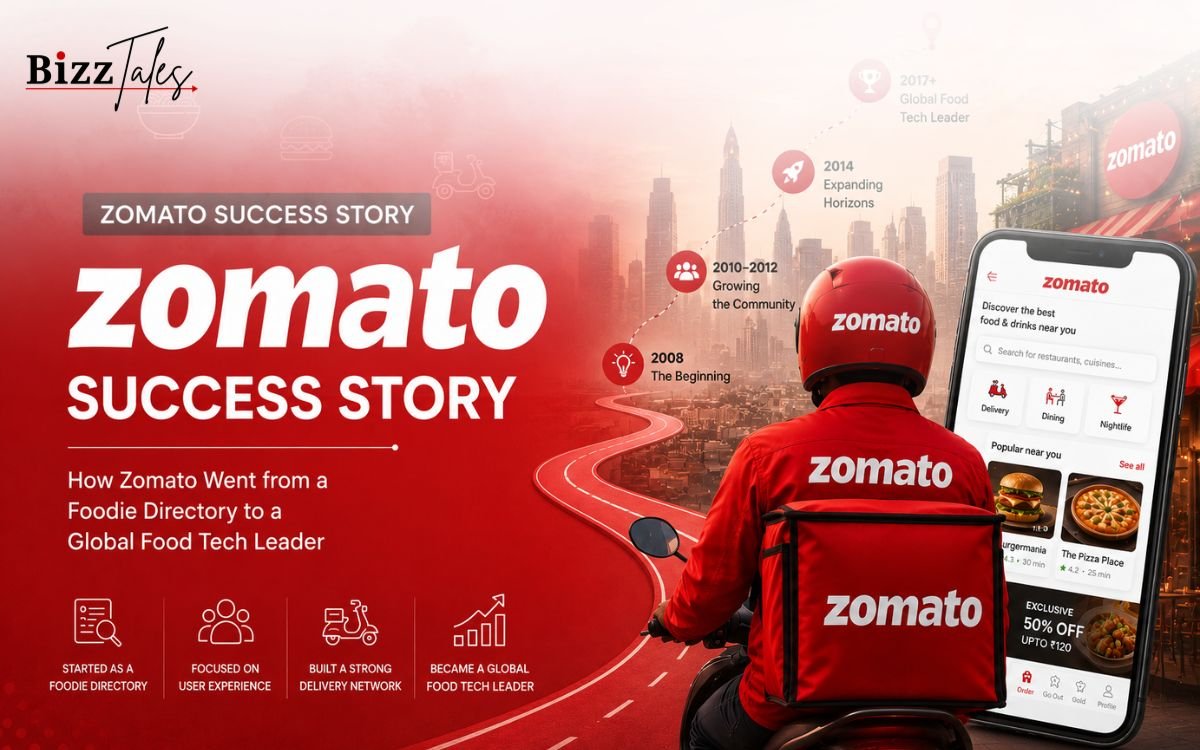
One of the biggest success stories of the Indian start-ups, Zomato’s journey is one of continuous growth and adaptation from the simple concept of placing restaurants online to being a billion-dollar company across numerous countries.
Millions today use Zomato for online food orders and to find restaurant information and reviews before dining out. The journey was paved with significant struggles, pressure of capital and tough business decisions.
The story goes beyond food delivery and delves into the realm of understanding customer problems and building solutions to change their behavior. Today, in 2026, Zomato has outgrown the label of “start-up” and has become a significant part of India’s digital economy.
- The Genesis of the Idea
- Early Days of Foodiebay
- Renaming the Brand "Zomato"
- Growth and Expansion
- Entering the Food Delivery Segment
- Competition with Swiggy
- Challenges faced by Zomato
- Pandemic's Role
- IPO and Key Milestones
- Acquisition Strategy and Expansion
- Deepinder Goyal's Leadership
- Learning Business Lessons from Zomato
- The Future of Zomato
The Genesis of the Idea
Deepinder Goyal and Pankaj Chaddah founded Zomato in 2008 with a rather simplistic yet profoundly impactful idea. Restaurant menus back then were spread across the restaurants’ vicinity in the printed form, which employees of office premises spent precious time scrutinizing before deciding what to order for lunch. Deepinder saw a huge potential in making restaurant information easily accessible online and decided to build an online menu of restaurants in close vicinity to save time for consumers, thereby revolutionizing the way they order food. What may seem to be a small observation, was the bedrock on which Zomato’s foundation was built.
Early Days of Foodiebay
Foodiebay was the name given to the first venture. The concept was a mere platform where the customers could find nearby restaurants and view their menus. It did not have the food delivery services involved in its business model. The idea, however, was revolutionary and was immediately embraced by the customers. With the growing popularity of the internet in India, the company started experiencing significant growth.
Renaming the Brand “Zomato”
To make the brand more prominent and easy to market globally, Foodiebay was later renamed Zomato. The brand wanted to break geographical barriers and position itself for international growth which proved to be a game-changer for the brand’s identity.
Growth and Expansion
The rise in smartphone usage and the increasing penetration of the internet provided Zomato with an unprecedented opportunity to expand its business. The company initially focused on listing restaurants in every city and on obtaining their menus. The customer review mechanism helped users decide what to order and, by being honest, the service built trust with the customers. To reach the top and to facilitate a seamless user experience, Zomato also invested heavily in technology.
Entering the Food Delivery Segment
One of the most crucial transitions was Zomato’s entry into the food delivery market. In 2015, the company observed a shift in the customer’s behavior and wanted to capitalize on the growing demand for food delivered at home. Zomato started experimenting with its delivery service, leading to a fierce rivalry with its competitor, Swiggy, in the food delivery sector.
Competition with Swiggy
The food delivery market became incredibly competitive. The founders of both the organizations had to compete for market share by offering steep discounts and extremely rapid delivery. While the market flourished under heavy competition, the cost of acquisition for the customer became too high. Despite the competitive environment, Zomato managed to expand its services across numerous regions in India.
Challenges faced by Zomato
The success story of Zomato has had its own set of challenges. Over the past decade, Zomato faced many challenges, from financial pressures to intense competition and evolving customer expectations. Building a strong food delivery network is fraught with a wide array of high operational costs and required relentless efforts from the organization to continuously enhance customer satisfaction. While the company faced a fair share of criticism related to its delivery services and profits, Zomato continued to invest in its growth strategy and innovations.
Pandemic’s Role
The COVID-19 pandemic presented a turning point for Zomato. Although there were some initial challenges, it witnessed a significant increase in the demand for food delivery services during this period. Zomato was quick to adapt to safety standards, introduce contactless deliveries and tap into new market segments.
IPO and Key Milestones
Zomato successfully became one of the first Indian startups to achieve an IPO. The company’s stock market listing was a landmark moment, fostering increased confidence within India’s startup ecosystem.
Acquisition Strategy and Expansion
Further expansions were marked by acquisitions of other successful businesses. The acquisition of Blinkit was a major strategic move towards expanding into the quick commerce sector and offering instant deliveries alongside food. This showed Zomato’s adeptness in adapting to market trends.
Deepinder Goyal’s Leadership
The successful journey of Zomato can be attributed to the strong leadership and vision of Deepinder Goyal. His core strategy revolves around understanding customer needs and innovating accordingly, rather than focusing on competition. Goyal is known as a pragmatic leader who relies on data and analytics for decision-making.
Learning Business Lessons from Zomato
Zomato teaches us that a problem, however small, when addressed in the most effective way, has the potential of growing into a colossal business. They focused on ease of use for the customers from the outset and eventually grew into a global organization. Companies must also be ready to adapt to the market’s dynamism as seen in the company’s transition to food delivery and various acquisitions. Technology and user experience play an indispensable role in today’s businesses and Zomato is a prime example.
The Future of Zomato
In 2026, Zomato is not just a food delivery platform; with expansions into quick commerce and logistics, and plans for ventures into further digital markets, the company aims to conquer all domains that cater to food accessibility. Furthermore, Zomato’s focus lies on using advanced technology to streamline delivery processes and enhance services.
Conclusion
The remarkable success of Zomato serves as a testament to the fact that the most minor idea can bloom into a successful enterprise with the right strategy and execution. This Indian startup is an embodiment of how innovative problem-solving can lead to the creation of a billion-dollar brand and significantly impact the digital economy. It is a valuable case study for aspiring entrepreneurs to draw inspiration from and build their own ventures for greater success.