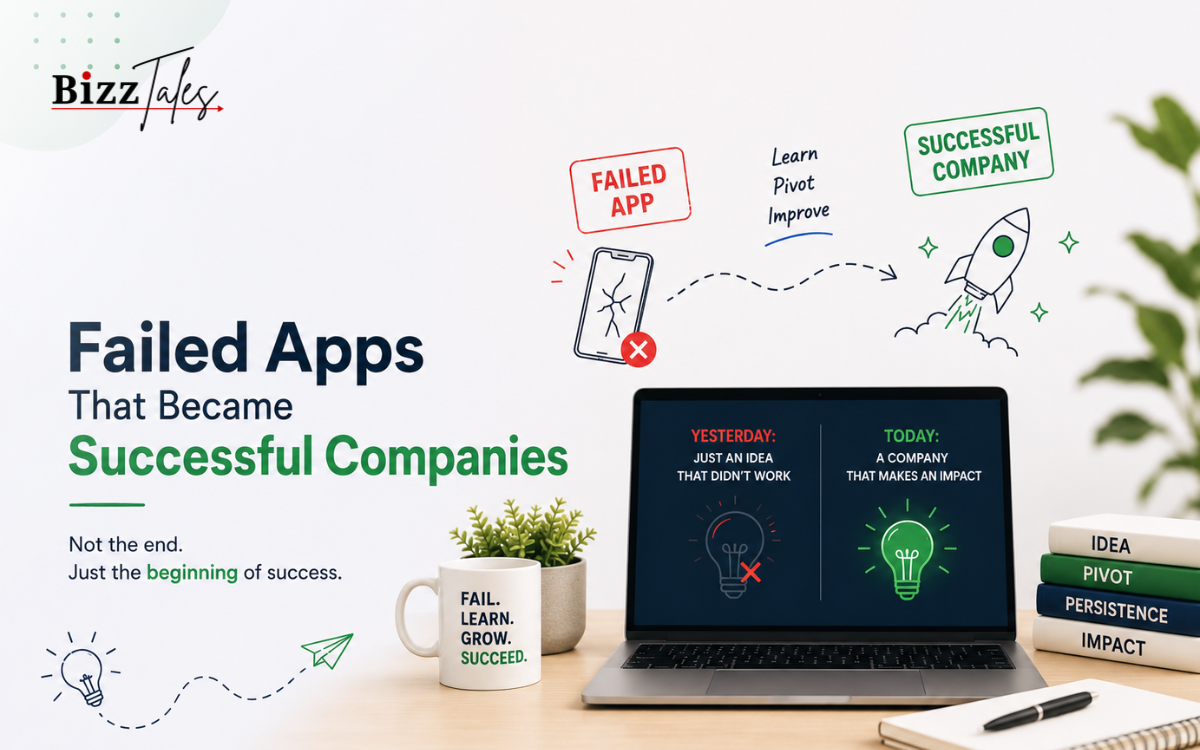
Failure in the start-up industry is seen as a necessary part of the journey to success. Although most companies can’t bounce back from their initial failure and will vanish after the first setback some businesses are able to rebound and do something amazing with a concept. They take a failing product or a struggling application with potential, reject the problem not the solution, and then turn that product or idea into a business with the power to revolutionize a whole industry.
The majority of successful companies that you know actually weren’t just conceived on one idea. Several of the world’s leading tech brands actually started out as applications, which at the time had no users or making no money, and didn’t actually address the issue they set out to solve. However, instead of just dissolving the product, the founders studied their customers’ behaviors and found opportunities therein. Pivots like these transformed thousands of startups into billion-dollar enterprises.
All these tales have one common message for all the would-be entrepreneurs. Simply because a product fails doesn’t mean its creator is doomed to fail too-failure can teach you what to do better next time.
Why Most Startup Apps Fail
Every year, thousands of new apps are released into app stores and across the internet. The vast majority fizzle out within a few months. Some teams make apps that nobody even has a problem with. Some apps fail because they come into markets where the big guys already rule. Another reason for app failure is a lack of users.
But, a flopped startup is different from a flopped industry. When an app fails, the founders accumulate insight. They see what users love, or hate, or ignore, what drives them crazy, and what gets them clicking. Those insights may become more valuable than the product.
The ‘disappear’ vs. Succeed issue for startups often hinges on how founders interpret failure. Some take poor achievement as a signal to call it a day. Others treat it as an indication of a more desirable opportunity.
History informs that some of the most prosperous global corporations fall under the second category.
Instagram: The App That Was Never Meant to Be Instagram
Currently, Instagram is one of the most powerful social media platforms in the world, being used by millions of users every day in order to upload pictures, videos or to follow stories. Influencers have earned their living using it, millions of dollars are spent by companies on advertising on it, and users use it as a source of fun and of keeping in touch. But the truth is that few people know that it was an entirely other application.
Prior to the launch of Instagram, founders Kevin Systrom and Mike Krieger were busy developing Burbn. Modeled along existing location-based social networks, Burbn was another check-in service with additional features such as making plans, uploading updates and interacting with friends. Seemed like a good idea on the book but in practice it turned out to be cumbersome and not user friendly.
The founders quickly saw something else interesting. Users didn’t really use everything but they took huge amounts of pictures. Instead of trying to improve an unsuccessful product, as an alternative, Systrom and Krieger made a major decision. They stripped away almost everything and zeroed in on one activity: photo sharing.
And this approachable version was the foundation of Instagram.
The results were remarkable. It took only a couple of months before the app had a collective user base in the millions. A phone-based app that initially failed was on the rise to becoming one of the best established social network sites for many years. The lesson that can be learned from Instagram is again quite simple: that customers have the potential of providing better business ideas than many entrepreneurs and founders ever envisioned.
Slack: From Failed Video Game to Workplace Giant
Another iconic case of a startup turning into a mature company is Slack. The communication platform we now know as Slack is used worldwide by medium and large companies, startups and other organizations. It is today one of the most popular communication tool in large offices. But Slack was never supposed to be set up in the first place.
It all started when a gaming company was founded by Stewart Butterfield and his team. They were trying to develop an innovative multiplayer online game named Glitch. This project a 3-year-long process, expensive investment and many working hours. Unfortunately, there weren’t enough players to sustain the business and they closed it down.
In all probability most of the founders would have seen this as the end of the line. However, the team was working on an internal communication tool during the production of Glitch that was aimed at enabling its employees to work better together. Significantly as the game itself was flailing, this communication application was addressing a tangible problem.
Rather than to concentrate on the unsuccessful game, they focused on the messaging application.
That tool was made Slack.
Today, Slack is used by millions of people worldwide, and is seen as one of the most successful business software products ever built. Interestingly enough, it was a forgotten, unsuccessful game that created the basis for this platform.
YouTube’s Surprising Beginning
Few have impacted the internet as much as YouTube has. Hundreds of hours of footage are uploaded every minute. It has built careers, companies and new types of entertainment. Yet this is not what YouTube was designed for.
Incepted by its founders as a video dating website, the idea behind it seemed just as simple; users would upload videos, introduce themselves to others, and start making connections. However, it was not compelling enough and so did not gain the required attention.
So no one wanted to use the platform for online dating.
However, in lieu of giving up, the founders looked at how people used the technology and understood that users needed a place to put up and search through all sort of videos, not just dating profiles.
This realization turned the organization on its head.
They also solved by removing the dating angle and opening the site up to all video content. This opened the floodgates to huge growth and within just a few short years it became the biggest video sharing site online.
It started as a failed dating app, and turned into one of the biggest technology companies in the world.
Twitter: A Side Project That Became a Global Platform
Prior to being one of the most eminent social media platforms, X was born from the hardships faced by a different company.
The founders previously developed an internet podcasting service Odeo, which was believed an attractive sector at the time. Nevertheless, once competitors larger than them adventured into the field, it encountered severe difficulties. Further growth was impossible, prospects may diminish and exit strategy questioned.
In this difficult period the team was trying certain innovations. One such innovation was the implementation of a simple service for sending brief status messages to friends.
The idea was simple, but it did appeal to users.
As interest developed, the founders uncovered that their side project was actually a far more promising enterprise than the one they had been working on. They abandoned the previous business altogether and rolled out Twitter.
The way that news was consumed, the way that politicians and celebrities were interacted with, the way that people conversed internationally-all were revolutionized by the website.
If not for Odeo’s failure, neither would exist.
Why Successful Founders Embrace Change
Working around a common thread runs through each of these stories. This is the fact that the founders were prepared to kill off the ideas that weren’t working.
This is frequently one of the most difficult choices an entrepreneur faces. Entrepreneurs burn themselves out on their companies. An entrepreneur can pour himself into a fledgling company, investing the firm with a part of his self. Saying that a company is a failure is difficult and painful. Several entrepreneurs cling to failing ideas just to spare face.
Entrepreneurs for Instagram, Slack, YouTube, and Twitter.
- They adopt a different mindset-they focus on data, not emotions.
- They understand their users.
- They observe, listen, and learn from what actually works.
The fact that they were willing to develop was their greatest strength.
This is precisely what a startup pivot is. Oftentimes, a pivot is an indication that the startup is not failing, but is actually being smart. It indicates that the entrepreneurs are listening to what the market truly desires.
The Role of Customer Feedback in Startup Success
One of the key lessons to be learned from each of them is the importance of the customer.
Users can expose opportunities founders wouldn’t think of.
- Founders of instagram found out that users were more interested in photos than check-ins.
- Founders of slack found out that their app was more useful for communication than for gaming.
- Founders of youtube found out that users wanted a general video platform than a dating site.
In each case, the customers successfully led the business down the better business model.
That’s why great entrepreneurs commit a lot of their time on understanding user behavior. Rather than getting married to ideas, they handle real problems.
Markets continually change and customer needs continually change. Betfrtign businesses listen and adapt much more than they survive than businesses that cling to obsolete assumptions.
What Entrepreneurs Can Learn From These Stories
The stories of many unsuccessful apps turning into goldmines is enlightening for aspiring entrepreneurs.
Lesson one – Failure is not the end. A failing project is never a reflection on the founder, who is undoubtedly talented and capable; often a failing product simply signals a need for change.
Lesson two is that flexibility is very important. Little is 100% certain in the market. Entrepreneurs who are flexible have the ability to turn what would be challenges into opportunities.
Observation is yet another insight which is proved very true. Several break through ideas are born just by observing the customers using products rather than their presumed usage.
Finally, these stories also teach you the value of never giving up. No company made it overnight. The entrepreneurs had to endure failures, struggle through doubt and make hard choices until they reached the winning strike.
Conclusion
While the startup world is littered with failures, there are some extraordinary stories of what happened next. Take Instagram, Slack, You Tube, and Twitter, all of which started as products that could not reach what they had set out to be but leveraged failure into a much more valuable offering.
These companies also serve as a reminder that success is rarely linear. Some of the hottest opportunities in the world can arrive from the unlikeliest of places. An app that didn’t quite work out can be transformed into a billion-dollar behemoth, if the team is open-minded, flexible, and ready for change.
The author has a single message for entrepreneurs. Don’t worry about failure. Just heed the failure. You may find within every ‘failure’ the idea of your greatest achievement.
FAQs
How do you define startup pivot?
A startup pivot is a fundamental shift in the business direction – by ‘shift’ we mean any significant change in the product, business model, target customer, or engine of growth based on the learning we’ve gained from the marketplace.
What makes some apps that don’t work in the game turn into big businesses?
Failed apps reveal what customers want. Founders can leverage these insights to build a better product that solves even more pressing problems.
Were there other apps before Instagram?
Yes. Instagram launched as Burbn, a geo-location check-in app similar to Foursquare, before pivoting into photo-sharing.
Where did Slack originate from?
Slack was born out of the failure of an online game called Glitch. Out of the company’s internal messaging system, the company built a product that has become huge around the world.
Has YouTube always been just a video sharing service?
No. Before YouTube became the broad video sharing site it is today, it was just a video dating site.
What can we learn most from these entrepreneur stories?
The great thing learned: you will not go out of business. Most successful businesspeople learn from their failures, adapt, and leverage customer responses so that setbacks become huge successes.