Compared to everyone else, only the legendary Honda had a greater impact on an industry. Today, Honda is among the world’s most highly regarded manufacturer of automobiles and motorcycles, and in dozens of nations across the globe, Honda vehicles come to tens of millions of people. Honda’s manufacturing reputation ranges from durable to groundbreaking and otherworldly manufacturing engineering. But we benefit from Honda’s success with a defeatist story of an unimaginably gifted individual who failed a hundred times over came back a survivor, endured war, survived economic depression, rejection, and personal disappointment, to create an industrial following.
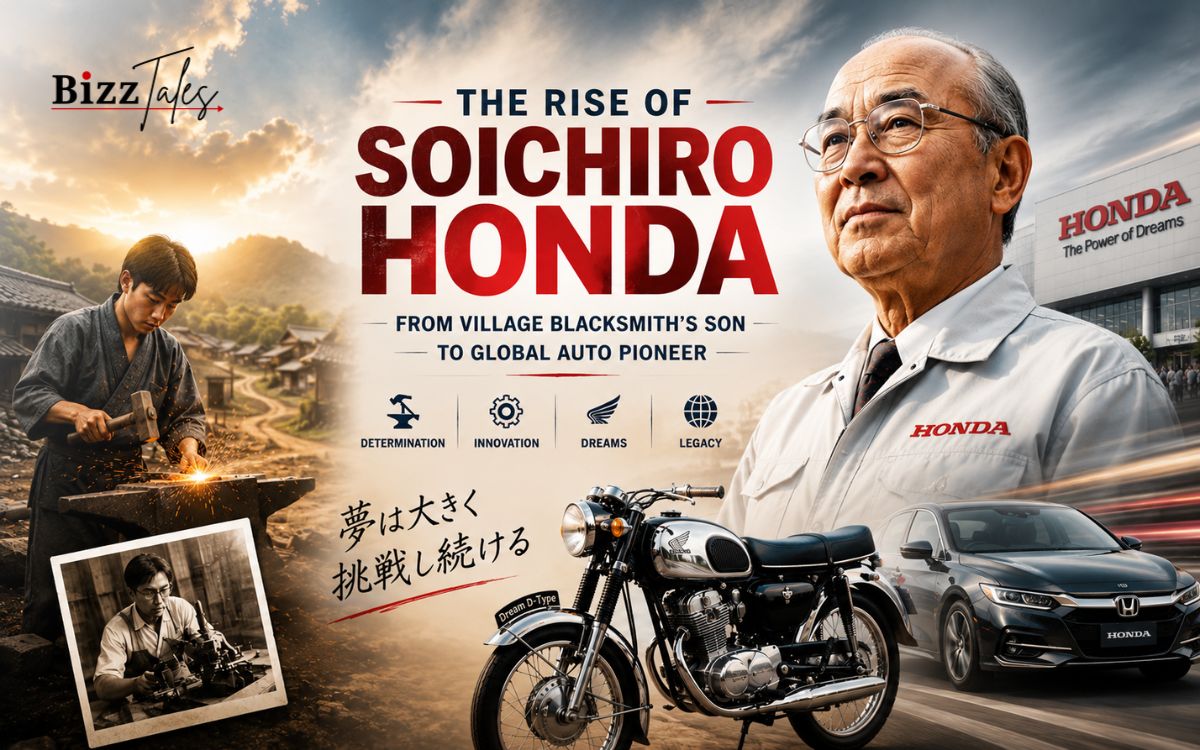
Soichiro Honda had humble beginnings. He was born in a rural village in Japan, and was the son of a bicycle repairman-an occupation he knew well. Honda was interested in the tools and machines as a child, and was not keen on the conventional school route that most prominent business owners take.
Born in a small village to a humble mechanic, his success story, from then on, was nothing short of inspiring. From birth, he struggled, was rejected then was successful. His story is one of determination to succeed, even when faced with failure, destruction and rejection.
Here’s the remarkable tale of Soichiro Honda, and how he went on to create a worldwide automotive empire from modest roots.
Early Life in Rural Japan
Soichiro Honda was born on 17, November 1906 in a tiny Village called Komyo situated near Hamamatsu in Japan. Soichiro Honda son of Gihei Honda who was a blacksmith and Bicycle repairman. His motherlike Honda was a very good Weaver.
As a child Honda helped repair machinery and bicycles for his father in the Japanese town where he grew up. He was always curious about motors; eager to take them apart and learn how they functioned; and was especially interested in mechanical devices.
One separate occasion seemed to have a very deep effect on him. When Honda was just a young boy he saw the first car drive through his own village and he was mesmerized by the noise, smell and sight of this machine. All the other children saw a strange car, he saw the future.
His grades were not very good and did not really like school and academics. However, he was very hands on and curious by nature. He loved the workshops more than the classroom and engines more than books.
This interest in would eventually shape his entire life and career in engineering.
Leaving Home to Chase a Dream
15-year-old Honda. The Honda revolution. Honda was feeling ambitious; he decided to leave behind his humble Japanese hometown of Hamamatsu and venture north to Tokyo, in search of a job in the car industry.
It was a gamble. He didn’t have much money, he hadn’t had much education and he had no guarantees of making a living, but he was set on working with motors.
He landed an apprenticeship at Art Shokai, a highly regarded car repair company in Tokyo. His first job was sweeping floors, fetching coffee and taking orders for the more experienced mechanics. It might not have been that glamorous, but it was close enough to the machines he covets to give him what he wanted.
As time went he learned more than he could at school about engines and repairs and design of vehicles and gained facility in engineering that later proved worth its weight in gold.
By about his early twenty Honda was one of the shop’s most reliable mechanic.
Building His First Business
Having learned at Art Shokai, Honda set up a branch on his return to Hamamatsu.
Business became so popular that they’ve made a name for their excellent work in repairs and their creativity in modification’s to their Honda’s. Honda’s ingenuity in engineering brought people from far away to get theirs done at this shop.
His achievements as a mechanic pushed him to think bigger ideas. He aspired to making car parts rather than repairing cars.
Ever eager to innovate, he created the company, Tokai Seiki, which developed and marketed piston rings.
This was Honda’s first entrepreneurial venture and would be his first major failure.
Rejection from Toyota
Honda has spent a great deal of time and money in ensuring that he makes OK piston rings for companies that produce cars. Believing he has produced a quality batch, he then approaches the motoring conglomerate of Japan, Toyota.
The outcome was catastrophic.
His piston rings were rejected by the manufacturers, they failed to meet the desired standards and after all that years of hard work seemed to have been for nothing.
For most entrepreneurs, that was the end of the road. Honda, however, regarded it as a valuable lesson.
He went back to school, where he pursued studies in metallurgy & engineering principles, and he worked tirelessly to perfect his products. He continued to make adjustments to his design & production techniques, and he landed a contract with Toyota.
The experience provided him one of the most important lessons of his life: failure is only something you have, along the road to success.
War and Destruction
When the demand for Honda’s manufacturing venture started increasing, World War II also came and upended all the plans.
Tokai Seiki entered the war. It supplied machining products related to wartime.
The war, however, put the company through great hardships.
Much of Honda’s factory installations were damaged in the American bombing raids over the country. It was a heavy damage and made production more and more difficult.
Adding insult to injury, an earthquake subsequently obliterated whatever evidence still survived.
One of the most painful things about this was how vast a setback this really was. Decades of effort were reversed in a relatively short time.
Instead of starting from scratch right away, Honda peddled away the remains of his firm to Toyota and explored new possibilities.
This was one of the low points in his career.
The Birth of Honda Motor Company
After the Second World War, Japan continued to have many shortages. Common people had trouble getting around because of lack of gasoline.
Monetary union Honda realized the existing demand for cheap transport. He was then made to connect small motors to bikes using excess generator engines from the armed forces.
The concept was met with great enthusiasm.
There was a market demand for functional modes of transportation and Honda’s motorized bicycles fit the bill.
He identified this opportunity as Honda, and managed to found the Honda Technical Research Institute in 1946 (eight years earlier than the world admittance of this company). On 1948, (two years later) he founded Honda Motor Co. Ltd. In Hamamatsu, Japan.
Honda attempts to captivate the crazy American market with (relatively) cheap but effective motorcycles and cars, initiated with few resources and your unending passion.
The Rise of Honda Motorcycles
Honda chose to develop bikes before cars as they cost less to produce.
His knowledge in engineering enabled him to engineer a product that was robust, high performance and low cost.
A new innovation was the new series of dream bikes. This line of bikes was an immediate hit throughout the whole of Japan.
Honda’s focus on innovation and quality primarily is the company’s success over rivals. Business experiences accelerated growth and the sales of motorcycles increased.
By the 1950’s Honda became Japan’s number-one motorcycle producer.
A lot of it was not to do with the engineering. Honda were also ahead of their time with their new marketing techniques, and also by expanding abroad; they started to build up a world presence.
Entering the Global Market
A number of Japanese businesses recently concentrating on regional markets. However, Honda felt believe differently.
He also saw the necessity of expanding globally if he were to have real long-term success.
Since Honda entered the U.S. In 1959 one of the most competitive markets in the world, “some in the industry even questioned whether a Japanese motorcycle company would be able to survive in the face of Western competition.”
Though, Honda’s products provided reliability, cheapness and economy in both price and consumption, so the brands became popular with consumers.
The well known “You Meet the Nicest People on a Honda” campaign was successful in changing public attitude towards motorcycles, and also brought in new market segments.
The sales soared, and Honda became an international brand.
It was a milestone on the road of the company’s success.
Expanding into Automobiles
Despite Honda triumphing with motorcycles, the original Soichiro Honda still had his heart set on automobiles.
The company launched its first car in the 1960s and had fierce rivalry form hugely successful local firms like Toyota and Nissan.
As for Honda…many analysts wondered if Honda would even get its foot in the door.
Honda managed to do it once again in disproving the critics.
The company pioneered a range of ‘new-generation’ cars, latter being praised for high quality engineering, low pollution and economy. Civic and Accord were sold worldwide and became resounding commercial successes.
Consumers began to buy cars which offered fuel economy during 1970s oil crisis. Honda was providing such vehicles.
The company continued to gain reputation and in no time helped Honda acquire one of the best brands in the world.
Challenges and Setbacks Along the Way
Although Honda’s success was unprecedented, there were never absent of tough problems in his hand
He endured numerous business failures, destruction in war, financial instability, manufacturing problems and cut-throat competition.
- His first piston ring project almost failed.
- His factories were broken out because of bombing, earthquake.
- His new product applications are sometimes difficult to get acceptance.
Honda continues to struggle to establish itself even after reaching international thresholds from its home country.
Honda still has to struggle with pressure from their larger competitors
However, he thought differently about setbacks than most entrepreneurs. Instead of being afraid of failure, he considered it an integral part of learning.
This attitude became one of the defining trademarks of the man and his organization.
Leadership Philosophy
Soichiro Honda held that new ideas need the opportunity to be tried out, explored and refined, and that this process necessarily involves taking risks:
He motivated employees to think outside the box and develop innovative ideas.
And whereas most businessmen disappeared what Honda was strongly interested in engineering and designing special product. He didn’t care corporate management so much but quite demanded good technical requirements.
A well known saying of his was that “200 work that only 1 Percent of 200 success, the other 99 Percent is failure “, refers to his attitude on entrepreneurship.
It led to a corporate culture that was rooted in the pursuit of working productively in a more continuous and innovative way.
Retirement and Legacy
In 1973 Soichio Honda was no longer directly involved in the running of the company.
Despite his deviation from everyday running’s, the driving force was still deeply grounded in Honda culture.
He held on to promoting innovation, engineering excellence and environmental responsibility throughout all he loved.
October 2023.22nd of March 1886 until 5th of August 1991.1991 and he left behind one of the most successful industrial enterprises to have ever existed in history;
His company expanded all over the world and still is one of the leading companies in automobiles, motorcycles, robotics and other high- technologies.
Conclusion
The Life and Legacy of Soichiro Honda begins long before the history of the successful corporation it creates. Born to modest conditions, Honda would rise to become one of the most influential engineers of his time, forever changing the world of automation.
His growth has been driven by fearlessness, perseverance and an inquisitive mind. His failures include bearish downtrends, bombings of London during the second world war, bankruptcy and continual failure. However, these made him even more ambitious.
Honda vehicles are now driving on the roads throughout the world. They are living tribute to the miraculous life of a single man. Soichiro Honda defined failure not as fleeing from failures but not admitting defeat when facing them.
His legacy still inspires entrepreneurs, engineers and innovators all over the world.
FAQs
Who was Soichiro Honda?
Soichiro Honda was a Japanese engineer, entrepreneur and founder of Honda Motor Company, one of the world’s largest producers of automobiles and motorcycles.
What was the catalyst that pushed Honda to start his career in the car industry?
As a child he became interested in mechanics when he saw a car for the first time and helped in his father’s bicycle repair shop.
Did Soichiro Honda encounter business failures?
Yes. He was turned down at first by Toyota for his piston ring venture, and he had his factories blown up by war and Hezekiah.
When was Honda Motor Company founded?
Regardless of the name Honda the company was formally founded in Japan in 1948.
What is the reason for Honda’s global success?
Honda won because… Of the quality in engineering, fuel efficiency, reliability, innovation, and worldwide expansion.
Which do you think is Soichiro Honda’s greatest legacy?
His most lasting legacy is his role in establishing Honda as a world leading car manufacturer and inspiring generations by his persistence, creativity and hope that “failure is the cornerstone of success”.