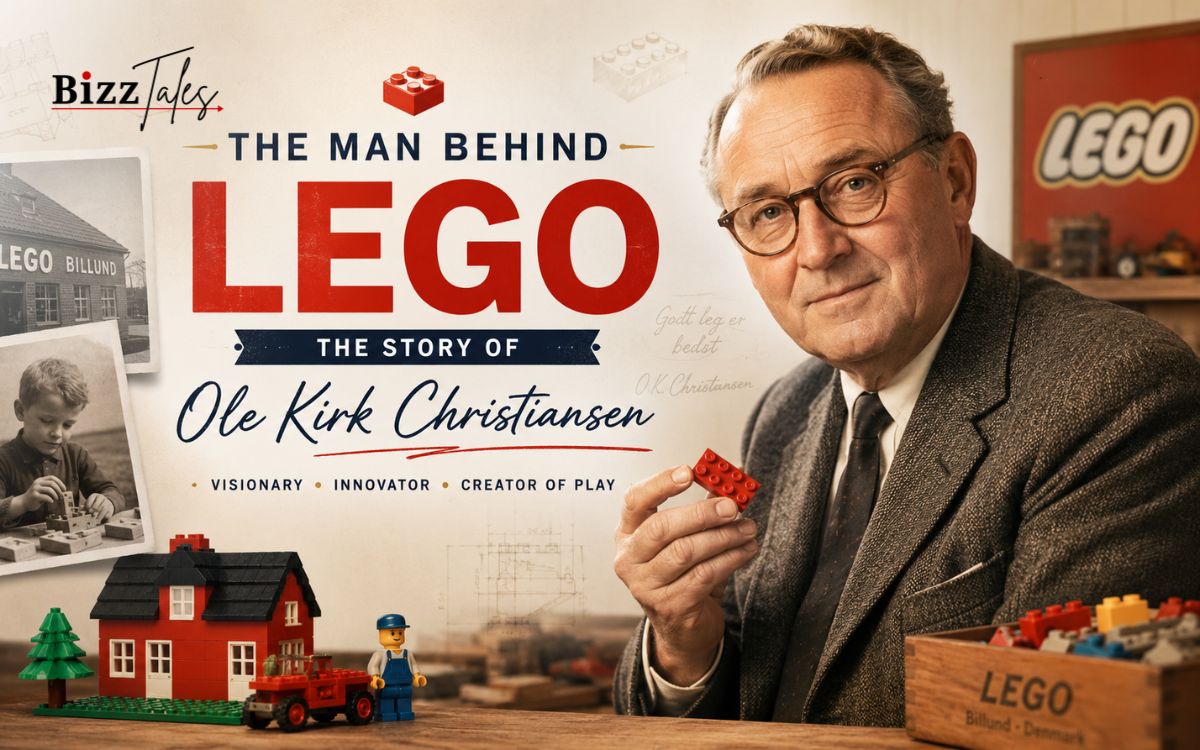
Nowadays, LEGO is one of the most well-known toy brands across the Globe. People of all ages use their tiny plastic bricks to create ideas of houses, cities, spaceships and even buildings. However these toys are not only fun, but they are also a huge achievement that would have been impossible without a leader who has gone through thick and thin, Ole Kirk Christiansen.
Long before LEGO was a multi-billion dollar enterprise, it was just an idea in the mind of Ole Kirk Christiansen, then a humble Danish carpenter who couldn’t manage to generate a living for his family during hard economic times. His story is not just about establishing a toy business; it is a story of endurance, farsightedness and how failure can be a blessing in disguise. After experiencing factory fires that crippled production, financial difficulties and funeral shocks, Christiansen was every sure to hang his shoes and call it quits, but he endured and established a timeless brand.
This is the incredible story of the man who founded LEGO and how his vision transformed the toy business.
Early Life of Ole Kirk Christiansen
Born on 7th April 1891, Ole Kirk Christiansen, was a native of Filskov-a tiny village in Denmark. As he was part of a humble farming family, he was brought up learning the nitty-gritty of farm work of which the children of most under-privileged families were a part of.
Christiansen’s childhood was marked by a deep fascination with craftsmanship. He learned woodworking and subsequently trained as a carpenter. By the time he was an adolescent, he had earned a reputation as a talented craftsman. Early in his career, he worked on building sites and became familiar with the ideas of a building being only as good as its craftsmanship, a concept to which the Lego brand would pay much attention in the future.
Following his apprenticeship, Christiansen left Denmark for a time and traveled around the country and abroad to gain more experience before establishing his own business.
Building a Carpentry Business
In 1916 he bought a woodworking shop in Billund, Denmark. At the time Billund was a tiny, impoverished rural village with very little to offer in terms of job opportunities, so he began to manufacture furniture, ladders, doors and furnishings for the home.
The business started on a good note and Christiansen became well known in the community. Christiansen’s obsession with quality set him apart from competition. Customers were pleased with the craftsmanship and reliability of his work.
However success was not a permanent thing. The unstable economic environment, market changes and the arrival of the Great Depression brought serious problems for European small furniture business. The demand for furniture dropped considerably and the business started to have difficulties for profit under Christiansen’s authority.
The recession hit him hard and forced him to reestablish his strategy in search of a new business.
Personal Tragedy and Financial Hardship
Christiansen’s most difficult years came in the 1920s and early 1930s. His wife died in 1932, leaving him with four young boys to take care of on his own. The pain from the loss would have been overwhelming for Christiansen.
Meanwhile, the world economic crisis struck the carpentry business hard too. For some time the orders dwindled, his income decreased and he faced the financial difficulties. Under these conditions most of the entrepreneurs would lose their endeavors.
Christiansen searched for ways to adapt instead. He knew that he needed to innovate in order to survive. Instead of keeping his focus on traditionallinewoodworking he started purchasing on a smaller scale and at a lower price. He offeredfamily-centeredlinewoodworking products.
This would have ultimately been the decision to change his life forever.
The Birth of Wooden Toys
As Christensen’s furniture sales faltered, he began to manufacture wooden toys. Early on, the toys were simply an additional source of revenue. He realized that even during tough economic times, the toy sales were not drastically affected
Parents were also prepared to part with some modest sums of money in order to bring happiness to his children. Knowing that he had something to offer in this respect, Christiansen, more than any other, began to turn away from furniture production to that of making toys.
His toys: woods ducks, cars, trucks, banks, pull-around animals.. Quickly became appreciated for high quality and consistency of design.
Each toy had to achieve a high degree of quality and would not allow cuts to be made on the count of parts but in quality even in hardest financial times. The quality of his toys was one of the characteristic features of his firm.
The Creation of LEGO
In 1934, Christiansen started naming his fast-expanding toy business. He asked staff, friends and family to come up with suggestions.
Finally he chose the name LEGO, which comes from the Danish words Leg Godt. Meaning Play Well.
The name was spot on. He felt that toys should go far beyond entertainment. They should inspire education, create and foster imagination.
What is more surprising is that years after, the word LEGO can also be translated to “I put together” in Latin, again quite valid in relation to the brand’s future produts.
Finally the LEGO brand was established, but its greatest innovations were still to come.
Disaster Strikes: Factory Fires
Christensen experienced the most vivid chapter in his life, a batch of disastrous factory fires.
In 1924, the workshop and much of the stock was destroyed by a fire accidentally started by his sons.
Numerous individuals advised Christiansen to close up shop. He re-established the factory, and also increased the number of employees.
Sadly in 1942, another devastating fire destroyed the factory. This could have been one of the worst fires yet, destroying factory and years of work and money.
For a second time, Christiansen was at a crossroads. His options were to pack up and walk away or try again.
And it was he who decided to start from scratch.
This unflinching commitment was to mark his legacy.
Embracing Plastic and Innovation
After the war, new ways of manufacturing were created thanks to the progress of technology. The most important innovation was the invention of plastic molding.
1947 Christiansen took the first daring and controversial step. He used the investment, and far sighted capital from his former company, to purchase a plastic injection moulding machine.
The general consensus was that people would prefer traditional wooden toys to those made of plastic. There was a feeling that consumers might not warm to plastics’ idea.
And calmly dismissed the doubts.
He was convinced that the future was with the more flexible creative products.
His ‘openness towards change’ went on to revolutionize the toy industry.
The Birth of the LEGO Brick
LEGO launched a new product in 1949, theAutomatic Binding Bricks.
The firstplastic bricks were developed as a variation on an existing British toy design which had been altered to adapt them more successfully
The children would link the bricks together and create a variety of structures. This differed from conventional toys as there was no specific reason for the bricks.
While sales were initially slow to arrive, the Christiansen was aware of their potential,
He carried on improving the design and spent a lot of money on research and development. His idea was to integrate play across the entire system so it was possible to combine various pieces.
In development of the modern LEGO brick.
Challenges and Skepticism
This shift from wood to plastics wasn’t begun without difficulties.
The retailers were not clear about the new products. People still wanted the natural wooden toys and some even doubted the strength of the plastic toys.
The company had financial issues. There were large expenses for the plant and product development withhigh risk.
However, Christiansen never gave up on his dream.
He had a lot of patience. He had a lot of persistence. I kept thinking, “Instead of trying to find many quick gains, you have to find the one that sticks that will last you a long time.
His persistence finally started to work as he promoted awareness of the LEGO brand.
The Rise of a Global Brand
By 1950s, the plastic bricks of LEGO were famous. The innovative ways of playing such as quality, consistency, creativity of LEGO painted out from other competitors.
On the other hand, now a newer generation entering the business, the son of the famous Christensen, Godtfred Kirk Christiansen, became more involved with the operations and helped to broaden the idea of the LEGO System of Play.
The two then concentrated on designing products intended to be played with repeatedly and built upon, in order for children to be able to grow and develop their creations.
This strategy changed LEGO from a manufacturer of toys into a creative environment.
With the increasing international demand for the product, LEGO started to expand into overseas markets. Its reputation for quality and continual innovation attracted customers from everywhere.
From humble beginnings in a small Danish workshop, it was really beginning to spread across the world.
The Final Years of Ole Kirk Christiansen
For decades, Ole Kirk Christiansen put a great deal of time and effort into making LEGO a well-respected firm in the midst of apparently insurmountable barriers.
Sadly, he didn’t live long enough to see the extent of LEGO in the future.
He was 66 years old when he died on 11th March 1958.
By the time of his death: Afterall he had done enough for the development to start following! His principles and values of fulfilling vision and quality of work has now become part of company culture.
His son took over the business and expanded it and today LEGO is one of the world’s largest toy makers,
The Legacy of the LEGO Founder
Since then, LEGO products are available in over 100 countries around the world and reach out to a wide variety of consumers through various needs and demands.
The effectiveness of the company is still relevant to Ole Kirk Christiansen. Hence their development and manufacture heavily relies on his well-known maxim that “Only the best is good enough”.
His journey shows us that wonderful businesses cannot emerge in a day. They can only come about if you persist in innovating, moving forward, overcomes failures till the emergence of a great business.
From navigating economic depression and personal tragedy to rebuilding after ravaging fires and embracing new technology, Christiansen continually transformed adversity into opportunity.
His story is one of the most inspiring entrepreneurial journeys in the history of business.
Conclusion
Ole Kirk Christiansen is a lot more than just a story about a toy manufacturer. It is one of perseverance, foresight and innovation. He turned a failing carpentry business into one of the most famous brand names the world has ever seen.
His ascent was driven by craft, single-mindedness, attention to the highest standards. His decline was driven by national depression and personal tragedy. But each one surged forward toward greater heights.
The influence of Ole Kirk Christiansen is still felt today, more than 60 years after his death. Every LEGO brick is a testament to his perseverance and drive to succeed.
FAQs
Who was Ole Kirk Christiansen?
Ole Kirk Christiansen was a Danish carpenter and businessman who created a small wooden toy company called LEGO and turned it into one of the largest toy companies in the world.
Any idea what is LEGO all about?
The word LEGO is actually an abbreviation of the Danish phrase “Leg Godt”, which means ‘Play Well’
What kind of business was Ole Kirk Christiansen running before LEGO?
Prior to designing the famous LEGO bricks, Christiansen ran a carpentry business where he built furniture, doors, ladders, etc.
What difficulties did Ole Kirk Christiansen encounter?
Time and time again the factory was burnt down, and he went bankrupt because of the Great Depression, he lost his wife, and the factory…
The history of LEGO begins in the year 1958.
LEGO’s first interlocking plastic bricks, known as Automatic Binding Bricks, were released in 1949.
What makes Ole Kirk Christiansen a figure significant to business history?
He is renowned for taking a small woodworking business and making it a worldwide brand showing strength, determination and innovation and an unswerving pursuit of quality.