Today, Artificial Intelligence is one of the fastest-growing industries in the world and it is generating hundreds of thousands of new job opportunities in various sectors such as software development, healthcare, finance, education, manufacturing, digital marketing, cybersecurity and business operations. Due to high investment by businesses of all sizes in the AI industry to optimize efficiencies and make smarter business decisions, the cost of hiring AI labor has plummeted.
The positive thing is that you don’t need doctorates or many years of experience anymore to jump in. With online courses and industry recognized certification programs, students and bright new graduates can develop hands-on skills in AI from home and boost their employment prospects for lucrative careers. However, given so many options available online, selecting the right certification can be perplexing.
I see many beginners wasting dollars on worthless certifications. The other common mistake is investing time in courses that are too theoretical and not enough hands-on. Currently employers want people who know how AI tools operate, understand the basics of ML, know how to tackle business issues and are hungry to keep learning as the tech develops.
This article will give you an idea about the most preferred AI certifications for fresher in 2026, that employers look for and shows you which training/certification best suits your career aspirations.
The importance of AI Certifications in 2026
No longer are we talking of AI being used only by tech firms. Now banks use AI for anything from fraud detection, Hospitals employing it to support doctors, retailers analyzing their customer base using machine learning (another term for AI), manufacturing companies operating intelligent machinery to make production more efficient and marketing agencies deploying AI to create content, evaluate marketing campaigns and customer service.
Since AI is spreading over most industries, there is a demand of individuals who can relate it to business scope effectively. For a fresher, having certifications can be a prove of their eagerness to learn new technologies and their familiarity with industry acquaintance.
Although earning a certificate may not in itself unlock a job, it can help enhance your CV when supplemented by projects, work experience and critical thinking.
Skills Employers Expect from AI Beginners
Before selecting any certification, you need to assess what the industry actually demands. Generally, entry level AIs require an understanding of machine learning concepts, data analysis, prompt engineering, Python and AI ethics and cloud-based AI services. Familiarity with ChatGPT, GitHub, Google Colab, TensorFlow, Microsoft Azure AI, AWS AI and generative AI platforms would be an added advantage.
Communication skills are also very important. Trainers want to see workers able to communicate machine learning solutions to a non-technical audience and work in teams understanding the business needs instead of just coding.
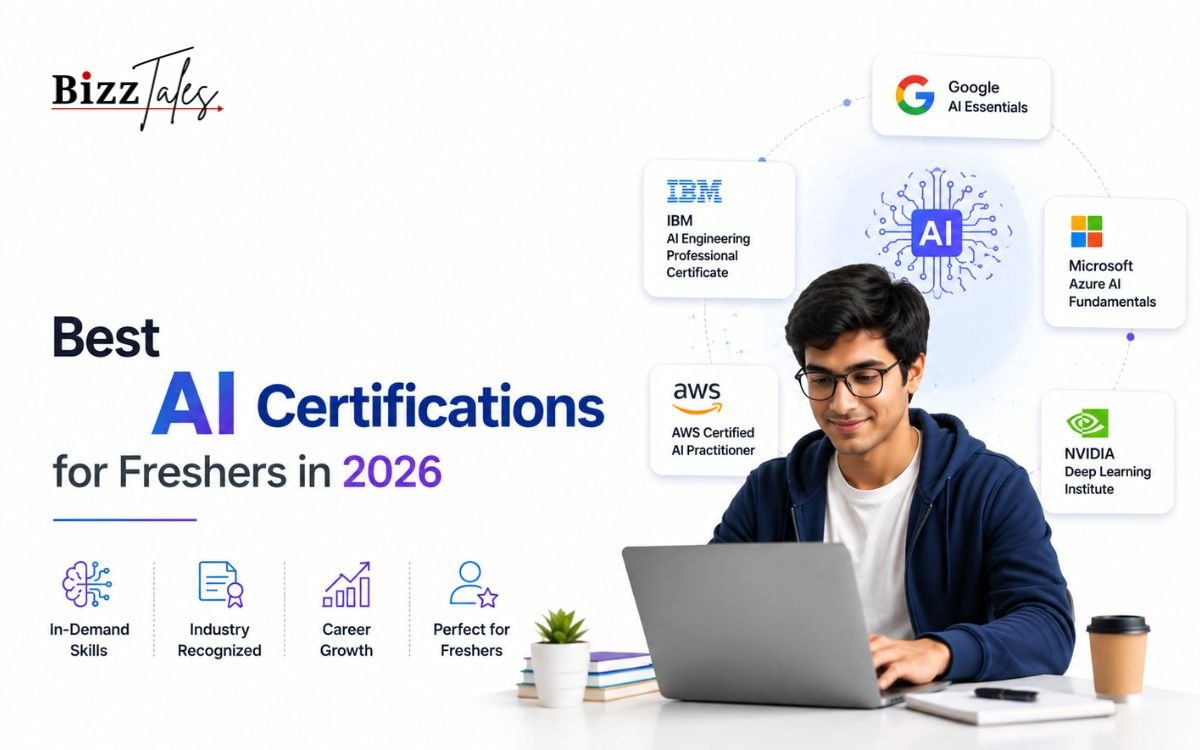
Google AI Essentials
Google AI Essentials is definitely one of the easiest certific…
It is very suitable for everyone who is new and has no or very little experience in AI topics. The ideal characteristic of this certification is that it does not require too much mathematics.
Learners are introduced to generative AI and responsible AI usage, prompt writing, productivity tools for the workplace, and practical AI tools to use in everyday life. As one of the world leading technology organizations, Google is highly trusted – so this certification is highly respected in the job market.
This certification provides a perfect entry point if freshers like to know about applications of AI in business scenarios.
Microsoft AI Fundamentals (AI-900)
Microsoft’s AI-900 certification is among the most recognized beginner AI certifications on the market. It covers fundamentals of AI introduction along with details of machine learning, computer vision, natural language processing, and conversational AI using Microsoft’s Azure platform.
The certification is fine for someone not experienced in programming since it emphasizes an understanding of AI services rather than building complex machine learning models.
As thousands of organisations around the world use Microsoft technologies, this certification can enhance the employer appeal of applications for internships, graduate schemes, and technology entry-level roles.
AWS Certified AI Practitioner
As the world’s largest cloud computing platform, Amazon Web Services is home to more and more AI deployments industry-wide. The AWS Certified AI Practitioner validates the knowledge of anyone new to AI and machine learning and covers concepts of generative AI and AI ethics common to implementations on AWS.
For freshers starting out in the field of cloud computing, AI infrastructure or enterprise technology, this certification provides excellent exposure to one of the most commonly used cloud platforms.
Cementing a good knowledge base for when you progress onto further AWS certification.
IBM AI Developer Professional Certificate
IBM has dedicated significant resources to artificial intelligence, including its Watson platform and enterprise AI services. The AI Developer Professional Certificate from IBM integrates theoretical learning with immediate practice, enabling participants to develop practical skills while gaining insight into the process of creating AI systems.
It covers fundamentals of Python programming, machine learning, deep learning, APIs, generative AI and model deployment. The project-based learning makes this certification particularly valuable as employers are now looking beyond theoretical knowledge and value practically proven work.
DeepLearning.AI Generative AI Courses
DeepLearning.AI has emerged as one of the most renowned providers of AI education. Established by AI expert Andrew Ng, the course provider offers specialised courses in generative AI, prompt engineering, large language model and building AI applications.
The certifications are aimed at students who already have a strong grasp of core Artificial Intelligence concepts and wish to evolve and specialize as practitioners in the application of current generative AI technologies shaping the future of business around the world.
As more and more companies use AI assistants and automation tools, experienced gained through these programs will become more and more useful in the job market.
NVIDIA Deep Learning Institute Certifications
NVIDIA is a big player in the AI space. Its specialization is the design of graphics processing units (GPUs) that are used for building complex AI systems. The Deep Learning Institute by NVIDIA conducts hands-on training in deep learning, computer vision, accelerated computing, and generative AI.
Even though some certifications are technical, by doing them, a beginner interested in machine learning or AI engineering could experience the technologies of the industry. The ones used by researchers or big tech companies.
Understanding of NVIDIA platforms is especially relevant in advanced computing and artificial intelligence where models are trained.
Choosing the Right Certification
Click-throughs are not necessarily the best way to prepare for every certification. Learners who are new to coding or programming will likely benefit from beginning with Google AI Essentials or Microsoft AI Fundamentals prior to pursuing more technical certifications.
Persons wishing to work as software developers should learn the basics of Python programming step by step in conjunction with the principles of machine learning. Persons thinking of working on cloud computing should focus initially on AWS or Microsoft Azure certifications. Researchers interested in working in Artificial intelligence might transition to more advanced courses in the future relating to deep learning, neural networks and computer vision.
Don’t rush to learn many certifications; it’s better to become proficient in one program and then use those skills in real-world projects.
Build Projects Alongside Certifications
A certificate gains much more significance along with practical work. Employers prefer to check exactly how the individual utilized his/her knowledge rather than checking the number of certificates he/she has.
Using free development tools novices can develop AI chatbots, image classification projects, document summarisation tools, recommendation systems and websites powered by AI. Submitting their projects on GitHub and building a portfolio enhance their career benefits dramatically.
The best way to demonstrate to recruiters that you can put AI to use is by gaining hands-on experience rather than taking a bunch of online courses.
AI Careers After Certification
As the number of AI beginner courses is growing steadily, the gateway in through entry-level jobs also opens wider. Those are AI associate, Machine learning intern, Data analysis, AI support, Prompt engineering, Business intelligence analyst, Junior data scientist, AI product associate, Cloud AI engineer.
Several institutions employ applicants familiar with AI solutions in fields such as marketing, finance, health, education, cybersecurity, and operations even without having artificial intelligence in their job titles.
With more experience, one can become a machine learning engineer, an AI research scientist, a robotics engineer, a computer vision or natural language processing expert, or an AI solutions engineer.
Conclusion
Artificial Intelligence is emerging as one of the hottest skills for the jobs of the future and more learning opportunities await in 2026 than ever before. Freshers don’t need to wait for years of experience before they start an AI career. Students can acquire industry leading certifications from reputed providers like Google, Microsoft, AWS, IBM, NVIDIA and DeepLearning.AI that create sound bases for tomorrow’s well-paid jobs in various industries.
But remember, your focus on certification is only the start of your learning. Employers are more interested in soft skills like problem solving, communication, ability to learn new concepts than certifications. If you can pair industry-recognized certifications with individual projects, internships and real-world experience, you’ll have a huge leg up in one of the world’s fastest-growing career paths.
FAQs
Which AI certification is best for complete beginners?
Google AI Essentials and Microsoft AI Fundamentals (AI-900) are some of the best entry points, as they involve little to no previous experience in AI.
Do I need coding skills before learning AI?
Not at all. Several beginner certifica ions present information about AI, which do not require being a programmer. Once learned, being familiar with Python opens several doors for you.
Are AI certifications enough to get a job?
Having certifications is a bonus for your CV, but employers will also look for some repositories, developed skills, use of search engines,… that give proof you are codish to last in the job.
Which AI certification has the highest industry value?
Microsoft AI Fundamentals and AWS AI certifications, IBM AI Professional Certificate, Google AI courses and DeepLearning.AI courses are very well recognized by companies.
Can non-engineering students learn AI?
Yes, students from commerce, arts, management, science, or other backgrounds can pursue initial AI certifications and develop their technical skills over time in line with their career objectives.