
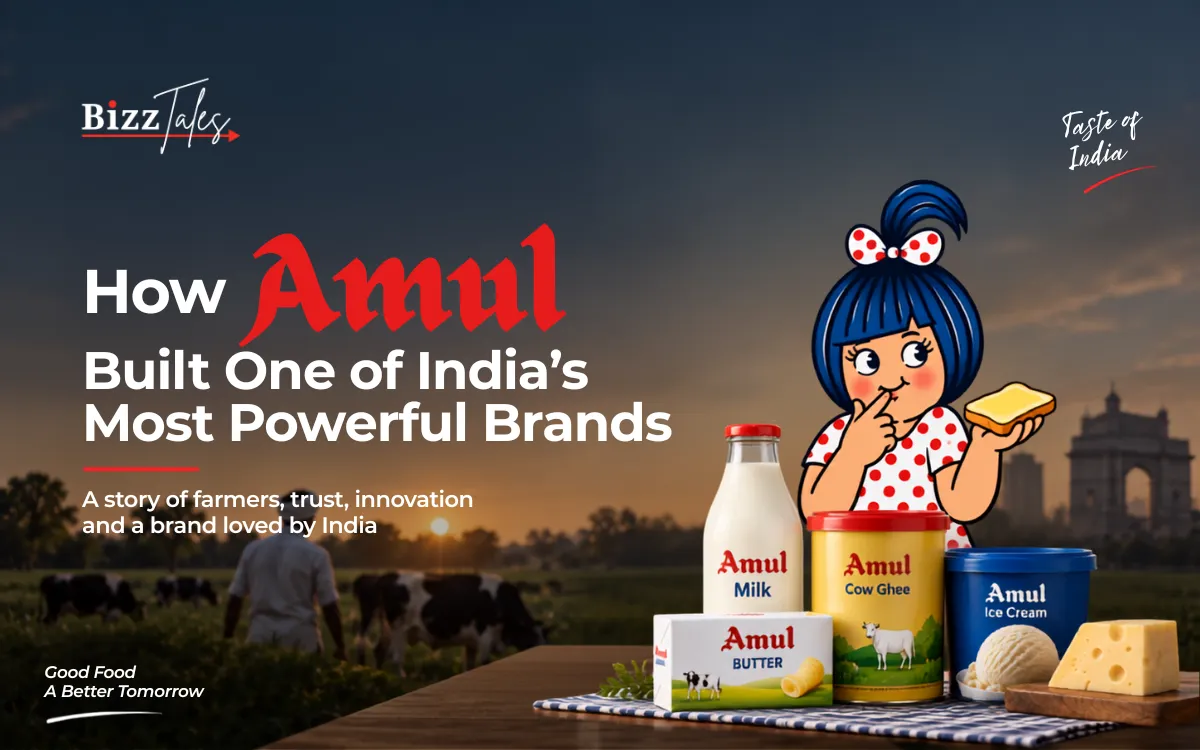
What if one of India’s most powerful brands was built not by a billionaire, a multinational corporation, or a celebrity—but by farmers?
That is what makes the Amul brand story so fascinating. What started in 1946 as a farmers’ cooperative in Gujarat eventually became one of India’s most recognisable consumer brands. Today, Amul is associated with milk, butter, cheese, ghee, ice cream and several other everyday products.
But Amul’s success was never just about selling dairy products. It came from combining a unique cooperative structure with professional management, strong distribution, affordable pricing, product diversification and one of the most memorable advertising strategies in Indian business history.
The Amul success story offers an important lesson: a powerful brand is built not only through marketing, but through a business system that consistently delivers value.
The Beginning of the Amul Brand Story
Amul’s journey began in 1946 in Kaira district, Gujarat, where dairy farmers faced an unequal marketplace and depended heavily on intermediaries to sell their milk. The cooperative movement gave these farmers an opportunity to collectively organise milk collection, processing and marketing.
Tribhuvandas Patel played a key role in organising the cooperative, while Dr. Verghese Kurien later helped transform it into a professionally managed dairy enterprise. This eventually became associated with the Anand Pattern, a cooperative model in which farmers owned the organisation while professional managers handled its operations.
This structure was significant because it connected the interests of producers with the growth of the business. Farmers were not simply suppliers to a company; they were part of the cooperative system itself.
That idea became the foundation on which Amul’s larger business was built.
Understanding the Amul Business Model
The Amul business model operates through a three-tier cooperative structure.
At the village level, dairy farmers are organised into cooperative societies that collect milk from producers. These societies connect with district milk unions responsible for activities such as milk procurement, processing and related operations.
The member unions work through the Gujarat Cooperative Milk Marketing Federation, or GCMMF, which markets products under the Amul brand.
This structure created a strong link between milk producers and consumers. It also helped build an organised supply chain capable of handling dairy products at scale.
For business students and entrepreneurs, this is one of the most interesting aspects of Amul. Its competitive advantage was not created by advertising first. It was created by building an operating model that could support a large consumer business.
Operation Flood and the White Revolution
Amul’s growth also became part of India’s much larger dairy transformation.
In 1970, the National Dairy Development Board launched Operation Flood, a major programme aimed at strengthening India’s dairy sector. The programme expanded cooperative networks, improved milk procurement and processing infrastructure, and connected rural milk producers with urban markets.
Operation Flood was implemented in three phases and continued until 1996. It helped create a stronger national dairy ecosystem and played an important role in India’s White Revolution.
For Amul, the development of this infrastructure created an opportunity to take the cooperative dairy model beyond its original regional base and serve a much wider consumer market.
The lesson for modern businesses is clear: great brands need strong systems behind them. Marketing can attract customers, but infrastructure and operations determine whether a company can serve them consistently.
Distribution: Making Amul an Everyday Choice
One of the biggest reasons behind how Amul became successful is its distribution network.
A consumer brand becomes powerful when people can easily find it. Amul expanded its presence across a wide range of retail markets, making products available where consumers regularly shop.
This was especially important for dairy. Milk is a frequent household purchase, while products such as butter, cheese and ghee create additional buying occasions.
As consumers repeatedly encountered Amul products, the brand became part of everyday consumption. Distribution therefore did more than move products from factories to shops—it helped build familiarity.
This is an important business lesson: availability itself can become a source of brand strength.
Amul’s Pricing Strategy: Winning Through Value
Amul has traditionally focused on serving a broad consumer market rather than positioning itself as an exclusive premium brand.
Its proposition combines accessibility with dependable quality. This is particularly effective in India, where consumers are often highly conscious of price but still expect products they can trust.
The distinction between being affordable and being cheap is important. Competing only on low prices can weaken a brand’s perceived value. Amul’s stronger proposition has been to make consumers feel that its products offer a sensible balance of price and quality.
This mass-market positioning helped Amul become a brand that could fit naturally into everyday Indian households.
From Milk to a Diverse Product Portfolio
Amul’s growth also came from moving beyond its original core product.
Over the years, the brand expanded into categories such as butter, cheese, ghee, milk powders, paneer, ice cream, flavoured milk and chocolates.
Product diversification gave Amul access to different consumer needs and occasions. A household might purchase milk regularly but choose butter for breakfast, cheese for cooking and ice cream for an occasional treat.
More importantly, Amul could introduce new products under an already familiar name. Instead of building consumer awareness from scratch for every category, the company could use the trust and recognition associated with the Amul brand.
This helped transform Amul from a dairy product label into a broader food brand.
The Amul Marketing Strategy: Advertising That Became Culture
If distribution made Amul familiar, advertising made it memorable.
The most famous part of the Amul marketing strategy is the Amul Girl, introduced in the 1960s. The campaign became known for topical advertisements that commented on current events, politics, sports, films and popular culture through humour and clever wordplay.
Rather than constantly telling consumers to buy butter, Amul found ways to participate in conversations that consumers were already following.
That difference was crucial.
An advertisement about a current event could attract attention even from people who were not actively thinking about dairy products. The brand therefore became part of popular conversation instead of remaining limited to the supermarket shelf.
Why the Amul Girl Created Brand Recall
The Amul Girl became one of India’s most recognisable advertising characters because the campaign combined a distinctive visual identity with a consistent tone.
The advertisements changed according to the news and cultural moment, but the basic identity remained familiar. This allowed each new campaign to strengthen the memory of previous ones.
That is a powerful example of Amul brand strategy in action.
Brand recall is rarely created by one viral advertisement. It is built when distinctive brand elements are used consistently for years. Amul’s character, humour and visual style became long-term brand assets.
The strategy also showed that a brand can remain consistent without becoming repetitive. The identity stays familiar while the subject matter keeps changing.
Trust and Emotional Connection
Advertising may create awareness, but long-term trust comes from repeated product experiences.
For decades, consumers have encountered Amul products as part of everyday life. Familiar packaging, product categories and consistent brand identity have helped create a sense of reliability.
Amul’s cooperative roots add another dimension. The brand is connected with Indian farmers and the development of the country’s dairy sector, giving it a story that goes beyond product features.
Its long-standing positioning around the “Taste of India” further strengthened the connection between the brand and Indian identity.
As a result, Amul is not simply remembered as a dairy company. It has become part of India’s food culture.
What Entrepreneurs Can Learn From the Amul Success Story
The Amul success story offers several practical lessons for entrepreneurs and marketers.
Build the business before building the brand
A strong advertising campaign cannot compensate for poor products, weak operations or unreliable distribution. Amul’s branding was supported by a substantial dairy ecosystem.
Make your business model a competitive advantage
Amul’s cooperative structure is not just an organisational feature. It is part of the brand’s identity and differentiation.
Think beyond a single product
Once a brand earns consumer trust, that trust can support expansion into related categories. Amul used its established identity to build a much broader portfolio.
Create distinctive brand assets
The Amul Girl demonstrates the long-term value of recognisable characters, visual identity and tone of voice.
Stay relevant without losing consistency
Amul’s topical advertising changes with culture and current events while retaining the characteristics that make the brand recognisable.
Conclusion: How Amul Became Successful
So, how Amul became successful cannot be explained by advertising alone.
Its strength came from connecting multiple elements into one coherent system. The cooperative model created the foundation, dairy infrastructure enabled scale, distribution created availability, pricing strengthened mass-market appeal, and diversification opened new consumption opportunities.
Marketing then gave the brand a distinctive personality. The Amul Girl created exceptional recall, while years of consistent products and communication helped turn familiarity into trust.
The biggest lesson from the Amul brand story is that branding and business strategy cannot be separated. A memorable campaign may win attention, but a strong business model gives consumers a reason to stay.
Amul did both. It built an ecosystem around farmers and consumers—and turned that ecosystem into one of India’s most enduring and trusted brands.