
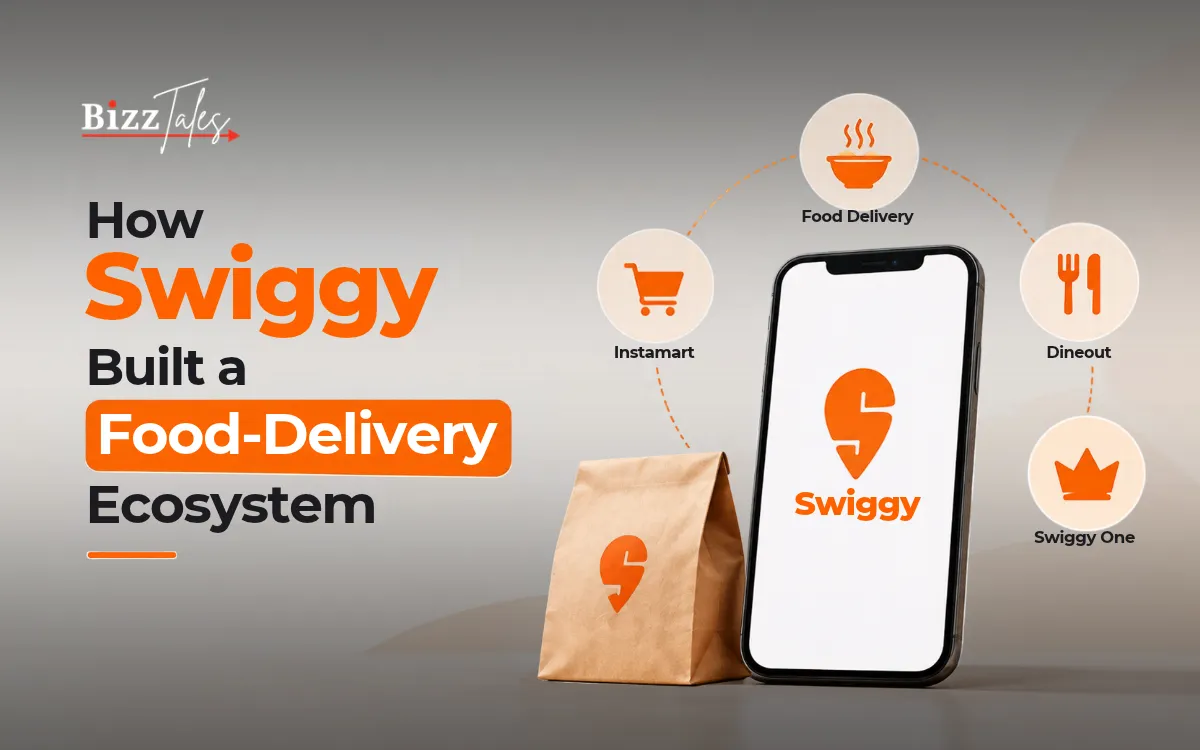
Swiggy is no longer just a food-delivery app. Over the years, the company has evolved into a broader food-delivery and convenience ecosystem, connecting consumers, restaurants, delivery partners, retailers and brands through a technology-driven platform.
From its food-delivery business to Swiggy Instamart, Dineout, Swiggy One and newer convenience services, Swiggy has built an ecosystem designed to capture multiple consumer needs within a single platform.
So, how did Swiggy build its food-delivery ecosystem, and what makes its business model work?
The Beginning: Solving Food Delivery
Swiggy launched its food-delivery business in 2014, entering a market where online food ordering was still developing in India. Its early strategy focused on solving a fundamental problem: making restaurant discovery, ordering and delivery more convenient.
Rather than simply acting as an online menu, Swiggy invested heavily in the complete ordering journey—from discovering restaurants and placing orders to tracking deliveries.
The company describes this as a full-stack approach, integrating the consumer experience with restaurant operations and its delivery network.
This approach helped Swiggy build an important competitive asset: a large network connecting customers, restaurants and delivery partners.
The Swiggy Business Model
At the heart of Swiggy’s ecosystem is its marketplace.
Customers use the platform to:
- Discover restaurants
- Browse menus
- Place and pay for orders
- Track deliveries
- Access offers and memberships
Restaurants receive orders through the platform, prepare the food and rely on delivery partners for last-mile fulfilment.
This creates a three-sided network:
Consumers → Restaurants → Delivery Partners
As each side grows, the platform becomes more useful to the others. More restaurants give customers more choice, more orders create opportunities for delivery partners, and a larger customer base makes the platform more attractive to restaurants.
Technology and Last-Mile Delivery
One of Swiggy’s biggest differentiators has been its investment in technology and logistics.
Food delivery is operationally complex. Orders have to be matched with restaurants and delivery partners while considering location, preparation time, traffic and customer expectations.
Swiggy therefore built technology around order discovery, delivery allocation, tracking and operational efficiency.
Its delivery network has also become a major part of the ecosystem. In FY2024–25, Swiggy reported more than 5 lakh delivery partners and nearly 2.4 lakh restaurant and brand partners.
This scale gives Swiggy a significant hyperlocal network that can support multiple services beyond restaurant delivery.
Swiggy Instamart: Expanding Beyond Food
The next major step was Swiggy Instamart.
Launched in 2020, Instamart moved Swiggy into quick commerce, allowing users to order groceries, household products and other everyday essentials.
The strategic logic was straightforward: the same consumer who orders dinner may also need milk, snacks, toiletries or other products.
Instead of building a completely separate customer relationship, Swiggy could use its existing app, technology and delivery capabilities to address additional everyday needs.
By FY2025–26, Instamart had expanded to 129 cities and 1,143 dark stores, according to Swiggy’s reported results. Its gross order value grew 68.8% year over year in that period.
This transformed Swiggy from a food-delivery company into a broader on-demand convenience platform.
Dineout: Connecting Online and Offline Dining
Swiggy also expanded its ecosystem in the opposite direction—from delivery to physical dining.
The company acquired and integrated Dineout in 2022, giving consumers tools to discover restaurants, make reservations, access dining offers and make digital payments.
This created another important use case:
At home → Food delivery
At the restaurant → Dineout
Instead of competing for only delivery occasions, Swiggy could participate in more parts of the consumer’s relationship with food.
Swiggy reported that its Out-of-Home Consumption business, including Dineout, delivered its first full year of positive adjusted EBITDA in FY2025–26.
Swiggy One: Increasing Customer Engagement
Another important component of the ecosystem is Swiggy One, the company’s membership programme.
Membership helps connect different Swiggy services under one customer relationship. Instead of thinking about food delivery, groceries and dining out as completely separate products, customers can access multiple benefits through the broader Swiggy ecosystem.
Swiggy reported that its Swiggy One membership base crossed 5.7 million members in 2024.
This type of ecosystem strategy can encourage repeat usage because customers have more reasons to return to the same platform.
Data, Personalisation and Discovery
Technology is not only about logistics.
Every search, restaurant visit, order and interaction can help a platform understand consumer preferences and improve discovery.
For a food-delivery marketplace, better discovery can mean showing relevant restaurants, cuisines, offers and products at the right moment.
Swiggy’s scale also creates opportunities for restaurant and brand partners to reach consumers through the platform. Its FY2024–25 annual report highlighted capabilities such as self-serve advertising and improved delivery-partner assignment.
This creates another layer of the ecosystem: advertising and merchant services.
From Food App to Consumer Ecosystem
Swiggy’s evolution can be understood as a series of connected expansions:
Food Delivery → Instamart → Dineout → Membership → New Convenience Services
The common thread is the consumer’s need for convenience.
Instead of building isolated businesses, Swiggy has increasingly connected multiple services through its platform and delivery infrastructure.
By 2025, Swiggy said its platform had surpassed 120 million transacted users.
Its current business portfolio also extends beyond traditional food delivery and quick commerce, with services and initiatives such as Dineout, Scenes and newer offerings.
What Makes Swiggy’s Ecosystem Powerful?
Swiggy’s ecosystem rests on several interconnected advantages:
1. Large consumer base: More users create demand across multiple categories.
2. Restaurant network: A broad restaurant selection increases platform utility.
3. Delivery infrastructure: The delivery network can support different types of orders.
4. Technology: Algorithms and operational systems coordinate complex hyperlocal transactions.
5. Multiple use cases: Food, groceries and dining out create more opportunities for engagement.
6. Brand ecosystem: Restaurants, retailers and consumer brands can use the platform to reach customers.
The result is a flywheel: more users attract more partners, more partners increase choice, more transactions improve utilisation, and greater scale creates opportunities to introduce new services.
The Future of Swiggy’s Food-Delivery Ecosystem
Swiggy’s future strategy appears increasingly focused on frequency, affordability, quick commerce, dining and technology.
In 2026, the company highlighted food-delivery growth, Instamart expansion and profitability improvements across its businesses. It also outlined ambitions to scale its food-delivery and Dineout businesses substantially through FY2031.
AI is becoming another part of this evolution. Swiggy announced a partnership with Sarvam in 2026 to develop multilingual, voice-led commerce across Food Delivery, Instamart and Dineout.
This suggests that the next phase of food delivery may not simply be about faster deliveries. It may increasingly involve AI-powered discovery, personalised experiences, integrated payments and seamless access to multiple forms of urban convenience.
Conclusion
Swiggy built its food-delivery ecosystem by starting with one core problem—making food delivery convenient—and gradually expanding around the consumer.
Food delivery created the initial marketplace and logistics infrastructure. Instamart expanded the platform into everyday essentials. Dineout extended it into offline dining. Swiggy One connected services through membership, while technology, data and delivery infrastructure tied the ecosystem together.
The bigger lesson from Swiggy’s journey is that a successful food-delivery business does not necessarily have to remain a food-delivery business.
By building around consumer convenience, technology, logistics and network effects, Swiggy has transformed from a food-ordering platform into a broader on-demand convenience ecosystem.