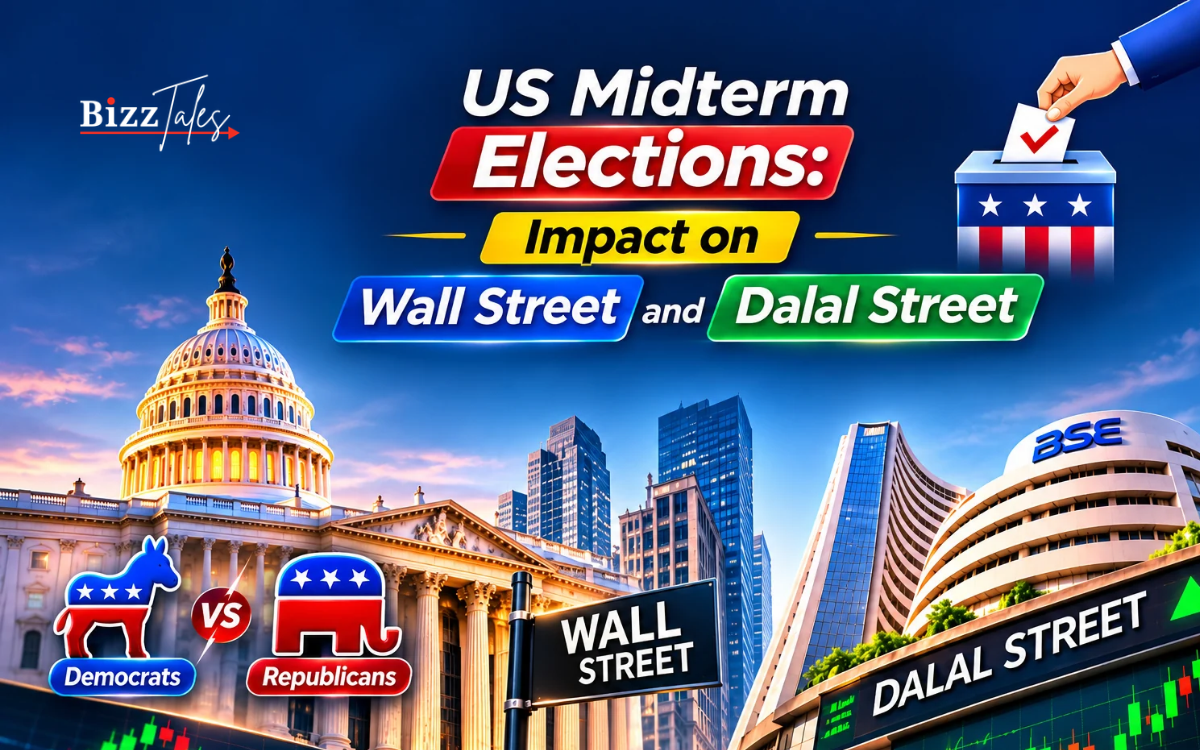
The US midterm elections are attracting significant attention from investors across the world. Scheduled for November 3, 2026, the elections could change the balance of power in the US Congress and influence important decisions related to taxation, government spending, trade policies, immigration and economic regulation. While American investors are looking at the possibility of a post-election stock market rally, investors in India are asking a different question: Will Dalal Street benefit if Wall Street moves higher?
The answer is not necessarily yes. The US stock market and the Indian stock market are connected through international investment flows, currency movements, crude oil prices, interest rates and global economic growth. However, these connections do not mean both markets will always move in the same direction.
Wall Street could welcome a clearer political situation or a divided government that limits sudden policy changes. At the same time, Dalal Street could face pressure if US Treasury bond yields increase, the US dollar strengthens or foreign institutional investors continue withdrawing money from Indian equities.
For India, the election result itself may not be the biggest concern. The economic and financial consequences of the result could matter much more.
What Are the 2026 US Midterm Elections?
US midterm elections take place halfway through a president’s four-year term. Unlike presidential elections, voters do not choose a new president during midterms. Instead, they elect members of the US Congress, including all 435 members of the House of Representatives and approximately one-third of the Senate.
The elections are important because the US Congress plays a major role in approving legislation, government spending, taxation policies and other economic decisions. The balance of power between the Republican Party and the Democratic Party can influence how easily the president implements the administration’s economic agenda.
For the 2026 elections, the Republican Party currently holds the presidency, while control of Congress is being contested. A change in either chamber could affect the government’s ability to introduce new laws and implement major policy proposals.
Investors are particularly interested in whether the elections result in a divided government. This happens when different political parties control the presidency and one or both chambers of Congress.
A divided Congress can make it more difficult to pass major legislation. Although this may create political disagreements, some investors consider it a relatively predictable environment because fewer large policy changes can be introduced without agreement between political parties.
However, a divided government does not automatically mean a stronger stock market. Investors still need to consider interest rates, inflation, government borrowing and corporate earnings.
Why Wall Street Could Cheer the US Midterm Elections
The American stock market has historically shown an interesting pattern around midterm elections. Although midterm election years can experience uncertainty and market volatility, the period following elections has often been positive for US equities.
According to historical market analysis from JPMorgan Asset Management cited in recent coverage, the S&P 500 has recorded gains during the 12 months following every US midterm election since 1950, with average gains of approximately 15%.
BlackRock’s analysis also identifies a historical tendency for US equities to perform better after midterm elections. Its research found that the S&P 500 delivered an average return of 14.1% in the six months following midterm elections since 1970.
These figures are historical observations, not predictions or guaranteed returns. Market performance during any particular period also depends on inflation, interest rates, economic growth, valuations and corporate profitability.
Nevertheless, there are several reasons why Wall Street investors may welcome the conclusion of the 2026 elections.
Reduction in Political Uncertainty
Financial markets generally prefer predictable policies and stable economic conditions. Before an election, investors may hesitate to make major investment decisions because they do not know which party will control Congress or what policy changes could follow.
Once the election results become clearer, investors can assess the likely direction of government policies and adjust their expectations.
A decisive outcome could reduce uncertainty surrounding taxation, regulation, government spending and trade policies. This may improve investor confidence, particularly if the result is considered less disruptive than expected.
However, political clarity alone cannot guarantee a rally. Investors will also examine whether the winning political arrangement supports economic growth and corporate profitability.
A Divided Congress Could Limit Major Policy Changes
One possible outcome of the elections is a divided Congress, where Democrats gain control of one chamber while Republicans retain the other.
Such an arrangement could limit the administration’s ability to introduce large legislative changes without bipartisan support.
For some Wall Street investors, this may reduce the risk of sudden changes in taxation, business regulation and government spending. Companies could benefit from a more predictable policy environment when planning investments and business expansion.
However, legislative gridlock can also delay important economic decisions. Disagreements over government funding, budget approvals and the debt ceiling could create additional uncertainty.
Therefore, investors will need to understand not just which party wins but also how the new Congress affects the government’s ability to manage the economy.
Government Spending and Corporate Earnings
Government spending is another important factor influencing the American stock market.
Infrastructure investment, defence spending, technology development and other government programmes can create business opportunities for companies operating in different sectors.
If the election outcome supports policies that encourage investment and economic activity, companies could benefit from stronger demand and improved revenue prospects.
Tax policies also matter. Lower corporate taxes can increase the amount of profit companies retain, while higher taxes may affect earnings expectations and business investment decisions.
However, additional government spending can increase borrowing requirements. If investors become concerned about government debt or inflation, they may demand higher returns on US Treasury bonds.
This creates an important challenge for Wall Street: policies that support corporate earnings may also increase borrowing costs. Higher interest rates can reduce the attractiveness of stocks, particularly companies whose valuations depend heavily on future earnings.
Why Dalal Street May Not Follow Wall Street
A positive reaction on Wall Street does not guarantee that the Indian stock market will experience a similar rally.
India has its own economic conditions, corporate earnings trends, inflation concerns and investment flows. Although international developments influence Indian equities, domestic factors remain equally important.
The US midterm elections could affect Indian markets through several financial and economic channels.
US Treasury Bond Yields Could Influence Indian Stocks
US Treasury bonds are among the most closely watched financial instruments in the global economy. Investors across the world use their yields to assess the return available from relatively low-risk US government securities.
When US Treasury yields increase, American bonds can become more attractive compared with investments in emerging markets such as India.
For example, international investors comparing Indian equities with US financial assets may reconsider their investment allocation when American bond yields rise significantly.
This can encourage foreign institutional investors, also known as FIIs or foreign portfolio investors, to reduce their exposure to Indian stocks.
Such selling can create additional pressure on the Nifty 50, Sensex and broader market indices.
On the other hand, if Treasury yields decline after the election, global investors may become more comfortable taking exposure to emerging-market equities.
For India, a stable or declining US yield environment could therefore be more supportive than a sharp increase in American borrowing costs.
A Stronger US Dollar Could Put Pressure on the Indian Rupee
Currency movements are another important connection between Wall Street and Dalal Street.
The US dollar plays a major role in international trade and financial transactions. When the dollar strengthens against other currencies, emerging-market currencies can face depreciation pressure.
A stronger dollar can make international investors more cautious about holding assets denominated in currencies that are weakening.
For India, a weaker rupee can increase the cost of imported goods, particularly crude oil, natural gas and other essential commodities.
It can also affect inflation expectations and the financial performance of businesses that depend heavily on imported raw materials.
A weaker rupee is not necessarily negative for every Indian company. Export-oriented businesses, including some IT services companies, may benefit when overseas earnings are converted into more rupees.
However, the overall effect depends on the company’s revenue sources, imported expenses, currency hedging and operating costs.
If the US election result strengthens the dollar significantly, the resulting currency pressure could become an important concern for Indian investors.
Crude Oil Prices Could Become a Major Risk for India
Crude oil is one of the most important factors affecting India’s economy and financial markets.
India imports a substantial portion of its crude oil requirements. As a result, changes in international oil prices influence the country’s import bill, inflation, currency stability and business costs.
US political developments can influence expectations around international trade, energy production, sanctions and geopolitical relationships. However, crude oil prices also depend on global supply and demand, production decisions by major oil-producing countries and geopolitical tensions.
If crude oil prices increase after the US elections, Indian businesses could face higher operating expenses.
The impact could be particularly visible in sectors such as aviation, paints, chemicals, logistics and automobiles.
Airlines may experience higher aviation fuel expenses, while paint manufacturers and chemical companies could face increased raw material costs. Higher transportation expenses can also affect businesses across several industries.
On the other hand, lower crude oil prices could support India’s economic outlook by reducing import expenses and easing inflationary pressure.
This is why Indian investors should monitor crude oil movements alongside the US election outcome.
Impact of US Midterm Elections on Indian IT Stocks
The Indian IT sector is particularly sensitive to developments in the US economy because American companies represent an important source of business for India’s software services industry.
Major Indian IT companies earn a significant portion of their revenue from international clients. Their performance depends on technology budgets, outsourcing demand, digital transformation projects, artificial intelligence investments and global corporate spending.
Companies such as Tata Consultancy Services, Infosys, HCLTech, Wipro and Tech Mahindra could therefore be affected by changes in American business confidence.
If the US economy remains strong after the elections, American companies may continue investing in cloud computing, cybersecurity, enterprise software, artificial intelligence and digital transformation.
This could support demand for Indian IT services.
However, if political uncertainty affects business confidence or companies become cautious about spending, technology budgets could face pressure.
Indian IT companies may then experience slower deal closures, delayed projects and increased pricing competition.
Currency movements will also matter. A weaker rupee may improve the reported value of overseas revenue, but it cannot completely compensate for weak demand or reduced client spending.
For investors, the important question is whether the US election environment supports sustainable technology spending rather than simply creating a short-term movement in IT stocks.
Will FIIs Return to Indian Stock Markets?
Foreign institutional investors play an important role in Indian equity markets. Their investment decisions can influence market liquidity, valuations and short-term price movements.
When global investors have confidence in emerging markets, India can attract substantial foreign capital. However, when international financial conditions become less favourable, investors may shift money towards US bonds, developed-market equities or other assets.
Recent market commentary has highlighted significant foreign investor selling during 2026. The Economic Times reported that foreign portfolio investors had withdrawn more than ₹3 lakh crore from Indian equities so far this year, amid concerns involving global interest rates, oil prices and other market pressures.
This makes foreign investment flows an important factor to watch after the US midterm elections.
A favourable combination of stable US bond yields, a relatively weaker dollar and improving global risk appetite could encourage foreign investors to reconsider their exposure to Indian equities.
However, a political outcome alone may not be sufficient to bring foreign capital back into India.
Investors will also examine Indian corporate earnings, valuations, economic growth, government policies and the performance of other emerging markets.
Domestic institutional investors and retail participation can provide support when foreign investors sell, but sustained market strength generally depends on broader confidence in earnings and economic fundamentals.
Which Indian Sectors Could Benefit or Face Pressure?
The impact of the US midterm elections will not be identical across every Indian industry. Different sectors respond differently to changes in currency movements, oil prices, international demand and global investment flows.
Information Technology
Indian IT companies could benefit if American businesses maintain healthy technology spending.
Demand for AI implementation, cloud services, cybersecurity and digital transformation could create opportunities for Indian technology service providers.
However, lower corporate spending in the US could affect new contracts and project expansion.
Banking and Financial Services
Indian banking stocks could be influenced by foreign investor activity, interest rate expectations and overall economic confidence.
If global financial conditions improve, foreign investment interest in Indian financial companies could increase.
However, higher borrowing costs, market volatility and weaker economic sentiment could affect valuations.
Automobile Sector
The automobile industry could experience mixed effects.
Companies with international exposure may benefit from stronger overseas demand, while manufacturers dependent on imported components could face higher costs if the rupee weakens.
Higher crude oil prices may also affect transportation expenses and consumer spending.
Aviation and Paints
Aviation and paint companies are particularly sensitive to crude oil and petroleum-linked input costs.
Higher oil prices can increase expenses for airlines and paint manufacturers, potentially affecting their profit margins.
Lower oil prices could provide relief, although company-specific demand and pricing conditions will remain important.
Pharmaceutical Sector
Indian pharmaceutical companies with significant US exposure may be influenced by American healthcare spending, regulatory developments and pricing conditions.
Currency depreciation can sometimes support the rupee value of export revenue. However, regulatory compliance, competition and product pricing remain important factors.
Wall Street vs Dalal Street: Why the Market Reaction Could Be Different
The difference between American and Indian markets becomes clearer when investors examine their economic structures.
Wall Street is directly exposed to US government policies, American corporate earnings and the country’s monetary and fiscal environment.
Dalal Street, meanwhile, is influenced by both domestic economic developments and international financial conditions.
| Market factor | Possible impact on Wall Street | Possible impact on Dalal Street |
|---|---|---|
| US bond yields increase | Higher borrowing costs may pressure valuations | Foreign investment in Indian equities may weaken |
| US dollar strengthens | Could support dollar-denominated assets | May put pressure on the rupee |
| Crude oil prices increase | Depends on energy-sector exposure and inflation | Can increase India’s import bill and business costs |
| US technology spending rises | May support American technology companies | Can benefit Indian IT service providers |
| Political uncertainty declines | May improve investor confidence | Could support sentiment if global conditions improve |
| Foreign investor risk appetite increases | May support equities | Could encourage FII inflows into India |
This comparison shows why a positive Wall Street reaction may not automatically translate into a positive Dalal Street session.
Indian equities need support from domestic earnings, reasonable valuations, stable currencies and healthy investment flows.
Historical Performance: Do Stock Markets Usually Rise After US Midterm Elections?
Historical performance provides useful information about how markets have behaved during previous election cycles.
US equities have historically performed better in the months following midterm elections than during some earlier periods of political uncertainty.
JPMorgan Asset Management’s historical analysis, cited in recent market coverage, found that the S&P 500 gained in the 12 months following every midterm election since 1950, with average returns of approximately 15%.
BlackRock’s research also identified an average S&P 500 return of 14.1% in the six months following midterm elections since 1970.
However, these statistics should be understood carefully. They describe historical market performance across different economic environments. They do not establish that the 2026 election will produce the same outcome.
The Indian market has its own historical experience. Indian equities have not consistently followed the same pattern as US equities after American midterm elections.
The Nifty and Sensex respond to domestic economic conditions, corporate earnings, interest rates, inflation, foreign investment and geopolitical developments.
Therefore, investors should avoid applying US historical returns directly to Indian stock market expectations.
What Should Indian Investors Watch After November 3?
The election result will attract attention, but the real market impact may become clearer over the following days and weeks.
Investors should monitor several indicators to understand whether the outcome is creating a supportive or challenging environment for Indian equities.
US Treasury yields: Watch whether American government bond yields rise or decline after the election. A sustained increase could make emerging-market investments less attractive.
US dollar and Indian rupee: Currency movements can influence foreign investment flows, imported inflation and the earnings of export-oriented companies.
Crude oil prices: Higher oil prices can put pressure on India’s import bill and corporate margins. A decline could provide support to several domestic industries.
Foreign institutional investor activity: Monitor whether foreign investors continue selling Indian equities or begin increasing their exposure.
US economic data: Inflation, employment figures, consumer spending and business activity will influence expectations around American economic growth and interest rates.
Corporate earnings: The performance of Indian companies will remain a major driver of long-term market returns. Strong earnings can support valuations even when global conditions are uncertain.
Trade and tariff policies: Any changes in US trade policy could influence Indian exporters, manufacturers and companies with international supply chains.
These indicators can provide a more meaningful understanding of market direction than focusing only on which political party wins the elections.
Will Nifty 50 and Sensex Rally After the US Midterm Elections?
There is no guarantee that the Nifty 50 and Sensex will rally after the US midterm elections.
A positive reaction in American equities could improve global sentiment and encourage investors to take greater exposure to emerging markets. However, Indian stocks will need support from their own economic and financial conditions.
A favourable situation for Dalal Street would involve stable US Treasury yields, a controlled dollar movement, moderate crude oil prices, improving foreign investment flows and stronger corporate earnings.
If these conditions develop together, Indian equities could benefit from an improved global investment environment.
On the other hand, if US bond yields rise, the dollar strengthens and crude oil becomes more expensive, Indian equities could remain under pressure even if Wall Street performs well.
Investors should also remember that the election outcome may already be partly reflected in market prices. If the actual result matches expectations, the immediate reaction could be limited. A surprise outcome or unexpected policy developments may create greater volatility.
The direction of the market will ultimately depend on how investors interpret the economic consequences of the election rather than the political result alone.
Conclusion
US Midterms Could Create an Opportunity for Wall Street, but Dalal Street Has Its Own Challenges
The 2026 US midterm elections are an important event for global financial markets. Wall Street may welcome the reduction in political uncertainty and the possibility of a more predictable policy environment. Historical trends also provide some encouragement to American investors, as US equities have often performed positively following midterm elections.
However, India’s market outlook is more complicated.
Dalal Street must deal with several factors, including US Treasury yields, dollar strength, crude oil prices, foreign institutional investor activity and domestic corporate earnings. These factors could determine whether a positive global market reaction translates into gains for Indian stocks.
Indian IT companies may benefit from stronger US technology spending, while oil-sensitive industries could face pressure if crude prices increase. Banking, automobile and pharmaceutical stocks may experience different effects depending on currency movements, investment flows and business conditions.
For Indian investors, the most important lesson is not to assume that Wall Street and Dalal Street will always move together.
The US election may influence global sentiment, but the long-term direction of Indian equities will continue to depend on India’s economic growth, corporate profitability and investment environment.
A rally on Wall Street could be good news for global markets. Whether Dalal Street celebrates the same outcome will depend on what happens next.
FAQs
When are the 2026 US midterm elections?
The 2026 US midterm elections are scheduled for November 3, 2026. Voters will elect members of the House of Representatives and approximately one-third of the Senate.
How can US midterm elections affect the Indian stock market?
The elections can influence Indian equities through US Treasury yields, dollar movements, crude oil prices, foreign institutional investor flows and American economic growth. These factors can affect the Nifty 50, Sensex and individual Indian sectors.
Why could Wall Street rise after the US midterm elections?
US stocks may benefit if the elections reduce political uncertainty and create a more predictable policy environment. Historical market data has also shown positive average returns in the months following previous midterm elections.
Will Nifty and Sensex rise after the 2026 US midterm elections?
A rally is possible, but it is not guaranteed. The performance of Indian markets will depend on domestic earnings, foreign investment flows, US bond yields, the dollar and crude oil prices.
Which Indian sectors could benefit from the US midterm elections?
Indian IT and pharmaceutical companies could benefit from stable US demand and favourable currency movements. Other sectors, including banking and automobiles, may be influenced by foreign investment flows, interest rates and economic confidence.
How do US bond yields affect Indian stock markets?
When US bond yields increase, American fixed-income investments can become more attractive to global investors. This may reduce investment flows into emerging markets such as India and put pressure on Indian equities.
Can a stronger US dollar affect the Indian rupee?
Yes. A stronger US dollar can create depreciation pressure on the Indian rupee. A weaker rupee can increase the cost of imports, including crude oil, while potentially improving the rupee value of some export earnings.
Why are crude oil prices important for Dalal Street?
India imports a large share of its crude oil requirements. Higher oil prices can increase import expenses, inflation and operating costs for businesses, potentially affecting corporate earnings and stock market sentiment.