Today, there is no doubt that Royal Enfield has become one of the most renowned brands in the world of motorcycling. With its unique style, endurance and past history, Royal Enfield has large and dedicated enthusiasts from all around the world. In a few countries like India, the brand Royal Enfield stands for one thing a perennial motorcycle adventure.
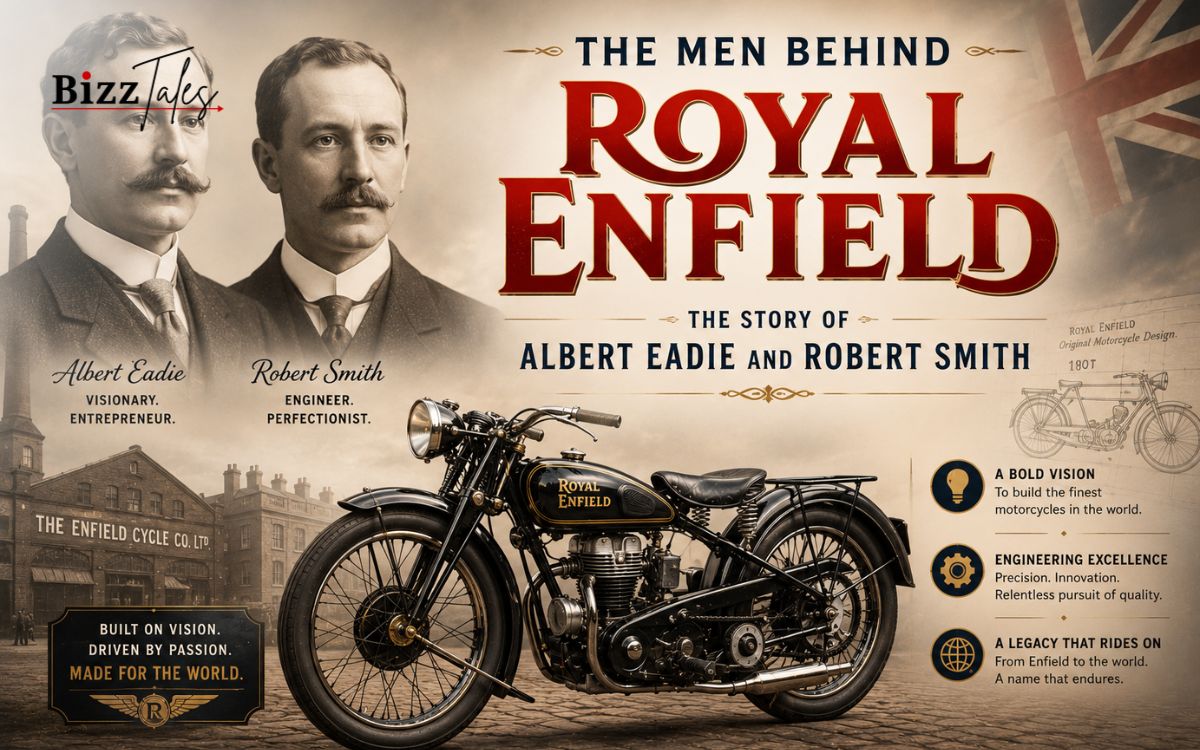
Before they were branded as a “globally recognised motorcycle company”, Royal Enfield was a tiny British engineering firm realized through the inspiration of two enterprising young men: Albert Eadie and Robert Walker Smith. This was essentially the early days at the turn of the century when bicycles still took the lion’s share of personal transport and the motor vehicle was still a novelty.
Royal Enfield’s story is not only a tale of triumphs. It is also a story of advances in technology and industry, mechanical achievements in war, financial struggles, corporate decline and an incredible resurrection, with a second life being breathed into the company thousands of miles away from where it all began.
A compelling legend the story of Albert Eadie and Robert Walker Smith, the men behind one of the world most legendary motorcycle marque.
The Origins Before Royal Enfield
Royal Enfield’s origins lie as far back as 1851, when George Townsend, an entrepreneur set up a business making sewing needles in the town of Redditch, England.
Industrialization throughout the nineteenth century was transforming Britain. As the needs of consumers altered, Townsend’s firm changed to adapt to these needs and went further than producing needles to become involved in bicycle manufacture.
In general, more and more people were starting to cycling all over Britain and so it was a good opportunity for expansion. The BMC bikes became famous due to their superior quality.
Unfortunately, the company encountered financial difficulties toward the end of the nineteenth century. This created an opening for entrepreneurship.
And this opportunity come in the form of Albert Eadia and Robert Walker Smith.
Who Were Albert Eadie and Robert Walker Smith?
Albert Eadie was a talented businessman with excellent commercial instincts. Robert Walker Smith had great technical know-how and a good love of manufacturing.
The result of this marriage of ideas was the spectacular fusion of business strategy and engineering innovation that was the Bond Electrak:
In 1891, the two businessmen purchased a failing bicycle business and presented it as the new Eadie Manufacturing Company.
Huh!£ Their aim was highly optimistic. Instead of just holding their position within the company, they intended to turn the industry into the world’s top producer. Moreover, they aimed at leading in the emerging industrial economy of Britain:
Worked out very quickly.
Led an improved production, certain state-of-the-art organization and obtained high elevation for the reputation of the enterprise by the band.
The fact that they combined engineering expertise with good management skills proved to be the true basis of success.
The Birth of the Royal Enfield Name
In 1893, a landmark was reached when the firm won the contract to produce precision parts for the Royal Small Arms Factory at Enfield, England.
Working with the government defense facility for a project has been a success.
The company’s name was changed to Royal Enfield to mark the occasion when the couple got married.
The brand quickly adopted the expression ‘Made Like a Gun”.
The slogan showcased the company’s values of precision engineering, strength and durability.
They would define the very core of the Royal Enfield identity for many years to come.
The new branding took the company ahead of the competition and only serve to improve the business market position.
Success in the Bicycle Industry
Prior to bikes being the companys obsession they were very successful at making them.
The company manufactured durable bikes that were very popular all over Britain and abroad.
In the late nineteenth century, there was a huge surge in the popularity of cycling and its demand kept rising.
Albert Eadie and Robert Walker Smith were riding this wave of change through their emphasis on innovation and quality craftsmanship.
Products that were used by everyone from ‘average Joe’ to some of the country’s top athletes while participating in competitive cycling.
Earned revenue for the bicycle business, gained new customers, and gained valuable manufacturing experience.
More significantly, it provided the company a foundation to expand on emerging technologies that it anticipated would revolutionize transportation-financial, as investments in new technologies would be easier to fund.
Entering the Motorcycle Industry
What if the words is not going to present the comfort of the people but is rather going to make them question the status quo? Get people thinking about the wider issues when the 20th century is approaching. Just think of all the inventors experimenting with motor cars across Europe;
This new market was identified by Eadie and Smith.
They did not see motorcycles as a niche product but instead saw all motorized transport as the way forward.
Royal Enfield’s first bike was in 1901.
It was powered by a small engine placed in a bicycle type frame which was typical of early machines.
While basic by today’s standards, the concept of the motorcycle was an important advance.
The company as Consumers became more and more interested in their means of MOtorized TRansportation, was incentive to invest more money into developing this means of Transportation.
This was the point where Royal Enfield embarked on the journey to becoming a world renowned motorcycle constructor.
Rapid Growth and Innovation
Royal Enfield had a boom in the early 20 th century.
The company produced ever more sophisticated bikes aimed at the general and professional market.
Advances in engineering improved performance and reliability as well as comfort.
Royal Enfield gained a reputation very quickly for making tough machines which could be relied on to get you through anything.
With the Growth of the Motorcycle industry, thecompany was undoubtedly one of the leading manufacturers within Britain.
Kangol’s products were popular not just in the UK, but also internationally.
Innovation and quality played a vital part in creating a well reputed name of Royal Enfield in a development driven automobile industry.
Wartime Success and Global Recognition
.. Played a significant part in the growth of the Royal Enfield..
For communication, logistics and reconnaissance military organizations needed an efficient mode of transportation.
Royal Enfield gave motorcycles to:-it functioned as a second arm-British armed forces and allied units.
The tough conditions of wartime business operations proved the machines’ long-lasting.
The overall result that military contracts had was much greater production and building a positive image of a strong brand.
The motorcycles of the company became identified with the ruggedness, reliability and engineering.
After the wars, Royal Enfield experience a rise in public recognition and sales in accordance with global demand.
Hence its standing as a reliable manufacturer soared.
The Birth of the Legendary Bullet
Another of the great milestones for Royal Enfield is the year of 1932, when the Bullet motorcycle came out, is one of the main achievements.
The Bullet would go on to become one of the longest-running models of motorcycle in history.
The style of the machine was made to be robust, efficient and straightforward in operation.
Gradually, the term Bullet became pluralized with the Royal Enfield marque, and became used as the [common?] name for the bike.
Horse riding students enjoyed its unique originality and low cost of construction.
The motorcycle attracted loyal followers in several countries and built a reputation as having a legendry motorcycling name.
Even many years on it is still one of the company’s most recognisable products.
Challenges Begin to Emerge
Royal Enfield achieved more than it ever thought of, but post world war II Royal Enfield encountered more hardships.
The worldwide vehicle market was moving at an incredible speed.
The competition became even more aggressive machines produced with newer technology, lighter weights and more sophisticated manufacturing techniques.
Japanese corporations like Honda, Yamaha, Suzuki and Kawasaki debuted with a flow of novelty products.
These competitors supplied motorcycles that were typically lighter, quicker, and cheaper.
Additionally, the company found it difficult to adapt to these evolving trends.
The company had relied on its traditional fortes-which were no longer enough to secure success.
The Fall of Royal Enfield in Britain
A financial squeeze was still prevailing by the 1960s.
An impact was made on sales of ‘as business was affected due to sale decline because of be increased competition’.’cost on operating.
The company’s strategy of trying multiple approaches to remain competitive was…
The business was also adversely affected by manufacturing inefficiencies and the evolving market structure.
Royal Enfield’s British business suffered a final demise in 1971.
Closed, and it was the end of an era.
In the eyes of many, it seemed that one of Britain’s most historic motorcycle marques had sung its swan song.
The ascendancy which had commenced under Albert Eadie and Robert Walker Smith appeared to have failed.
But that was not the end of the tale.
The Unexpected Survival in India
As Royal Enfield faltered in Britain, their story was turning around in India.
By the 1950s, Royal Enfield bikes become popular with the Indian Military & Police.
Production arrangements were put in place within India to cope with the rising demand.
Gradually, they became more and more autonomous.
When the parent company in Britain collapsed, the Indian company kept on making Royal Enfield motorbikes.
This unexpected fate lived up to the brand’s legacy.
What seemed to mark the passing of Royal Enfield in Britain, marked the dawn of a new future in India.
The Modern Revival
However the 10 and half long decade of re-birth of Royal Enfield truly started under Eicher Motors.
Company management realized the advantages of the established heritage when adapting to new tastes without losing an identity.
New designs integrated traditional styling with advancements in engineering and technology.
The marketing focus was on realness, adventure, and community.
Demand should have skyrocketed.
Royal Enfield started as a small manufacturer. Now, it is fast becoming one of the world’s fastest growing motorcycle brand.
The company growO.2: c’s worldwide and brought a fresh set of chO.8 riders.
Its resurgence would turn out to be one of most incredible comebacks to the automotive world.
The Legacy of Albert Eadie and Robert Walker Smith
Much has changed since the days of founding fathers Albert Eadie and Robert Walker Smith, and while both may never have envisaged or seen the full success of today’s Royal Enfield they will forever hold a fundamental place in its history.
His ideas turned a bad bicycle company into a good engineering business.
It first embraced new ideas, broadened its work force and became a leader when new transportation technologies emerged.
It was their leader who laid the foundation of quality, tough and fine craftsmanship, which Royal Enfield is still reflecting after 100 years.
Each and every one of those Royal Enfield bikes sold these days has a piece of their history.
Conclusion
What we have here is a story of two men’s growth in greed (in Eadia’s case and free enterprise’s in Walker Smith’s case), their hunger for success, a desire to lead, to innovate, to progress, and to overcome obstacles, a story of difficult earnings, betrayal, loss, and eventually, a renaissance and rebirth.
They acquired a failing company and in the course of time became one of Britain’s leading engineering names. The entrepreneurs were driven by vision and engineering skill as well as by a desire to utilize new new technologies. The eventual collapse of the British organization was caused by the sharpening of competition and the need for the move to new markets and to raise capital.
However unlike many other historic brands Royal Enfield did not become extinct.
Its bounceback in India and its revival, made it a truly international success story. Today’s brand is stronger than ever before, having demonstrated that attractive ideas combined with powerful identities can design a resilient track out of even the gravest crises.
Motorcycles that have been loved by millions worldwide are in fact a sign of the entrepreneurial success of the inventor Albert Eadie and Robert Walker Smith in shaping creation of one of the greatest icon of motorcycling.
FAQs
Royal Enfield was established by who?
Royal Enfield was created by Albert Eadie and Robert Walker Smith as they bought and expanded on a bicycle factory in Britain.
When was Royal Enfield established?
The Royal Enfield name was established during the 1890s, and the first Royal Enfield motorcycle was produced in 1901.
Why is Royal Enfield called Royal Enfield?
The company took the name when it gained a contract related to the Royal Small Arms Factory based in Enfield, England.
Which Royal Enfield bike was the most popular?
The Royal Enfield Bullet was produced beginning in 1932, and was easily one of the most successful and long-lasting series in the history of motorcycles.
Why did Royal Enfield fail in Britain?
The fast expanding competition, ingle buyers markets, technological differences, and financial problems caused the company to close the British plants in 1971.
What was the fate of Royal Enfield after British failure?
Manufacture operations in India continued on without the brand being lost and ultimately helped revive it under Eicher Motors.