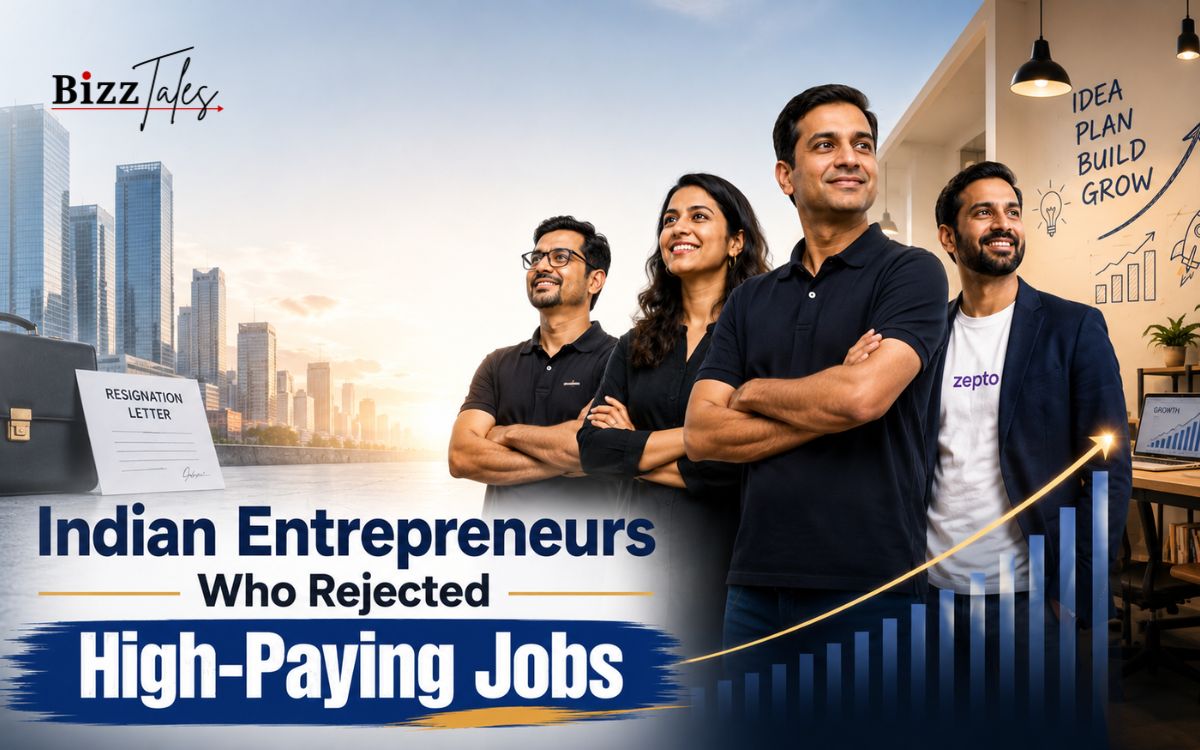
In a land where landing a good paying job is widely regarded as the ultimate success, venturing into entrepreneurship might seem like an unorthodox and risky approach. Since ages Indian families have been coaxing their children into becoming engineers, doctors, government employees, or employees with MNCs. The comfort of a remunerative salary, a reputed job profile, and social stature isn’t something people would like to miss.
But some people walk away from what other millions of people dream about having. They flee high-profile careers, lucrative salaries, and cushy corporate jobs to pursue of all things…midnight business ideas. Time and time again, their choices seemed senseless. Friends and family pitied them; the world mistrusted them.
Today, however, many of those entrepreneurs have created billion dollar companies, hundreds of thousands of jobs, and in some cases, changed entire industries. Their lives are living proof that an entrepreneur’s big opportunity is often not within the security of a steady paycheck.
Here’s the story of India’s entrepreneurs who turned down lucrative careers and decided to build something for themselves.
Why Leaving a High-Paying Job Is One of the Toughest Decisions
To most professionals, a high-paying job provides not only financial security but also a sense of professional advancement along the expected and comfortable progress towards a predictable future. Turning down the high-paid job is selling away the present rewards in fund of an undefined dream.
Starting a new business is not like going into a normal job where you get paid a monthly salary, have set working hours and expect the business to be successful. A new business will often take the entrepreneur years to get financially stable, they may spend their savings and take loans.
Making the same decision, in India, is more complex. Families exert significant influence on career decisions. Children whose parents have invested in them, expect work to guarantee comfortable livelihoods.
Herehowever, make successful entrepreneurs recognize that building something meaningful exceeds the security of a corporate income. Their struggles underscore conviction and the value of long term vision.
Ritesh Agarwal: Leaving Conventional Education Behind to Build OYO
Ritesh Agarwal is commonly mentioned while talking about young entrepreneurs in India. Barely in his late teens and a few years back, he was just a curious teenager intrigued by business and travel.
Nevertheless, Ritesh was exposed to the traditional academic and business tracks as a talented student. Instead of choosing a traditional route he chose something unique. He decided to drop out and dedicate himself full time to solving a problem that he personally encountered-find decent and reliable housing at a reasonable price.
That idea was eventually born as OYO Rooms. The initial year was not so glamerous. The efforts were very immense to create the credibility among hotel owners, customers and investors. There were other lot of operational hiccups and I thought we can fail.
Thanks to Ritesh’s rebellious attitude against the conventional ways, OYO grew at a tremendous pace across India and went international. Today, it is one of the most recognizable names in the hospitality technology industry to come out of India.
He showed that aside from from reinventing cattle, any entrepreneur’s journey can start much earlier as he moved on to choose a vision over a blue-walk.
Sridhar Vembu: Turning Away from Silicon Valley Opportunities
Rarely is there a more convincing story of entrepreneurial daring than Sridhar Vembu’s.
Having earned his high degrees and established a prosperous career in the US, Vembu had access to opportunities that would be the dream of any working professional. The possibilities of staying in Silicon Valley meant high-paid job, prestigious designation and maximum career growth.
And he decided, instead, to take the road less traveled.
By some twists of fate Zoho emerged. Rather than looking to climb the corporate ladder, he co-founded Zoho. At that time, going head to head with the fairly large local software giants appeared quite a task to an average observer. Most of the people thought that building a worldclass software company from India was quite a difficult task.
Vembu was interested in building a viable, long term company, rather than chasing valuations in the short term. He concentrated on buildig a good product, satisfying customers and generating profits. Unlike several other startups that spent lavishly and then bombed, Zoho expanded through disciplined execution over a period of several years.
Currently, Zoho is an enterprise with millions of users, and is listed among India’s most successful software companies. Vembu’s decision to opt out of the “conventional” career path sends out a clear message that raising a business is more about passion and freedom than it is about earning the maximum cash.
Nithin Kamath: Leaving Traditional Career Paths to Build Zerodha
Prior to joining the league of India’s most respected entrepreneurs, Nithin Kamath considered several options to go forward as. Nithin Kamath worked for multiple life goals and got the chance to build a promising career for himself.
However, Kamath had always been passionate about the stock markets and trading. He believed there was another big problem in the brokerage industry in India. As the brokerage fees were high and the systems were complex, people often avoided from investing.
So he said: Enough of this! He resolved to construct his own solution.
As a result was Zerodha, a company that transformed the brokerage industry in India. Zerodha’s innovation in cheap pricing and easy to use technology allowed for penetration of millions of investors into the stock market.
What is special about Kamath’s story is that, Zerodha received no external venture funding. The company was based on a simple philosophy of value for the customer and profitability.
Thanks to his determination, today Zerodha is one of the largest broking firm in India. This Zerodha story emerged as a case-study for sustainable entrepreneurship.
Bhavish Aggarwal: Leaving Microsoft to Create Ola
Almost most of the professionals would like to be in Microsoft as they consider working there as the biggest achievement of their career. The company is provides very good packages and is having global opportunity along with lot of growth.
Bhavish Aggarwal had the chance to do that.
He had encountered the problem himself while traveling. The problem inspires a idea that is to become Ola.
Deciding to leave a leading tech company and build a transportation marketplace was a risky move. The Indian ride-hailing market was still nascent, and it was uncertain whether consumers would actually use the service.
In the beginning, there were fierce rivalries, operational challenges and financial doubts. However Bhavish stayed on to pursue his dream.
Ola grew to be one of the largest mobility company in India and was instrumental in reinventing urban mobility in India.
His experience illustrates an important lesson that is crucial for every entrepreneur. Most successful companies are created when entrepreneurs first realized common hardships and designed products and services that could be scaled to address them.
Deepinder Goyal: Moving Beyond Corporate Comfort to Build Zomato
Prior to Zomato, Deepinder Goyal was not an entrepreneur. He was working in a corporate setting, earning a good salary and considering good upward mobility.
During his employed, he found a problem. It was something simple that is just simple to access menus for restaurants. He then thought of an idea that could solve the problem.
Rather than ignore the opportunity, Goyal chose to look into it further. The start of a menu-listing site turned into Zomato.
It took patience, of course, innovation, and significant risk to establish a food technology company. We encountered a great deal of competition, faced difficulties in our operations, and observed fluctuating consumer trends.
However, in-spite of the whole lot of problems, Zomato grew to be one of the most familiar technology brands in India. It Spread out not only in restaurant discovery, but in the field of food delivery and other similar reasons.
Deepinder shows us that entrepreneurial ideas can be discovered from everyday observations which might sound obvious to you but other people may miss the opportunity.
Why Entrepreneurs Often Reject High Salaries
In itself, declining a high-wage job seems irrational from a financial standpoint. But entrepreneurs view opportunity costs distinctively.
Most employees think in terms of regular monthly income and moving up the career ladder. Entrepreneurs think in terms of ownership, influence, and future value.
A corporate salary has a ceiling. Among the best paid, CEOs, even the best paid directors sometimes bump into a ceiling. Corporate firms, however, can go beyond..
The flexibility to innovate-create new products and to design and grow their teams-is also something many entrepreneurs find more valuable than earning a bigger paycheck
Another one is “purpose”. Entrepreneurs can be emotionally involved with the problems they are addressing. Compared to the benefits and security of a typical job, that can seem more tempting to resist.
The Common Traits Shared by These Entrepreneurs
Despite the vast differences in the markets they serve, most of the successful Indian entrepreneurs have similar characteristics.
They are not afraid of being wrong. They are willing to take action in spite of the risk and the often partial knowledge in hand.
They think long term. Most founders spend many years developing companies until they reach a level of real scale. They have a broader perspective on growth.
They are problem solvers. Regardless of whether it’s in the transportation business, hospitality business, financial investing, software designing, they are problem solvers.
They learn and adapt all the time. Markets change, new technologies and products emerge, customer requirements become ever-more diverse. It is entrepreneurs who are willing to learn and adapt who keep going.
Most of all, they believe. The entrepreneurs with faith in a concept when the world doesn’t buy it have the edge over those who give up far too soon.
What Aspiring Entrepreneurs Can Learn from Their Journeys
The experiences of these entrepreneurs not only inspire us, they offer lessons as well.
Firstly, being an entrepreneur does not mean quitting your job just for the independence of it. The very best entrepreneurs do act however by abandoning a secure job looking for an opportunity that really matters.
Secondly, it usually takes time to be successful financially. Every successful entrepreneur has often worked tirelessly for years and faced setbacks and sacrifices along the way that may be unrecognized.
Third, execution trumps ideas. Significant numbers diagnose problems. Few dedicate themselves to resolving them.
Finally, entrepreneurship requires resilience. Markets evolve, new rivals appear and setbacks happen. The capacity to overcome such obstacles and keep going is often what makes the difference in the long run.
Conclusion
The entrepreneurial world in India has changed a lot over the last 20 years. As new companies continue to revolutionise different sectors, it’s becoming more commonplace to hear of entrepreneurs leaving good-paying jobs to start their own ventures.
Innovators like Deepinder Goyal, Bhavish Aggarwal, Nithin Kamath, Sridhar Vembu, and Ritesh Agarwal have shown us that greatest career risks may turn into the greatest rewards. They turned their personal dreams into professional ventures that upended deeply entrenched norms and practices.
Their stories inspire us to understand that entrepreneurship is not driven just by the pursuit of profit, but by the desire to create value, find solutions and contribute to a greater cause.
You don’t have to assume that everyone should ditch their job and start a business of their own. But if an individual has a compelling vision and conviction to go after it, he might get opportunities more valuable than salary.
FAQs
What motivates them to abandon well-paid jobs?
Numerous entrepreneurs get out of the high paying jobs they are in for a chance to do their own thing, to touch on truth and meaning and to generate long-term value as the head of a business.
Would I have to leave a job if I wanted to be an entrepreneur?
No. There are cases where entrepreneurs have started working for the idea while they had a job and switch to the business ones the latter improves.
What are the top three most significant dangers of ditching a lucrative occupation?
Principally risk of financial uncertainty, absence of regular income, failure of the business and increased responsibility.
Could be more reward giving opportunities entrepreneurship than a career. In the corporate world?
Entrepreneurship tends to result in more economic upside, personal freedom and Satisfaction from making an impact than traditional employment, though it comes with higher risk.
What are the positive characteristics of entrepreneurs that lead them to be successful after leaving their protected employment?
General characteristics of an entrepreneur Successful entrepreneurs are generally resilient, adaptable, good problem solvers, tend to have a long term perspective and are committed to their vision.