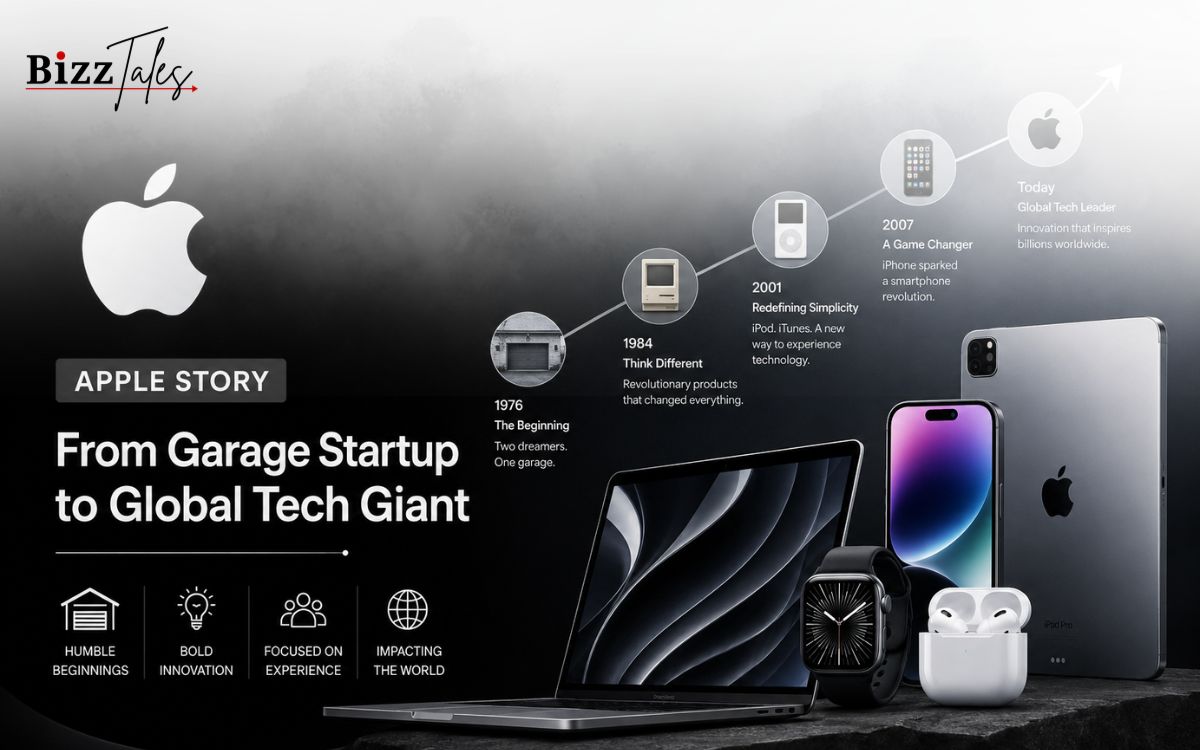
Apple is, without any doubts, one of the strongest and most powerful computers and technology organizations in the world. Nowadays, hundreds of people use its technology in their everyday lives in China, England or the United States. The list is endless; from iPhones and Mac Book to iPads and smart devices.
However, Apple’s story did not all start in an enormous office or billions of dollar headquarters. It all started in a little garage with two young men, who thought computers could change the world.
It’s about a business that was born out of invention, adversity, intense competition, failure, and the true resurgent of business in history. In 2006 Apple is not just a technology. It is one of the world most powerful brands.
- The Beginning of Apple
- Building the First Computer
- Apple II Changed Everything
- Steve Jobs' Vision
- Challenges and Internal Problems
- Apple's Decline Without Steve Jobs
- The Return of Steve Jobs
- The iMac and Brand Revival
- The iPod Revolution
- The iPhone Changed the World
- Expansion Beyond Smartphones
- Apple's Business Strategy
- Challenges Faced by Apple
- Business Lessons from Apple
The Beginning of Apple
Apple was founded in 1976 by Steve Jobs, Steve Wozniak, and Ronald Wayne.
Computers were huge, costly equipment that mainly belonged to company and research organizations at that time. Most of the common people didn’t consider computers as personal machines.
Steve Jobs and Steve Wozniak wanted computers to be easy, allowing anybody to use them. This proved to be the main reason for Apple’s success.
Building the First Computer
Steve Wozniak designed the first computer manufactured by Apple, named the Apple I.
The initial work took place in a garage and would go on to be one of most popular tales about the startup phenomenon globally.
The company originally sold circuit boards and then moved on to whole PCs.
There was a good response from the geeks and the buzz about Apple had started slowly.
Apple II Changed Everything
The launching was a turning point and innovation.
It was one of the initial personal computers designed successfully for everyday consumer use.
The product gained a lot of popular support because it was so much easier to use than a lot of the other computers going around.
This was the beginning of the rapid success of Apple and major step in its recognition in the technological world.
Steve Jobs’ Vision
One of the key people who defined Apple as we know it was Steve Jobs.
He was of the view that technology should not only function efficiently, but should look elegant and work in simple ways.
This focus on design and user experience became one of Apple’s biggest strengths.
Jobs wasn’t only selling products. In fact, he was selling experience and feelings.
Challenges and Internal Problems
However, with some early success, internal difficulties at Apple occurred.
Disputes among leadership teams and competition pressures.
Because as the company grew the administration became more challenging.
Of course, eventually Steve Jobs left after constant battles within the company.
This may have been one of the biggest shockers in the history of Apple.
Apple’s Decline Without Steve Jobs
Lost its innovative edge. Apple ceases to thrive after Steve Jobs departed.
The company launched a few products but hardly anything made a big impact.
The intense competition of the Microsoft, PC producers grew very fast.
In the past, Apple was nearly bankrupt.
The Return of Steve Jobs
Steve Jobs went back to Apple in 1997.
This turned out to be one of the most creditable otherhits of business history.
Jobs streamlined Apple’s product range and centered on innovation.
He thought the company should have fewer products, but a higher quality of them.
The iMac and Brand Revival
One of the big successes upon Jobs’ return to Apple was the iMac.
The product had its own design and it was helping put Apple’s name back into the spotlight.
People began associating Apple with being technologically innovative and fashionable again.
The iPod Revolution
Apple has entered the music business with iPod.
While digital music players were not new, Apple took those devices which were complex and bland, and made them far more simple and stylish.
The iPod and iTunes revolutionized the way the world bought and listened to music.
The iPhone Changed the World
The greatest turning point for Apple began in the year 2007 when the original iPhone was first launched.
Prior to the iPhone, the majority of smartphones were business phones with limited capabilities.
Apple created the concept of a smartphone, unifying the looking glass, design, internet access and application.
The iPhone has revolutionized the way consumers behave and remains one of the most successful items produced.
Expansion Beyond Smartphones
Following the iPhone’s success, Apple entered various categories.
The company launched products such as:
- iPad
- Apple Watch
- AirPods
- MacBook innovations
- Digital services
Furthermore, Apple created a solid environment with synchronized application.
Apple’s Business Strategy
Apple’s strategy is mainly around high quality and customer service.
While most companies will try to win from the lowest price point, Apple brand, innovation and design.
As such, the company can benefit from the incredible customer loyalty.
Leadership Style of Steve Jobs
Jobs had a very tough, perfection oriented style of leadership.
He challenged teams to develop products that were not merely functional, but groundbreaking.
Thanks to his obsession with detail and simplicity, Apple was always driving ahead of competition.
Challenges Faced by Apple
If were not without its share of obstacles.
The company was criticized for its pricing, competition and market pressure.
There was also doubt after Steve Job’s death whether Apple could still come up with new innovations.
Nevertheless, the business continued to expand under new management.
Impact on the Technology Industry
Apple changed multiple industries, including:
- Personal computing
- Smartphones
- Music
- Tablets
- Wearable devices
Additionally, the company had an impact on the way the products of technology market are designed and promoted.
Business Lessons from Apple
There are some powerful lessons to be learned from the story of Apple.
One lesson will be how vital innovation is. When someone is coming around with the next best thing, companies have to keep up.
Another lesson is that brand building and customer experience matter. Customers form emotional bonds with strong brands.
Another lesson to be learnt here is the importance of focus. Apple confined itself to few products rather than many lines.
Future of Apple
By 2026, Apple will further深入 into artificial intelligence, mixed reality, health tech and digital businesses.
The company is still one of the most valuable brand in the world.
Conclusion
Few business stories can compare to the meteoric rise of Apple, which began in a small garage to become one of the world’s largest technology companies.
Its success was based on innovation and brilliant management. This included the ability to forge new markets and set industry standards.
Apple’s story is a clear demonstration that massive concept can be born in modest setting.
With vision, dedication, and hard work, a garage startup is capable of moving the world.