
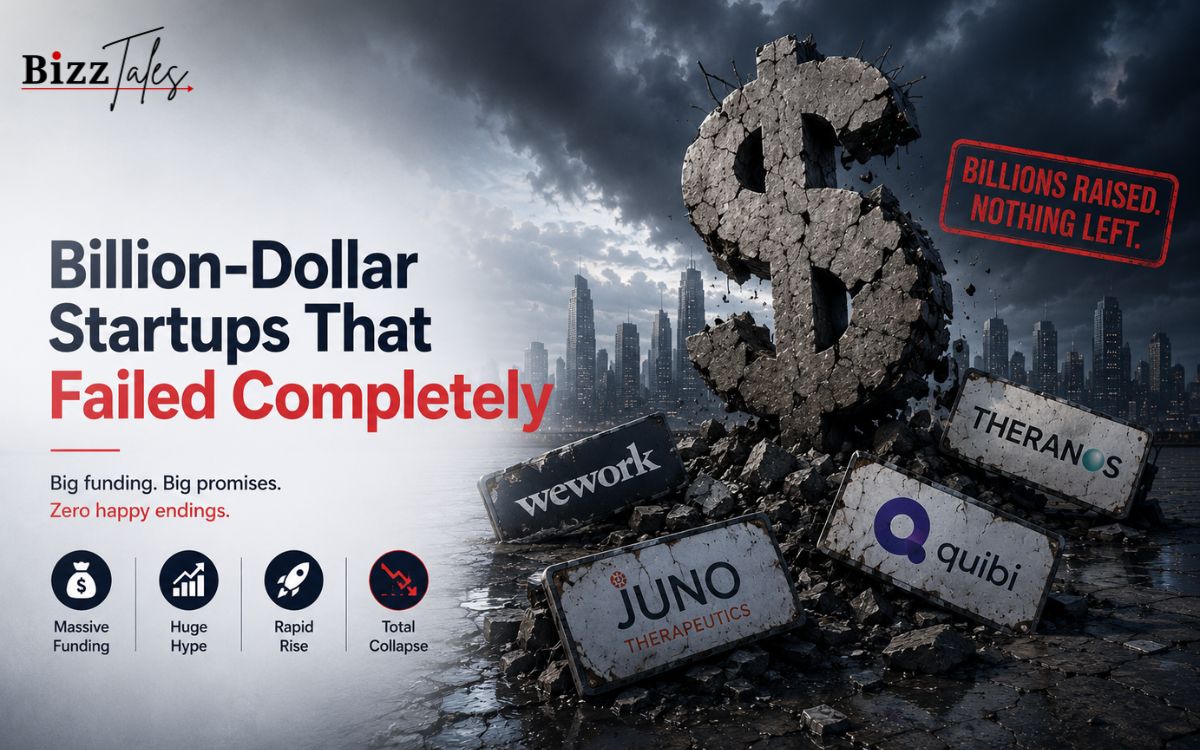
In the startup space, reaching a billion-dollar valuation is considered to be the holy grail for most startups. Those startups that reach such a valuation are known as ‘unicorns’ and garner a lot of attention from investors and the press.
People often think that once a startup is worth billions, success is assured forever. Luxurious offices, large funding rounds, celebrity founders and headlines in every paper make you think they just continue to grow and grow.
However, the truth is that it is nothing like this.
During the past decade, many billion-dollar startups have failed entirely despite the huge financial investment and popularity. Several companies lost confidence of the investor community, while others had lackluster business models, or collapsed due to over-expansion, incompetence, or fraud.
These failures shook the business world to the core, for these startups once appeared infallible. Investors lost billions of dollars; employees lost their jobs and customers their confidence.
The boom and bust of these startups also offers an important lesson. Valuations mean little, true strength is in businesses that can keep growing sustainably and profitably under good management.
The Startup Hype Culture
Contemporary startup culture can be extreme, pushing for hyper-growth.
Startups that raise big rounds of funding are on every headline. Founders are becoming celebrities, investors are fighting over who will invest in them and the companies are getting a lot of online coverage.
Thus, this forms a very powerful hype cycle that prices in valuation more than business fundamentals.
Some startups just become hyped up because investors are excited.
WeWork – The Startup That Shocked the World
One of the most famous startup crashes in modern history is WeWork.
WeWork’s beginning is a shared office space business and within a few years the business has been deemed the hottest startup in the world. Investors felt the firm was changing the way we work.
WeWork was valued as high as $47b at its peak. WeWork opened offices worldwide, leased expensive real estate, and allocated large budgets to branding and expansion.
However, we did not get to enjoy all the good things for a long time because the cruel reality was that some serious problems gradually emerged.
The company was hemorrhaging huge sums of money, leadership decisions were called into question and investors were beginning to doubt the business model.
Financial details shocked investors when WeWork attempted to float. Losses were large, governance issues appeared, and investor confidence quickly evaporated.
The company’s valuation plummeted in value leading it to become one of the largest failures in start-up history.
Theranos – Fake Technology and Fraud
Another well-known startup failure was.
Theranos announced that it would reinvent blood testing through innovative technology that required far less blood than traditional methods. Enthusiasm for the company’s prospects was quickly built up among investors, media and corporate leaders.
For a brief period of time, Theranos had a valuation of billions of dollars.
And yet later inquiries discovered a lot of the equipment didn’t work in the way it was supposed to.
The company had overstated its capabilities and lied to both investors and customers. In the end, it was the latter that took down the startup, and the scandal became one of the largest frauds of all time in the world of startups.
Quibi – A Billion-Dollar Failure in Entertainment
Quibi was yet another startup that fell apart quickly.
The company secured massive investment and was positioning itself as the leader in the mobile entertainment space, specifically short form premium videos. It had star support from major celebrities and big name venture capital firms.
Even with heavy promotion and plenty of funding, the customers just didn’t love the product enough.
The firm closed shop just a few months after launch as growth and adoption had stalled.
Why Some Billion-Dollar Startups Fail
There’s no one single reason for startup failure. As a rule there is several issues that compound together over time.
Some common reasons include:
- weak business models
- poor leadership
- fake growth strategies
- overspending
- lack of profitability
- aggressive expansion
- customer dissatisfaction
- unrealistic valuations
Once a startup starts moving too fast, before laying good foundations.
Growth Without Profit Is Dangerous
Most startups pursue growth and visibility at the expense of profitability.
They invest heavily in marketing, discount offers and high recruitment to enhance their growth figures.
Initially this is enough to get the public and the media excited. However, eventually the businesses have to show they will survive financially.
Investor Money Cannot Last Forever
However, this may lead to over-reliance on investor funding.
As long as funding persists, the business is viable. However, as soon as the investors cease to pour money into the losing business, trouble quickly ensues.
Leadership Problems Destroy Companies
Leadership plays a very significant role in a startup.
Others, like a few billion-dollar companies, fell apart because founders behaved irresponsibly, disregarding advice or forging a destructive organizational culture.
Social Media Creates False Success Images
We sometimes glamorize startups more than they really are, through social media.
The thrill of the online: luxury offices, celebrity interviews, funding announcements and expansion updates.
But on camera, you don’t typically see the financial pressures, operational challenges, or internal mayhem.
Valuation Does Not Equal Real Success
Valuations alone mean very little. One of the biggest lessons from failed unicorn startups is:
A company can be worth billions but still losing billions a year.
Valuation is a primarily future-oriented concept and not a measure of long term sustainability.
Fast Expansion Creates Hidden Problems
A few startups grow rapidly at first and then settle down.
While it may sound impressive to announce the opening of many offices, expansion into different markets, and rapid hiring to the rest of the world, be warned that this increase in risk is nothing to laugh at.
Customers Ultimately Decide Success
Even if we allocate unlimited funding, no business will survive in the long run if customers do not feel the product or service is valuable to them.
Customers keep coming back and businesses stay alive.
Startup Failures Hurt Employees Too
When big startups go down, their staff is usually the ones who get the short stick.
Billions of workers can have their jobs abruptly eliminated and ambiguity causes enormous pressure on the teams inside.
Investors Became More Careful
Following several startup failures, a number of investors began to be more wary.
Today investors tend to care less about hype and more about profit, business rules, and sustainable development.
Important Lessons for Entrepreneurs
Lessons from business failure for future entrepreneurs:
The most important lesson is this: The enormous excitement and hype of the last 12 months can never, by itself, create powerful companies.
The second thing I’ve learned is that growth, sustainable growth, is a lot more important than fast growth.
And maybe the most valuable lesson of all is that business is built on trust and openness.
Why Real Businesses Take Time
Many long term businesses that succeeded developed slowly rather than the high speed hype up expected of the new startups.
Secure customer confidence, financial self-control and operational order are likely to produce a stronger footing over time.
The Startup Ecosystem Is Changing
The startup industry is gradually becoming more down to earth.
Presently, both investors and consumers are increasingly aware of the importance of profitability, product quality and sustainability.
Conclusion
The collapse of billion-dollar startups proved that high valuation and media hype do not guarantee long-term success.
Many companies that once looked unstoppable eventually failed because of weak business models, overspending, poor leadership, or fake growth strategies.
These failures remind entrepreneurs that real businesses are built on strong foundations, customer trust, profitability, and sustainable growth — not only on hype and investor excitement.
For upcoming founders, the biggest lesson is simple: building a stable, trustworthy, and financially healthy business is far more important than chasing short-term attention or unrealistic valuations.
FAQs
What is a unicorn startup?
A unicorn startup is a private startup company valued at over one billion dollars.
Why do billion-dollar startups fail?
They may fail because of poor leadership, weak business models, overspending, fraud, or lack of profitability.
Was WeWork a failed startup?
WeWork experienced one of the biggest startup collapses after valuation and financial problems became public.
Does high valuation mean a company is successful?
No, valuation reflects investor expectations and does not always guarantee profitability or long-term stability.
What can entrepreneurs learn from failed startups?
Entrepreneurs can learn the importance of sustainable growth, transparency, financial discipline, and customer trust.