The startup scene seems very attractive from an outsider’s perspective. Every day, there are news articles about startups that manage to get millions of funding, become unicorns, reach the international markets, and gain growth at an incredible pace. You see content on Facebook about young founders creating billion-dollar companies.
However, there is an ugly truth about the startup world that is hardly discussed behind this sexy face. Many startups focus on the appearance of success, rather than actually building a sound company. They generate counterfeit excitement with counterfeit growth tactics, instead of genuine growth.
These measures are aimed at drawing investors, gaining media coverage, social proof and customer appetite. There are occasions where startups fudge the figures, burn money just for buzz or care more about valuation than profit margin.
Not that all startups are a lie. Most do innovate. But many are in the business of showing a rocket trend at all costs even when the business is fundamentally weak.
These fake growth strategies are interesting because they give entrepreneurs, investors and customers an insight into how the startup ecosystem really operates.
The Pressure to Show Fast Growth
The other big reason fake growth strategies happen is because of pressure.
During the startup phase, the founder is under an immense pressure of the investors, competitors, social media and marketplace. Investors are looking for scaling growth, growth in number of users, more exposure in media and higher valuation.
Due to this encouragement, some startups start to emphasis on image rather than building sustainable business.
In the startup world, perception can be extremely powerful. A firm that “looks successful” can sometimes bring in more capital even if it is unprofitable.
Buying Customers Through Heavy Discounts
One of the most widespread ways to fake growth is through a strong discounting policy.
Certain startups sell something at a very low price to scale up the user base rapidly. Users signing up are doing so because it’s cheap or free, rather than because they feel an affinity for the product.
Initially, it appears to be a phenomenon of explosive growth. Downloads of apps go up, number of orders increases, and you find headlines all around. However, once you cease offering discounts, a majority of the customers are gone overnight.
Burning Investor Money for Visibility
Some startups waste an enormous amount of investor money on marketing and just soak up attention.
They buy endorsements, fill social media pages with ads and generate buzz all over the internet.
While this creates visibility very rapidly, this is not sufficient to prove good business fundamentals.
A startup might be huge on the internet but still losing a lot of money every month.
Fake User Numbers and Vanity Metrics
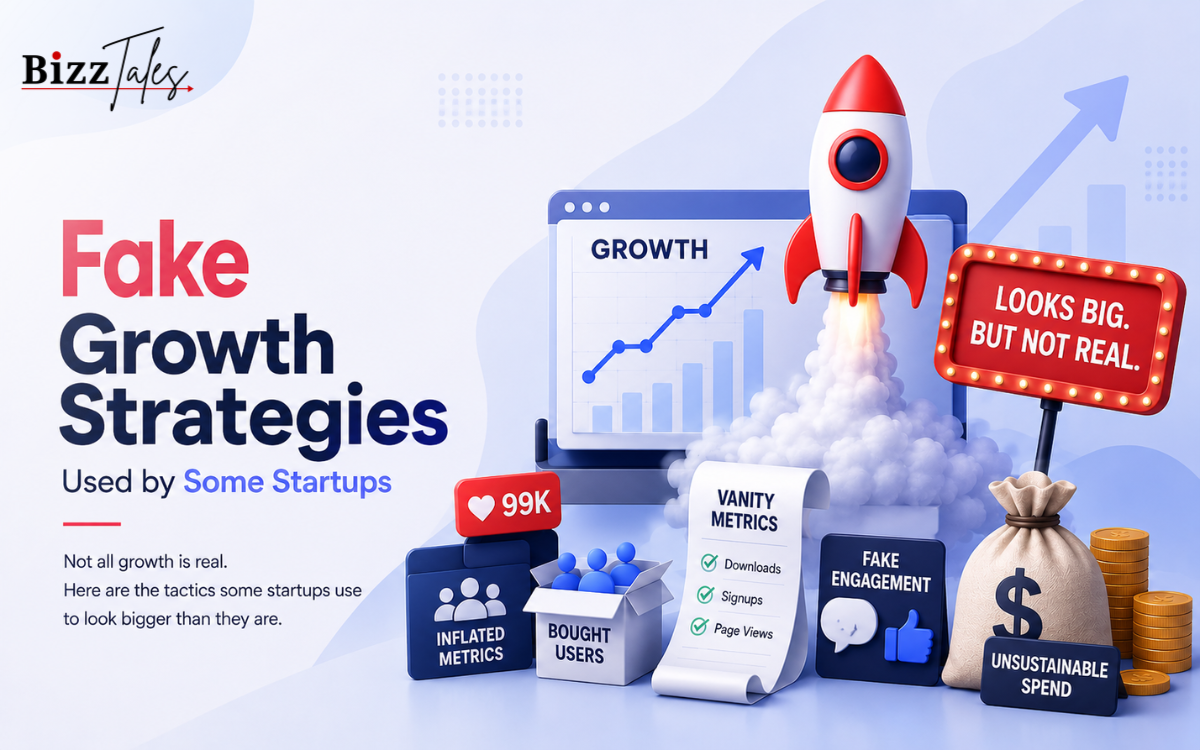
Another popular trick is to attention to vanity metrics, while ignoring what really matters: business health.
For example, startups may highlight:
- app downloads
- website visitors
- registered users
- social media followers
- media mentions
However, these figures can be misleading in terms of actual customer loyalty and profit.
Social Media Creates Illusions
Social media exacerbated startup hype culture.
Founders often put up funding announcements, pictures of snazzy offices, expansion announcements and targets online. This gives the impression of a thriving successful company.
But these things usually never make it out to the public, because the focus is rarely on the risk itself but rather on the risk taker. Audiences may never see financial distress, internal conflicts, burnt out employees or operational hiccups.
Growth Without Profitability
A lot of startups will go to enormous lengths to grow even at the expense of profitability.
If a company is unprofitable for a longer period, then the above strategy does not work anymore.
Just a few of them manage to stay in business just because investors continue to pump money into them over and over again.
Creating Artificial Hype
Hype has huge power in the world of the startup.
Certain startups intentionally foster excitement and urgency to generate immediate interest. They do this by releasing products in small batches, leveraging influencer outreach, making bold marketing promises and marketing stories, all of which give off the impression that they are larger than they really are.
Investor Psychology Plays a Big Role
Hype culture can also sometimes be driven by investors.
By one investor investing in a startup, some other investors may afraid to miss the “next big thing”. This drives investment competition among investor and raising startup valuation.
As a result, some weak businesses keep getting funded for no reason other than markets being overheated.
The “Growth at Any Cost” Mentality
Many startup founders get fixated with how quickly they can scale.
They recruit aggressively, grow rapidly, and invest heavily before establishing sound business systems.
Fast expansion may seem exciting; however, expansion that isn’t controlled can lead to severe financial issues down the line.
Fake Reviews and Fake Engagement
A few startups also has used fake reviews, fake followers, or fake engagement to boost their online reputation.
Naturally, customers will place faith in businesses with a high rating and social proof. This is why some unscrupulous companies cheat the system by artificially creating a good reputation.
Media Attention Can Be Misleading
It is what headlines in the media love to talk about: Money and valuation.
However, fundraising does not always signify a success for the start-up.
A large number of companies that secured massive investments went on to fail miserably or close down altogether.
Why Some Startups Collapse Suddenly
Eventually, the lie runs out of steam.
Cash flow issues, poor business model, frustrated customers and soaring, unsustainable costs, gradually reveal themselves.
This is the reason that some startups go under very quickly in spite of seeming successful in public.
The Difference Between Real and Fake Growth
True business growth tends to be a little bit slower in pace, but more steady.
It comes from:
- loyal customers
- strong products
- healthy revenue
- customer trust
- sustainable operations
Fake growth instead is primarily about the look, hype and a few months of the numbers.
Customer Trust Gets Damaged
As startups exaggerate to much, trust finally breaks.
Customers are disappointed if the quality of the products or services does not meet the marketing promise. Once lost, credibility is hard to win back.
The Role of Startup Culture
Today, the startup culture might be glorifying scaling way too fast.
Founders have been compelled to hide nothing and constantly display updates on growth, funding rounds and expansion strategies on various platforms.
This environment may lead to poor choices.
Lessons for Entrepreneurs
Any future entrepreneur should know that to build a business is a long term process.
The strongest companies are built on patience, happy customers, and sustainable growth. Not hype.
Why Profitability Still Matters
At some point, every company is going to be financially sound.
Investor funds cannot indefinitely support losses. A business that fails to develop a profitable system is unlikely to sustain itself over time.
The Importance of Authentic Branding
The customers are more intelligent now.
In today’s world people prefer realness, transparency and real business over overexaggerated startup hype.
Conclusion
The startup world is filled with innovation and opportunity, but it also contains artificial hype and fake growth strategies.
Some startups focus too much on looking successful instead of building sustainable businesses. Heavy discounts, vanity metrics, fake engagement, and aggressive hype may create temporary popularity, but they rarely guarantee long-term success.
Real business growth takes patience, strong products, customer trust, and financial discipline.
For entrepreneurs, one of the biggest lessons is simple — sustainable growth is always more powerful than artificial hype.
Businesses built on strong foundations survive much longer than businesses built mainly on perception.
FAQs
What are fake growth strategies in startups?
Fake growth strategies are tactics used by some startups to appear more successful than they actually are.
Why do startups focus on hype?
Some startups use hype to attract investors, customers, and media attention quickly.
Are all fast-growing startups fake?
No, many startups genuinely grow rapidly because of strong products and market demand.
Why do some startups lose money despite popularity?
Some startups spend heavily on discounts, marketing, and expansion before becoming profitable.
What creates sustainable startup growth?
Strong products, loyal customers, profitability, trust, and long-term business planning create sustainable growth.