Manufacturing has been the foundation of economic growth. The very first Industrial Revolution, driven by steam engines, dramatically changed how products were designed, manufactured and sold. Now, each breakthrough in technology-automation and artificial intelligence alike-is changing the face of manufacturing. Robotics-the foundation of the next Industrial Revolution-will create intelligent factories, boost productivity and allow companies to succeed in a digitized economy.
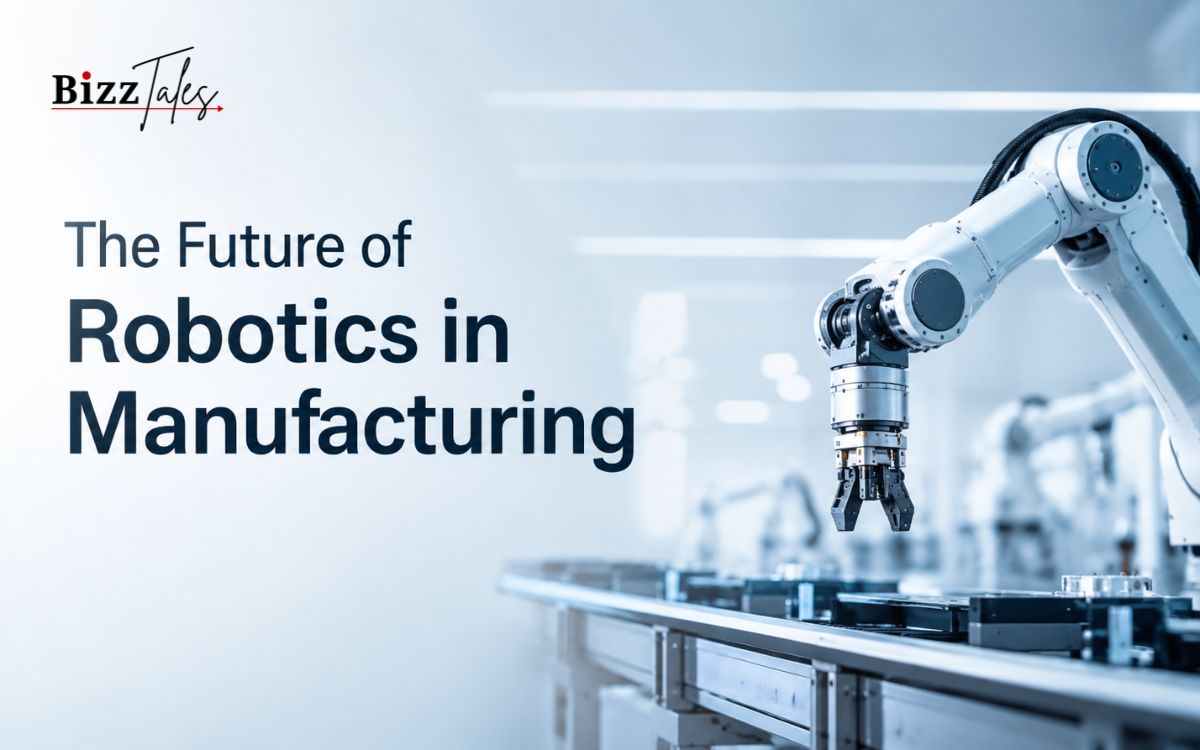
The utilization of robots in manufacturing is no longer confined to the automobile big factories. It is now applied in other various industries including electronics, medicine, food production, aerospace, logistics and other consumer goods. Powered with the aid of recent technology such as artificial intelligence, machine learning, computer vision and enhanced sensor capabilities, robots are evolving to be smarter, more flexible and perform even more difficult jobs.
As the industry faces new pressures, including an increasingly tight labor market, higher manufacturing costs, and elevated customer expectations, robotics is quickly becoming one of the key technologies driving the industry’s future. It is critical for manufacturers, investors, entrepreneurs and lawmakers to understand how robotics is developing and how it will affect business well into the next century.
Understanding Robotics in Manufacturing
Robotics in manufacturing involves applying programmable machines to carry out the work of production. These machines can do repetitive, hazardous, accurate, or physically strenuous, work with a high degree of repetition.
For a long time now, standard industrial robots have been confined to use in the automotive industry, where they are used to automate processes such as welding, painting, assembly and material transport. Now, due to recent advances in technology, a vast list of tasks can now be performed by robots.
Today’s manufacturing robots have camera-based vision systems so they can visually inspect products, robot-human coworkers (co-bots), predict upcoming production needs, control manufacturing data, streamline workflow, and even teach themselves by means of learning systems.
Incorporating robotics into production, results in increased productivity, higher quality, decreased errors, waste and variations in product quality and reduced long term operating costs.
Why Robotics Is Becoming Essential in Modern Manufacturing
There are a number of global trends that are driving the increased utilization of robotics throughout the manufacturing realm.
A significant cause is the increasing lack of skilled labor. Several nations or regions are experiencing aging workforces as well as a lack of interest in assembly-line careers from their youth. As skilled workers retire, factories struggle to find a suitable substitute. Robotic systems aid in smoothing the transition.
The second major reason is an increase in the cost of labor. Manufacturers need to stay in competition and but at the same time need to limit the costs. Robots being machine don’t need any breaks or holidays or working shifts.
These expectations have evolved considerably over time as well. Customers now want faster delivery of products with improved quality and more customization. Robotics, in this case, helps manufacturers achieve the increased speed required by customers while maintaining high accuracy.
The overarching context is also shaped by disruptions along the entire global supply chain, emphasizing the importance of agility and resiliency in manufacturing itself. Automated manufacturing systems can enable industry to be more responsive to fluctuating needs.
The Evolution of Industrial Robots
The initial industrial robots were considered primitive machines. They were used during the 1960s and were incapable of any intelligent actions. They required special programming in order to perform simple everyday actions.
With the passage of time, the enhanced capabilities of computing, sensing and software allowed robotic technologies to evolve. Present-day industrial robots interact with their environment, identify objects and flexibility adapt to changing situations.
Artificial intelligence has fast-tracked this process. Robots equipped with AI are capable of examining data, recognizing trends and making decisions instantaneously. Moreover, thanks to machine learning, robots can refine their actions by trial and error.
Robots are equipped with computer vision systems which allows them to “see”. With sophisticated, high bit-rate cameras and sensors, robots can distinguished different parts, assess severity of broken by mistakes and follow the circuit/ exist working with a great precision.
They’re creating a new breed of smart manufacturing systems equipped to perform functions that relied on human knowledge just a few years ago.
Collaborative Robots Are Changing Factory Floors
One of the biggest trends moving in manufacturing robotics today are collaborative robots, or cobots.
They are built to work within human environments, unlike traditional factory robots, which work in the separate area of the factory for safety reasons. Cobots have various sensors and safety features built in to ensure they don’t bump into humans.
The benefits of collaborative robots are varied. They are easy to program, need less floor space and can be moved from one operation to another with ease. Many small and medium manufacturers, earlier unable to afford automation systems, are now turning to cobots.
Some of the common applications to utilize cobots include assembly, packaging, quality inspection, machine tending and material handling. Enabled by the cobot partnership of human and machine, the humans can take on a more value added and complex task.
In stead of replacing workers completely, collaborative robots usually increase efficiency of human with enabling safe work environments.
Artificial Intelligence and Smart Robotics
The future of manufacturing robotics is going to be very closely linked with the world of artificial intelligence.
AI-enabled robots have the ability to analyze large data sets from a variety of sources including production lines, sensors and connected devices. This helps to streamline processes, streamline inefficiencies and inform better decisions.
An instance of how AI is changing manufacturing is predictive maintenance. Machines fitted with sensor networks are able to intervene should equipment show signs of deterioration or impending failure.
Quality assurance: Another advantage of AI is quality assurance. Robots with sophisticated vision systems can examine finished product for defects faster and more accurately than human quality inspectors. This reduces wastage and ensures quality consistency.
Support vector machines are inspired by the functioning of the human brain and are capable of processing information greatly faster than any one of us. Progress in AI is occurring at such a rapid pace that we can expect manufacturing robots to rapidly increase in independence.
The Rise of Smart Factories
The smart factory is the next phase of industrial evolution. It is a factory that utilizes advanced interconnected technologies such as robotics, Artificial Intelligence, Internet of Things, cloud computing and real time data monitoring for a highly automated production.
Within a smart factory, the robots are interconnected with the machines, sensors and software programs during the manufacturing operations. This interconnected network aids in real time monitoring, fault prediction, storing the inventory levels and enhancing the productivity of the process.
More insight into operations and to make data driven decisions- these systems enable any manufacturing company to act faster to change, better manage its resources and produce higher-quality products. Production schedules can be continuously refined at the kanban system can be automatically modified based on predictions of demand, machine utilization and supply chain factors.
This synergy enables robotics to bring increased efficiency, lower downtime and competitiveness.
In conclusion, with the growth of Industry 4.0 in international market, smart factories may become a normal in future manufacturing.
Robotics and Workforce Transformation
The employment issue is perhaps the most debated topic on robotics in manufacturing.
Although many repetitive jobs have or will be automated, robotics is opening up new jobs. The need for engineers, software programmers, robotics technicians, data analysts and automation specialists is growing.
As the manufacturing workforce prepares to work in more automated environments, manufacturing workers are expected to acquire additional skills to work with automated systems. Businesses are investing in training and reskilling to this effect.
As we move into the future, man’s ingenuity, problem solving skills and strategic thinking will be united with the mechanics, precision and efficiency of the robot.
Benefits of Robotics in Manufacturing
The benefits to manufacturers when using robotics is:
Productivity improvements are certainly one of the major benefits. Robots working round the clock can produce at a higher rate and we know that the quality level is always kept!
Accuracy and precision reduce defect rates and material scrap. This results in a cost reduction and a higher customer satisfaction.
Another benefit is safety in the workplace. Robots can handle unsafe tasks such as heavy lifting, chemicals, and working in harsh conditions to minimize accidents.
Automation provides additional capability for the wide to scale-up. In other words, a manufacturer can boost production output without having to depend entirely on labor.
In addition, it promotes configurability, providing the means to carry out adaptable manufacturing processes and reducing the number of different products produced.
Challenges Facing Robotics Adoption
However, there are difficulties in the adoption of robotics, although there are the following advantages:
The entry costs can be high (especially for smaller manufacturing companies) in the form of robot purchase costs, system integration costs and employee training costs.
Technical challenges can also be a barrier. To achieve successful implementation, there may be a need for knowledge in software, automation, engineering and data management.
Workforce adaptation presents an additional challenge. Workers may need to learn new skills to adapt to the new technology.
Overcoming these challenges will be important to fully harness the potential of robotics in manufacturing.
Future Trends in Manufacturing Robotics
The future of manufacturing robots will be influenced by several following new trends:
Self-governance of AI technology will advance-robots will be able to “think” on their own, utilizing autonomous functions that are adaptable to different circumstances.
Humanoid robots are able to do more and more and may soon be 100 per cent general purpose.
Modern machine vision allows robots to ‘see’ better and will improve robot inspection capabilities.
Digital twins will enable manufacturers to create virtual models of the production processes prior to their implementation in physical plant.
Learning with edge computing: by bringing the analysis closer to the production data, edge computing will help to improve reaction and decisions in real time.
Sustainable manufacturing will be a strong motivation for robotics adoption for many companies as they will look to (a) lower the amount of waste produce, (b) become more energy efficient and (c) strive to minimize the impact they have on the environment.
It is predicted that these innovations will produce manufacturing systems that are smarter, more adaptable and more productive in the years to come.
Conclusion
The field of robotics is revolutionizing industry faster than ever before. Once limited to basic automation, robotics now encompasses smart machines that can learn and negotiate with other human-operated systems. With the rapid development of AI, machine learning, and smart factory solutions, robotics are destined to have a significant impact on modern manufacturing.
For those who adopt robotics, manufacturers should experience increased productivity, improved quality, reduced costs, and increased competitiveness within this ever-changing global economy. Although the questions of initial investment costs, job replacement concerns, and cyber security looming, automation benefits can no longer be denied forever.
The future manufacturing is neither humans or robots, but collaboration. Creating a brilliant partnership of human inventiveness and robot intelligence, manufacturing will become smarter, and open up brilliant opportunities for growth in industry.
FAQs
What is robotics in manufacturing?
Robotics Manufacturing refers to the use of programmable mechanical devices to perform operations such as assembly, welding, packaging, inspection and material handling.
How do robots boost manufacturing productivity?
Can be operated 24 hours a day. Has better accuracy and efficiency. Reduces human error and has greater productivity.
What exactly are collaborative robots?
Cobots, or collaborative robots, are built to be safe and interact with human workers to offer support for manufacturing processes.
Is it possible that robots will eliminate manufacturing workers?
While robots will replace repetitive jobs, the turn of the century will also create many jobs in the design, programming, maintaining and the management of automation.
Which industries benefit from manufacturing robots?
Robotics is used heavily by companies in sectors such as: automotive, electrical, electronic, healthcare, aerospace, food processing, logistics and general retail.
What do you see for the future of robotics in manufacturing?
In the future the following is to take place the the humans will work along with AI empowered robots the, computers in the factory will be intelligent even more, the sources will be automated.