For over 20 years, “Search Engine Optimization” or “SEO” has been the key to online existence. Companies, bloggers, publisher and marketers have created all kinds of strategies, campaigns, and money behind SEO platforms to boost up their rankings on search engines like “Google” or “Bing”.
However, the way people search is evolving quickly. Advances in artificial intelligence are leading to a new paradigm in online research. Instead of entering keywords into a search engine and trawling through dozens of websites, more and more people are asking questions of artificial intelligence systems including ChatGPT, Gemini, Perplexity, Copilot and other generative search engines. In response, these systems are returning direct answers instead of lists of links.
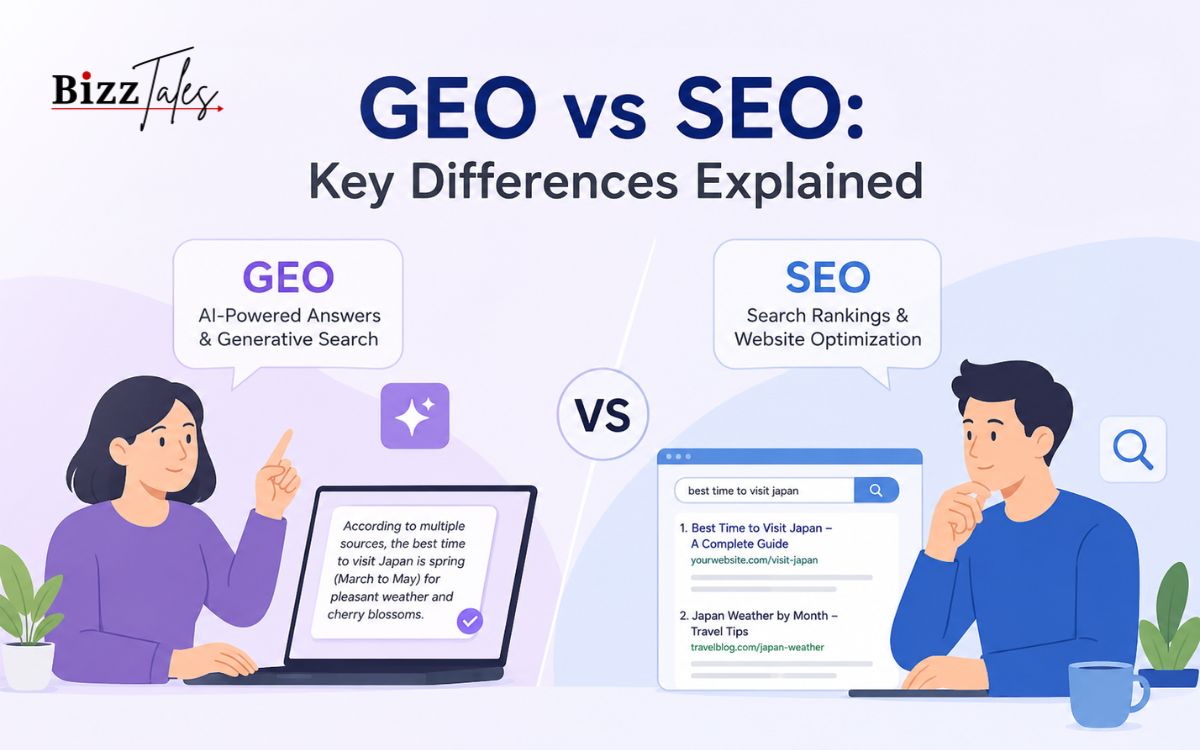
This then led to the concept of Generative Engine Optimization (GEO). While SEO revolves around ranking web pages in classical search engines, GEO aims at helping content being found, understood, referenced and seen by AI-only search systems.
As business is planning for the new era of digital marketing, taking the difference between the two – GEO & SEO has been of great importance. Those companies who adopt the earliest will have the best advantage when going into the next age of AI search.
What Is SEO?
Search Engine Optimization (also called SEO): is a set of techniques for improving the position of a website in the lists of search engines. 93the goal of SEO is to ensure that search engines comprehend what the web page is about and to assess the significance of the content specified to a user’s search.
Time for a history lesson on SEO. In the old days you could rank for a keyword quite easily if you either had a good number of keywords or backlinks, now a days. SEO is more complex: page authority, domain authority, site authority, page rank, content quality, page speed, user experience, expertise, authority, and search intent all contribute to SEO in 2023.
Depending on the search conducted on Google, the search engine crawls billions of web pages to identify relevant websites which best matches the topics query. Good search engine optimization (SEO) practices will enable a website to rank higher during a search.
Search engine optimization still is among the best things for your online marketing initiatives because the search traffic it receives is so focused. The searcher is exploring an intent to learn about, purchase or having a need fulfilled.
What Is GEO?
Generative Engine Optimization aka GEO refers to the optimizations to a content for AI based search engines and generative answer engines.
Instead of returning links to websites (as traditional search engines do), For example, AI may use the data it gathers from several published sources to directly answer questions or generate an article, provide suggestions, or explain a concept without the need for user to visit a website.
GEO intends to raise the probability that mentions, references, cites, summaries or in any way draws on the content of a website’s pages in the process of responding to an input
The AI assistant boom has pose a new challenge for businesses. Even if one’s site appear directly on the search engine standings, such site does not necessarily be cited by the AI engines. And some not so great on Google sites get AI citations.
This new world, this new reality, compels content creators to think through a new lens -– one that looks past traditional ranking signals and aims to develop content that AI can seamlessly digest, trust, and utilize.
Why GEO Is Becoming Important
Top searches are evolving at an unprecedentedpace.
Many users now ask AI assistants questions such as:
- Which is the best laptop for students?
- “How does digital marketing work?”
Can you tell me the difference between GEO and SEO?
They get a detailed answer immediately instead of ten blue links.
With AI-driven search on the rise, companies realize that being featured in AI answers might soon be as critical as showing up on first page of Google.
GEO organizations that choose to not adapt may lose the subscription exposure as user action changes to conversational search experience.
Simultaneously, organizations that refined with the help of the search engine also discover on various websites that don’t depend solely on search engine positions.
The Core Difference Between GEO and SEO
The main distinction between GEO and SEO has to do with what each of them aims to achieve.
Efforts to enhance positions in search engine listings is what SEO is all about.
GEO proposes to enhance visibility for AI-generated responses.
SEO is about getting clicks from the search engines.
GEO’s objectives include: Become a trustable source for all kind of information to AI systems.
Success of SEO is defined through rankings, traffic and clicks.
GEO: This brought us tremendous success, but our success can also be quantified; it is measured by citations and references to our brand, as well as how often we are mentioned in answers generated by AI.
While both strive to be seen online, they exist in different worlds and demand different techniques for optimization.
How Search Engines Work
The classic search engine searches the world wide web by crawler. Wb pages crawlers have spread throughout the web. Those pages are then indexed and ranking algorithms..
Upon a user submitting a query, the search engine pulls up pages from it’s database that contain the best results based on hundreds of ranking factors including relevance, authority, user experience, and content of the page.
They are presented with a list of search results, from which the user can select to click on.
This model has been reigning on the net for many years, and it is still powerful.
How Generative Engines Work
The two undergo quite a different process.
For example, instead of having an AI system showing us certain web pages, it processes a wide range of information and generates in natural language the reply to this prompt:
These engines might synthesize responses from a wide range of resources-websites, databases, knowledge repositories, and live feed sources.
Instead of looking for pages, the search now is for answers.
As a consequence, it is important that content is composed in a manner that enables AI to disassemble facts, contextual information, reasons etc.
Content Strategy in SEO
Conventional SEO content on keywords.
Writers determine keywords in high demand and generate an article matching the preferences of a user.
A typical SEO article might target keywords such as:
- “best smartphones 2026”
- “how to improve website speed”
- “digital marketing strategies”
This is the keyword list we want to rank for and bring in organic visitors.
SEO content is something that might have elements of keyword placement, internal linking, metadata optimization etc. Among many other things.
Content Strategy in GEO
TheGEO content is aimed at clarity, authoritative extent, context and completeness.
AI is all about providing content that directly addresses queries, provides explaination, and information that is accurate and reliable.
GEO instead is not satisfied with the keyword that you target but ask you the meaning of those keywords.
For example if you continually mentioned your target keyword over and over again, a GEO article would get into every aspect of a topic, the questions, the definition, the definitions, how to use it, how to benefit from it, why it might be hard to use etc…
This makes it easier for the systems of artificial intelligence to see and refer to the content.
The Role of Authority
Authoritat has always been important in SEO, but it is arguably more relevant in GEO.
AI are designed to give correct and reliable information. Therefore, AI would tend to use the sources that are trustworthy.
Authority is achieved through aspects like authority based upon subjects or brand, quality, consistency, citing, quality, following, and actually being known out of this industry.
In Short, if companies position themselves as the expertise, they are likely to be cited by AI?
Structured Content and AI Understanding
GEO plays a crucial role in how content is structured.
The way information is organized is crucial to allowing AI systems to reason more efficiently.
Understandable headings, simple and direct policies, elements that are broken down into question types, and supporting context information makes it easier for AI models to identify various features of the content.
What makes good content? Good content is structured in a way that human and search engine bots can easily read and understand.
The way in which content is organized will become more crucial as AI search develops.
Why AEO Matters Alongside GEO and SEO
SEO making way for AEO. Answer Engine Optimization (AEO) bridges the gap between SEO and GEO.
AEO is about tailoring content to directly answer particular user inquiries.
AEO practices help featured snippets, responses to voice queries, knowledge panels and answers produced by AI.
Content targeted toward AEO often features questions, answers, and conversational tone.
As AI search is invariably question-driven, the AEO has now become a key aspect of contemporary content creation strategies.
By integrating SEO, GEO, and AEO, companies are ensuring their presence on conventional, voice and AI.
How Businesses Should Adapt
The future of visibility in the digital realm will necessitate all businesses having a multi-channel search approach.
Docthas shown thatseo is still a big source of traffic and companies should keep investing in it.
Meanwhile, companies should facilitate AI by optimizing the content for expertise, trustworthiness, structured data, and topic depth.
Creating excellent content which effectively addresses users needs will be more important than chasing keyword density and deadold ranking techniques.
Brands that align with the Google credo of ‘authority and usefulness’ will thrive in both legacy and AI-enabled search.
The Future of Search
The future is not going to be a battle between GEO and SEO.
Rather, the two approaches will collaborate.
AI features are also being incorporated into traditional search engines. However, AI programs still need to access data stored on web pages across the internet.
This results into a hybrid ecosystem where the business have the transparency in search results and AI results.
The most effective content strategies will leverage the combined capabilities of SEO, GEO and AEO.
Those organizations that will take advantage of the new informed human9 will have more opportunities for reach audiences no matter how they found information.
Conclusion
The digital marketing world is heading into a new phase. SEO is still critical to helping your website attract free traffic from Google et al., but GEO is growing in significance.
The main distinction is that SEO aims to bring sites to search engines results pages, the GEO focus on having contents included in answers provided by AI. Although the concepts are similar, SEO and GEO work on different search ecosystems.
Companies that utilize SEO, GEO and AEO in tandem will be ready for the future of online discovery. Rather then competing for supremacy, SEO, GEO & AEO should learn to work together as a unified force to enhance online visibility, grow authority and attract audiences.
Moving forward in the age of search, it will be those organizations that produce credible, service-oriented, well organized content will stand the best chance of succeeding.
FAQs
Is GEO replacing SEO?
No. GEO is not replacing SEO. Google and other traditional search engines continue to bring us huge traffic. GEO is just offering an additional way for your content to be shown in AI-based answers.
What does GEO stand for?
GEO, or Generative Engine Optimization, is an optimization aimed at content aimed at ai-powered search engines, and generative answers engines.
Why is GEO important in 2026?
AI assistants and conversational search tools are being adopted by more and more users, but how do businesses optimize for appearing in answers offered by AI?
Can a website use SEO and GEO together?
Yes. As a final solution, applying the three together in business providing the combination of SEO, GEO, and AEO is undoubtedly the most competitive strategy.
How can businesses prepare for AI search?
Make authoritative content, thoroughly answer users’ questions, make good use of the structure of information, and focus on expertise and authoritativeness. Do these, and you also get good GEO.