
Google has been the king of search for more than 20 years. If you had a question about the nearest sushi place, hobby to pick up, business opportunity to explore, the need to compare vegetables or general information on anything, you went straight to Google. Its preponderance had become such that the noun Google itself became a verb,
But every leading technology platform encounters a moment of disruption. For example, it was the use of smart-phones in place of other methods of personal computing, the streaming services replacing traditional modes of entertainment, and now it is artificial intelligence playing a role in online searches.
One of the startups driving this change is Perplexity AI, established in 2022 to take on one of the globe’s most saturated markets. Their ambitious promise was to ‘make it easy to find what you want, just by asking’.
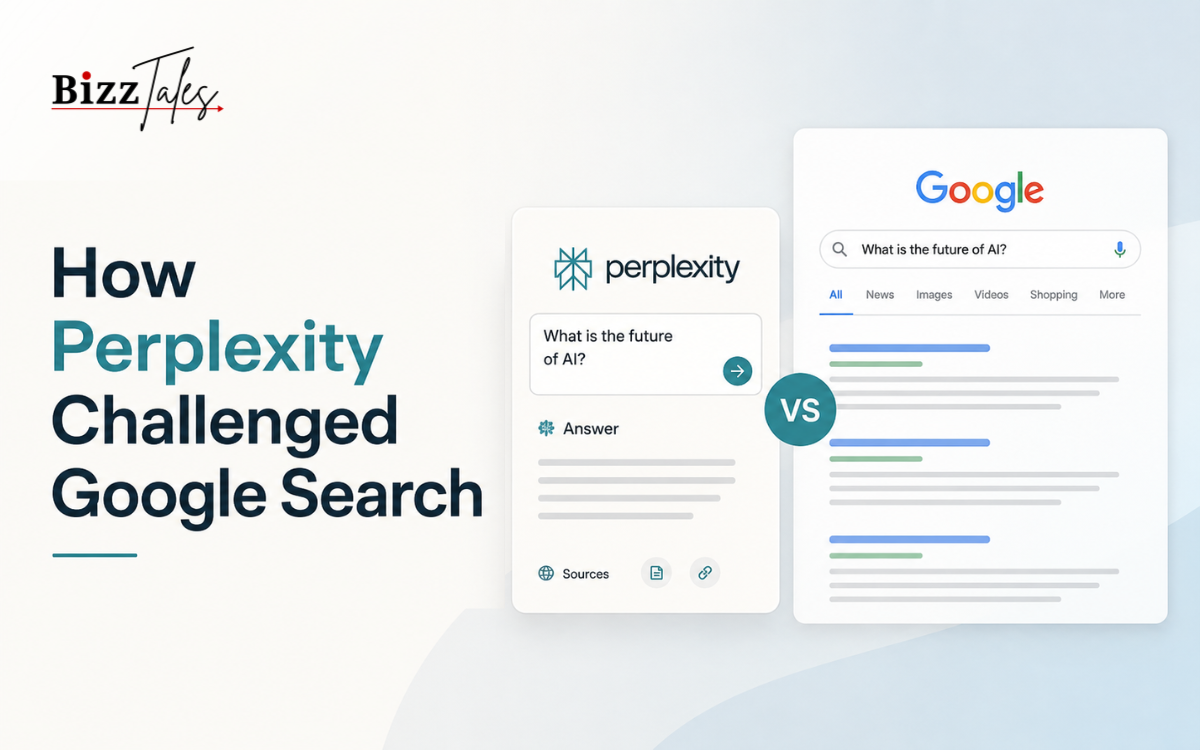
Instead of showing blue links, ads and SEO friendly pages, Perplexity offers a list of direct answers with links to support these answers. What seems to be such a simple idea has made Perplexity one of the strongest threats to search engines as we know them today and has led to something of a debate on the way forward.
This is the tale of how Perplexity took on Google Search and became one of the hot AI startups in tech.
The Search Industry Before Perplexity
Let’s take a moment to get a sense of the where we were before Perplexity arrived:.
Google brought order to the growing world of information available on the internet by creating an algorithm that ranked Web sites for both relevance and authority.
However, in the course of time, search has become more complex.
The second major effect of cheaper and more accessible online data was the widespread inundation of search results with advertisements, sponsored listings and affiliate sites designed simply to rank highly in the search engine. As Google refined its algorithms, users found themselves opening tabs, closely followed by more tabs, always in search of that webpage containing exactly what they had needed.
Say, someone searching for the best A.I. Tools for business. They might have to go through various articles, compare their views, judge their sources, and filtered through the given sponsored links.
This led to friction.
Simultaneously, whereas artificial intelligence became expert at providing users with information in a conversational manner, rather than simply as a list of hyperlinked attachments.
The market was prepared for change.
The Founders Behind Perplexity
Perplexity was founded by Aravind Srinivas, Denis Yarats, Johnny Ho, and Andy Konwinski.
The founding team combined this theoretical expertise with deep knowledge of machine learning, artificial intelligence and largescale technology infrastructure.
The man who became the company’s public face, Aravind Srinivas, had been involved in AI research and was aware of the strengths and weaknesses of present search engines.
The founders identified there was one key change in these user’s behaviors.
People didn’t want to bother clicking on the dozens of websites anymore.
Rather, they wanted quick answers.
They wanted to build not another search engine but an answer engine,.
And this difference would turn out to be one of the best competitive advantage of Perplexity.
What Is Perplexity AI?
Perplexity is an answer engine based on AI that combines AI for chat with live Web search.
Instead of giving you a list of links like other search engines, Perplexity actually produces a full answer to your question and the references that it used to come up with that answer.
This approach allows users to:
- Receive instant explanations
- Verify information through citations
- Ask follow-up questions
- Conduct research faster
- Explore multiple viewpoints
It is more like chatting with an oracle who is knowledgeable on a specific subject.
This easy approach became popular in the global penetration of AI adoption.
Why Traditional Search Needed Reinvention
The traditional search model was built on the premise of locating information for the users.
As far as Agitation he talks about how there should be used to help users elaborate on and assimilate information. (Perplexity)900
Perplexity had been concerned with assisting users to be better able to understand the information.
Although appearing almost insignificant, this disparity instantly alters the way in which the user experiences the system.
Traditional search often requires:
- Multiple searches
- Several open tabs
- Comparing conflicting information
- Evaluating source credibility
- Reading lengthy articles
Perplexity simplifies this step by providing one response.
This can save a huge amount of time for researchers, students, marketers, entrepreneurs and other professionals.
The startup understood that today’s consumers demand rapid, transparent and easy solutions.
The Rise of Conversational Search
What added up to a sea change in user expectations was the arrival of generative AI tools.
As billions of people started talking to AI assistants, they become used to asking questions naturally.
Instead of typing fragmented keywords, users could ask complete questions such as:
What are the most suitable AI solutions for small companies that have small budgets?
This conversational style seems more natural.
Perplexity adopted this fashion right from its initiation.
It provides a space for users to pose nuanced questions, narrow searches with subsequent questions, and tease apart intricate subjects without having to start over.
This resulted in the whole experience being more fluid with more productive research.
How Perplexity Differentiated Itself
Source Transparency
Foremost among Perplexity’s innovations is citing sources.
Many of the AI’s will give and answer without knowing where the pieces of information came from.
Leads to a trust issues as users cannot verify the accuracy.
Let me tell you how it handles this:
Allows the user to quickly check the input and judge whether the information is trustworthy.
This transparency has become synonymous with the [platform] itself.
Cleaner User Experience
Typical search results can be cluttered with included advertisements, sponsored links and competing content.
Perplexity provides a more streamlined interface that is geared towards questions.
It is evident that the simplicity of is attractive to people who take little time to analyze a situation.
Research-Oriented Design
Instead of overall search replacement, Perplexity shines for heavy research jobs.
This service is heavily used by students, professional and analyst, who want to quickly get information from multiple sources.
Contextual Understanding
A conversation with questions already made is saved in the system and the platform certainly “takes the benefit of it”.
This context-awareness makes research more similar to natural representation, thus much more natural and productive.
Challenging Google’s Search Model
The complete still dominance in world search engine market:
Each day, companies undertake billions of searches, and hold such dominant market share over the world’s search business.
Scale1 Perplexity never tried to compete on size.
However, it in fact was a critique of Google’s fundamental framework.
Google uses a searching model to recommend suitable websites to users..
Perplexity has built over first principles which give predefined answers.
This differentiation enabled the startup to carve out a distinctive place in the market.
Instead of replacing Google altogether, Perplexity emerged as a faster, more conversational alternative.
The Role of AI in Perplexity’s Success
Perplexity has artificial intelligence at the heart of its strategy.
This is where the company use large language models (LLMs). LLMs are sophisticated models that can comprehend questions, search for relevant information, and produce answers in a logical manner.
But it is not isolated AI chatbot-Perplexity integrates language models with live web search.
This hybrid approach delivers several advantages:
- More current information
- Better source attribution
- Reduced hallucinations
- Improved factual accuracy
Combining AI with web search, Perplexity built a tool that smacks of intelligence and reliability.
The Impact on SEO and Digital Marketing
The ascent of perplexity has profound consequences for the advertisers, publishers and the search engine optimizers.
While the initial focus of website optimization was its rankings and keywords optimization, modern-seo has now.
The advent of search-engine-relevant AI brings new priorities-
Content must now be:
- Authoritative
- Accurate
- Well-structured
- Easily understandable
- Source-worthy
With answer engines gaining in popularity, companies will need to produce content that can be consulted and cited by AI systems.
Making this transition has prompted a surge of focus around Answer Engine Optimization (AEO), which relates to optimizing content for being included in a response written by AI.
The future for search may be less ranking oriented and more trusted source oriented.
Challenges Facing Perplexity
Perplexity is extremely fast growing website. However, it has a lot problems to resolve.
Competition from Technology Giants
Google, Microsoft, OpenAI, Meta, and Anthropic are all still making the big bucks on AI search.
These companies have vast resources and large existing communities.
Maintaining Accuracy
Content generated by AI needs to be accurate and dependable.
Frustrating errors can shake user confidence at any time:
Publisher Relationships
Numerous publishing companies are worried about losing traffic to their website due to the summaries written by the A.I.
The delicate balance of innovation with proper attribution for content continues to be a problem.
Scaling Infrastructure
Huge amounts of technically investments are needed if you want to support millions of users performance wise.
What the Future Holds
The search industry is beginning to move into a new phase.
The use of AI to find, interpret, and distribute information is quickly becoming part of every day life.
Future search experiences will likely become:
- More conversational
- More personalized
- More context-aware
- More integrated with AI assistants
Perplexity has greatly contributed to hastening this shift.
Even if Google stays the main search engine in the future, the startup has already set an impact on the fact that search products are changing towards.
The’ success shows the importance of answers more that links to surfing.
Key Lessons from Perplexity’s Growth
The story of perplexity carries important lessons for entrepreneurs and companies.
To begin, even in mature industries, providing a real user solution has new opportunities to offer.
Second, new technologies open the door to new competitors.
3rd trust which is still an absolute competitive advantage.
And lastly, differentials matter.
Instead of turning into another chatbot, Perplexity decided to focus on being an answer engine and develop that into its brand.
Conclusion
The emergence of Perplexity has been one of the most landmark events in the search industry since Google was founded.
Through the integration of conversational AI, web search on demand, and visible listing of citations, this company developed a completely new approach to information retrieval.
Perplexity haven’t dethroned Google as the king of Search yet-but their existence has driven home the message that the markets are still up for grabs.
Its growth underlines shifting user expectations and emphasizes the growing significance of information finding by AI.
Even if Perplexity never pushes Google off its throne and more just revolutionizes the game, there’s one thing you can be sure of-IT’S ALREADY SCRYPTED UP THE FUTURE OF THE SEARCH.
FAQs
What is Perplexity AI?
What is Perplexity AI? Perplexity AI is an answer engine empowered by AI that delivers answers in a conversational manner with citations of sources sourced from all over the web.
Who founded Perplexity?
Perplexity was founded in 2022 by Aravind Srinivas, Denis Yarats, Johnny Ho, and Andy Konwinski.
What is it that making Perplexity more fashionable?
Its rise to prominence is due to conversational search, source transparency, AI-generated answers, and a more streamlined user experience.
Can Perplexity take the place of Google?
However Google still rules in navigation, local searches, shopping, and its world leading crawling and indexing capabilities.