
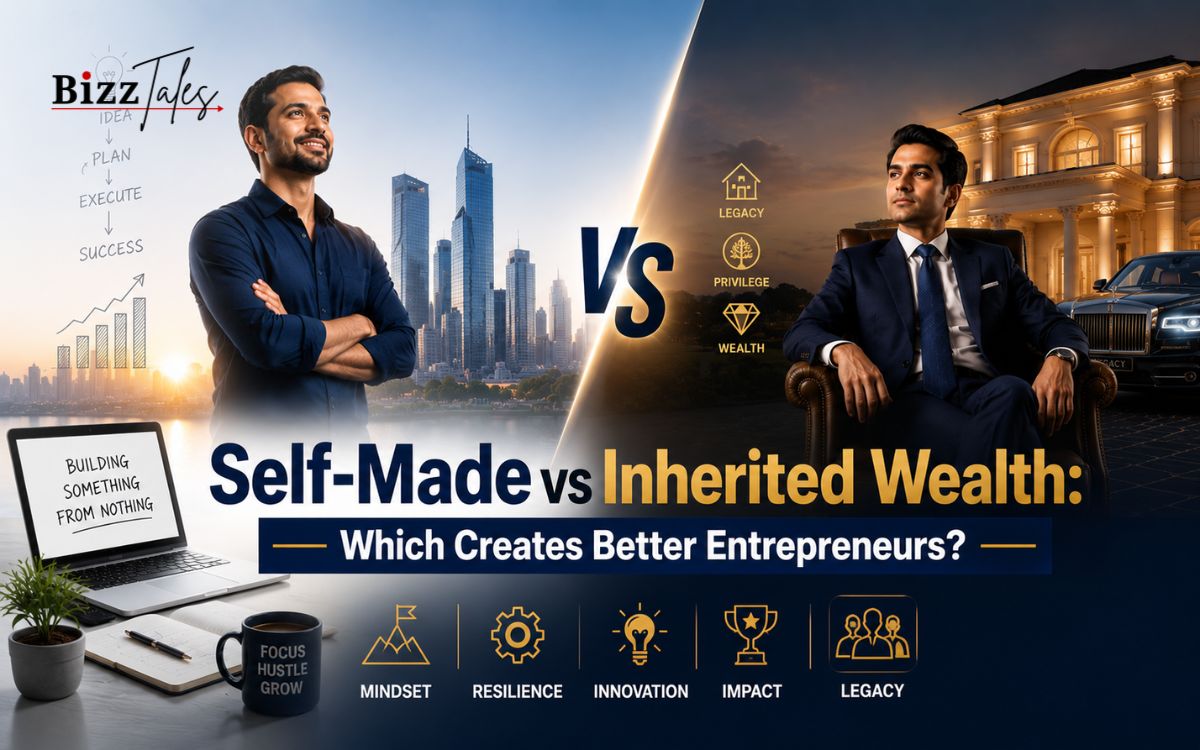
The argument between Self-Made vs Inherited Wealth has been going on for a lot of time. Normally, people’ discussion about entrepreneurs, there almost always one question pops up: whether or not building business from nothing makes better entrepreneurs than inheriting money in the first place and then further develop it.
There are those who think that the self-made entrepreneurs have a more robust work ethic as they have lived the experiences of financial hardship, rejection and doubt. However, there are those who believe riches can open up resources, relationships and opportunities that will allow entrepreneurs to grow even larger entrepreneurships.
Nothing is black and white, one side or another. We had entrepreneurs with no capital who created multinational empires and on the other hand we had plenty of top business leaders who, inheriting family business or wealth, successfully developed them into multinational conglomerates.
The need to compare is misguided. The key question should be, do the situations of self-made and inherited wealth lead entrepreneurs to behave differently, and do those differences matter?
It is important to understand these distinctions. They also reveal useful observations about – are you ready? – entrepreneuership, leadership, taking risks and success in the long term.
Understanding Self-Made Wealth
A self-made entrepreneur is someone who “created wealth on one”s own. A self-made entrepreneur is often a person with a very humble background.” Strong determination and resilient are often the characteristics of the self-made entrepreneur who is usually self-motivated. Their wealth is individually built on their own, perhaps by going into business owned by them.
The self-made story often comes with a “hard-ship” flaire. Self-made entrepreneurs starting from humble background typically struggle with lack of investment, financial resources, or prevailing network.
As resources are limited, they are forced to learn how to make the most of every available opportunity. They develop expertise in problem solving, cost management, negotiation, dealing, and flexibility.
Most of the entrepreneurs who are most loved in the world belong in this category. The stories of their rise to success motivate millions because they prove that people can achieve anything no matter where they begin.
The fun of self-made accomplishments is in the fact that one earned it all on his own.3
Understanding Inherited Wealth
Heredity wealth is another term used for inherited wealth. It is defined as money, property, assets, business, family wealth, etc., transferred from one generation to the other.
Many people think that inherited wealth is a direct gateway to the success of the business. But, growing and managing wealth itself has its own hitches.
In addition, entrepreneurs who come from a wealthy family have a potential access to better education, experienced mentors, well-established contacts and capital for starting up new businesses. All these resources can ease many difficulties experienced by inexperienced entrepreneurs.
Simultaneously, there is the expectation that inherited money will be able to be carried on by certain groups. Next generation owners of inherited money are already expected to be able to take the family’s production to the next step.
A performance pressure can be very high. While self-made entrepreneurs are challenged by the task of wealth creation, heirs are challenged by the task of proving their right to the wealth.
It’s not exactly easy to expand accumulated means rather than keep it as it is. You need real entrepreneurial ability for that.
Why Self-Made Entrepreneurs Are Often Admired More
Many in the society admires the entrepreneurs who made their own way to the success.
Stories of hardship, sacrifice and success naturally resonate with most individuals. A highly successful entrepreneur who begins with almost nothing can easily be a beacon of what can be possible.
Self-made founders have encountered each phase of growing a business. They get it. They know how to find and keep a customer, handle cash flow, find and hire good people, and fight off competitors because they have been through it themselves.
This practical experience frequently enhances their judgment skills.
Another factor behind their popularity is that self-made entrepreneurs are more relatable than other famous businesspeople. Actually, a major portion of the population does not owe big money or carry on a well-known enterprise. Hence, self-made entrepreneurs are a model to be followed.
These stories give hope to would-be founders by showing that one’s past does not always predict their future.
The Advantages of Self-Made Entrepreneurs
The entrepreneurs who ever end up getting rich on their own are likely to possess many of the characteristics that makes money on his own.
An advantage of self-made entrepreneurs is resilience. As they face many hurdles, self-made entrepreneurs get to understand how to bounce back from a failure.
And they also tend to be very creative. Their small budgets require that they come up with creative solutions instead of having time, people and money available.
Another shared trait is financial discipline. Entrepreneurs who have lived through a period of deficit tend to be very conscious of they costs, investments and profitability.
Finally, self-made founders tend to be intimately familiar with their own companies. They’ve managed the company through each step of growth, from creation to scale.
Experienced as this through your career, you can develop formidable leadership skills and a practical sense of business realities.
The Advantages of Entrepreneurs with Inherited Wealth
Although self-made entrepreneurs are competitive and highly respected, inherited wealth will attract without much suffering.
One clear advantage of having access to capital. Having cash in hand gives an entrepreneur greater room to invest in everything from product innovation to talent.
Existing networks also count. Existing family ties can help introduce one to seasoned executives, investors, advisors, and industry partners.
Another benefit is education and familiarity. It is likely that the son of a business family (whether incorporated or unincorporated) will have learned business skills before he can remember. Such a person will have learned “business skills” well before many of his competitors have learned them all by themselves.
Inherited wealth may also lead to increased risk taking. With their financial survival not at immediate risk from failed ventures, wealthy businesspeople can go after more speculative projects than might otherwise be the case.
Collectively, when applied along with talent and vision, these are the fruits of incredible result oriented management.
Mukesh Ambani and the Expansion of a Legacy
Among one of India’s top businessplexamples of inherited wealth along with entrepreneurial execution is Mukesh Ambani.
Ambani did not have to start his empire from the beginning, but he had the advantage of inheriting a large business base that was built by his father Dhirubhai Ambani. Although a heritage is a prospect that many businessmen dream of, it does not ensure glory.
While under the guidance of Mukesh Ambani, Reliance ventured into telecommunications, retail, digital service space and many new emerging areas. The massive expansion exemplifies the fact that business created by predecessor still needs to have continuous innovation, strategy and leadership.
His story makes one thing clear. Wealth coupled with inheritance may offer opportunities, but to leverage those opportunities into greater success one has to be entrepreneurial.
Dhirubhai Ambani and the Self-Made Journey
However, Dhirubhai Ambani is often considered to be one of India’s greatest self-made entrepreneurs.
Using small beginnings he grown up i.e. Reliance an empire of Indian most powerful business group. The Life history of Dhirubhai Ambani holds many similarities of ‘Self-made’ founders like resilience, risk taking attitude, huge ambitions, and forceful growth.
The comparison of Dhirubhai and Mukesh Ambani brings out an interesting fact. Both have very different backgrounds but ended up being very successful.
One established the base, while the other greatly developed it.
Implications of what we have learned. Based on what we have learned their stories lead to the suggestion that entrepreneurship is alive and well where it is self-formed or handed down.
Does Inherited Wealth Reduce Hunger for Success?
Another common objection to the inheritance of wealth is that it could potentially serve as a disincentive.
However, detractors state that those born into wealth lack the pressure that many entrepreneurs face to succeed. This lack of pressure, while in absolute terms providing a better life, may result in a lack of the work ethic and risk taking spirit of its self made entrepreneurs.
There is some truth in this observation in some cases. Throughout history, well established fortunes have been spent away by subsequent generations.
But the other side is also possible.
Numerous heirs are under considerable demands to justify. Instead of being complacent, they continue to fight in order to prove to others that their success is from their own achievements and efforts.
It is more often personality that determines the result than the size of the pocket.
What Research Says About Entrepreneurial Success
Even in those studies that have A prevailing theme in entrepreneurship studies has been the exploration of the reasons behind a specific success; never or very rarely have these studies emerged with just one advantage in favor.
Resources are important. Connectivity/Networks are important. Education is important. Experience is important. Timing is important.
Nonetheless, some characteristics including perseverance, adaptability, leadership and decision-making seem to be prominently among those of interest, no matter how wealthy their background might be.
An entrepreneur who is not disciplined can be a failure even through determination to succeed. A entrepreneur with family background can be a failure even through the advantage of capital.
Who are the best founders and most successful? It is probably those who find the best opportunity and who execute the best.
Opportunity may be the same at the start, but long-term success depends on how well opportunities are utilized.
Which Type of Entrepreneur Creates More Innovation?
Having innovation originated from either Group 1 or Group 2 was possible but their incentives and motivations to innovate were not necessarily comparable.
Entrepreneurs who makes their way up from grass levels motivated through necessity to invent a product or l business idea in order to address a personally pressing problem (Hatten, 2006). Limited resource restraints push the entrepreneur to think creatively and differently.
Entrepreneurs endowed with inherited wealth may tend to innovate because they can afford to be innovative, since they can afford to be financing ambitious projects, try out new inventions, and explore new technologies.
Many of the most disruptive companies the world has seen were founded by entrepreneurs with minimal initial resources. Then there are those has turned existing assets into huge technological breakthroughs.
What does it really takes to make “it” happen? Innovation is more about vision and execution than the capital.
The Real Difference Is Perspective
Maybe, the most important difference between self-made and inherited money is the point of view.
Self-made entrepreneurs tend to develop an opportunity creation mentality by learning to generate value from meager resources and embracing the unknown.
Entrepreneurs who inherit wealth form an mind-set about acquisition of opportunities. They discover how to access, reuse, enhance and leverage their inherited resources, inputs and stocks.
However, both have their merits.
One is great at creating new opportunities. The other is sometimes a hero at getting old ones to work to their maximum advantage.
Top business executives are those who incorporate some aspects of each of the approaches.
Conclusion
The debate between making it oneself or having it handed down will likely go on forever. No matter which is taken, a self-made and (inheritance) made entrepreneur will come out of it, with their own different benefits and problems to deal with.
Self-generated entrepreneurs often acquire resilience, ingenuity, and thorough-operational knowledge by trial-and-error. Their successes motivate their audience.
Entrepreneurs with inherited wealth have access to capital, networks, and opportunities that can foster growth. This, coupled with vision and leadership, it can generate spectacular business success.
In the end, all of the readings say that wealth is simply not the key to entrepreneurial success. Other attributes such as character, implementation, flexibility, and good judgment matter far, far more.
Where they came from does not define the best entrepreneurs. They determine by what they create, how they lead and how they add value to other people.
Wealth, regardless of self-made or inherited, what I believe true entrepreneurship is turning opportunity into sustainability.
FAQs
What distinguishes landowning wealth from self-made wealth?
Self-made wealth refers to wealth that is generated by an individual through his own enterprises or investments and is not inherited. Inherited wealth refers to wealth inherited from parents and family.
Can self made entrepreneurs achieve equal or higher levels of success compared to entrepreneurs from inherited wealth?
Not necessarily. Today’s success is determined by leadership, choosing, innovation and execution and not how the money was made.
What is it about self created entrepreneurs that attract so us to them?
Successful self entrepreneurs are often admired because it’s about the story of trial and error, of risk taking, building from nothing.
What if? Can a private fortune “boost entrepreneurship”?
Yes. Old wealth, like boomer wealth, can be a resource of capital, education, mentorship and good information networks.
Are entrepreneurs with family wealth at a disadvantage?
Yes. They frequently find themselves under the strain to uphold family histories, demonstrate their competences and successfully steer current assets and businesses.
Which is more important in an entrepreneur: mind set or money?
Awareness typically has a greater impact. While prosperity can offer benefits, attributes like perseverance, flexibility, leadership, and implementation often play a more significant role in lasting achievement.