
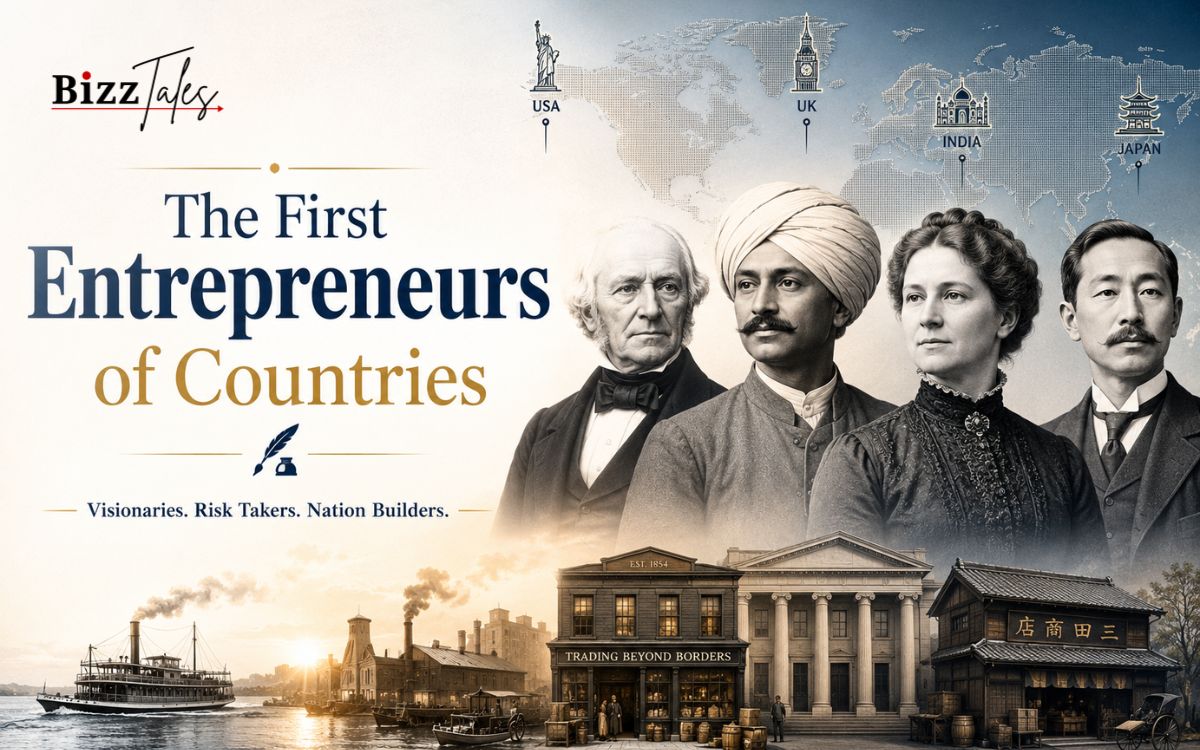
Everyone has a prototype entrepreneur in his mind when he hears a word “entrepreneur”-today’s young start-up entrepreneurs, technology freaks, and billion Dollars company CEOs. But entrepreneurship is much older than internet, industrial revolution and corporations.
People already had entrepreneurs, understood the concept of risk and business, and had established wealth long before the existence of venture capital companies, financial markets or multinational corporation. Trade, industry and the beginnings of nations were being established by them.
Though there is no way to definitively determine the very first entrepreneur of any given country, some of the earliest innovators and entrepreneurs that helped create nation states and turn economies around are described below.
Entrepreneurs who created international trading routes and those who transformed techniques of production and production itself, from traders in search of larger markets to founders who changed manufacturing industries, shaped the modern world.
This trip is sure to introduce you to some of the first stars of major countries, whose ideas, risks and innovations continue to provide inspiration for businesses today.
What Makes Someone an Entrepreneur?
I think it is crucial to learn about entrepreneurship as a whole before any extensive individual country comparisons.
There is more to it than being a business owner. Entrepreneurs detect opportunities, assemble resources, take risks and deliver value using different approaches-innovation and commerce.
Throughout history entrepreneurs existed in different forms. They included traders who imported and exported goods from different regions of the world, designers who created manufacturing systems, technological dynamists and entrepreneurs who pioneered new opportunities.
Despite the evolution of facilities and markets, the fundamentals of entrepreneurship are the same: the identification of opportunities, the willingness to take risks and the creation of value.
The United Kingdom: Matthew Boulton and the Birth of Industrial Entrepreneurship
There’s no one more fundamental to early British entrepreneurship than.
Born in 1728, Boulton was one of the leading entrepreneurs of the Industrial Revolution. Although Britain had for many years had traders and merchants, Boulton was the beginning of a new type of entrepreneur-one who combined innovation, manufacturing and large scale business.
His collaboration with James Watt brought the use of the steam engine into commercial use.
Instead of simply creating products, Boulton sought to make entrepreneurship out of his innovations. He established large manufacturing facilities and pioneered new commercialization strategies to facilitate widespread dissemination of technologies throughout Britain.
That studies in business and economics now see the entrepreneur as the ‘discovery and masterful exploitation of economic opportunity’ and that according to many historians entrepreneurs such as Boulton ‘can count as leading the ‘first industrial nation’ in Britain’, suggests that in their contribution to the development of Britain as Europe’s first industrialized economy-entrepreneurs played a significant role!
His work revealed that technological change could actually result from entrepreneurship in the macroeconomic scope.
The United States: John Jacob Astor and America’s First Business Empire
From the early days of the United States, entrepreneurs have emerged at an alarming rate. However, the very first and one of the finest entrepreneurs is said to have been called John Jacob Astor.
Born in Germany, where he immigrated from to America, he was under equipped but over ambitious. During the second half of the eighteenth century and the first quarter of the nineteenth century, he made his wealth selling fur and transitioned into real estate.
When the United States was in its infancy, Astor built one of the nation’s first great business empires.
He gained advantages, which rendered a success, through in-depth knowledge of demand at the market, establishing large shopping centers (networks) and identifying opportunities with longer-term value (investment view).
- Astor possessed some characteristic attributes of an entrepreneurial founding father, innovations, perspective, risk taking, sense of timing etc.
- Astor was innovative.
- Astor was able to anticipate potential opportunities other entrepreneurs failed to recognize.
He was the richest man in modern American history at the time of his death.
India: Jamsetji Tata and the Foundation of Modern Indian Entrepreneurship
The roots of Indian entrepreneurship go back hundreds of years through its myriad traders, merchants and industrialists. But in the realm of modern day entrepreneurs, few have a worthier mention than that of Jamsetji Tata.
Founded in 1839, Tata had the foresight for an industrial India at a time when India was under British domination.
But instead of emphasizing trade, he felt compelled for the implementation of comprehensive industrial expansion. He put resources into textiles, aluminum and iron and steel plants, focused on teacher preparing and transport facilities that came to be foundational for Indian economy.
It was Tata’s future-oriented vision that set him apart. In his mind, the Indian economy had to be built on robust indigenous industries;
Many of the institutions and companies he set up are still advancing India today, as the Tata Group.
His entrepreneurial vision was prevalent profit alongside nation building. His vision still remains one of the most respected definitions of entrepreneurship in India.
China: Hu Xueyan and the Entrepreneurial Spirit of Imperial China
The commercial history of China is over several thousand years. It is hard to find the first entrepreneur in the world, but one of the well-known entrepreneurs is Hu Xueyan.
While living in Qing Dynasty the domains in which Hu built a deep business connection was in banking, trade and traditional medicine.
- He understood the dynamics of relationships, reputation and markets.
- He grew his businesses in many sectors and become one of the richest businessmen of China.
- He was known as a philanthropist and a contributor to the common well-being.
Hu aided community parks, supported charitable funds, and financed flood control.
His entrepreneurial lifestyle is still current focus of study in China.
Japan: Eiichi Shibusawa and the Father of Japanese Capitalism
Few people have influenced Japanese business more than Eiichi Shibusawa.
Born in 1840, Shibusawa is credited to have consolidated Japan’s modern economy during the MEIJI RESTORATION.
He played a role in the creation of hundreds of companies in the fields of banking, manufacturing, transportation, and commerce. He was committed to profitable and ethical business principles, which was not always the case with his contemporaries.
Shibusawa held that economic growth and social responsibility should co-exist and not compete with each other.
His impact contributed significantly towards establishing the groundwork for the drastic changes faced by Japan’s industrial and economic structure.
So it is that today considered to be the ‘grandfather’ of Japanese entrepreneurs!
Germany: Werner von Siemens and Industrial Innovation
It is however to be noted, that is not only the number of the inventors and industrials that make up the entrepreneurial history of Germany but also the figure of Werner von Siemens, who is an important part of it.
The company detected years in advance the business opportunities of electricity.
However, through the company that later became Siemens, he promoted telecommunications, engineering, and industrial infrastructure.
His ventures showed that scientific innovations could lead to full-fledged enterprise.
His vision is still enduring, as evidenced by the fact that the Company still exists on the global stage.
France: Armand Peugeot and the Rise of Manufacturing Entrepreneurship
Innovative Spirit thrives through entrepreneurs throughout France. Some early industrial entrepreneurs were influential, such as:
Peugeot saw the promise of the car while the industry was still young.
His experimentation with newer form of technology helped establish one of the world’s oldest motor companies.
Like many entrepreneurs seeking to make their mark, he was the first in his industry to address an undefined marketplace. He was venturing into a world of daunting unknowns, where the signs of mass-marketdom and the corresponding needs among consumers were mostly absent.
He was exhibiting a fundamental entrepreneur trait: the recognition of like-minded opportunities well ahead of the rest of us.
Why Early Entrepreneurs Were Different
Today, modern entrepreneurs have access to technologies, infrastructures, capital markets, and global markets that their predecessors could not even dream of.
Yet those from earlier centuries encountered challenges as perilous as those of today.
Communication was much slower. Transportation was also limited. Monetary systems were not well established. Political collapse often resulted in even more uncertainty.
Following these difficulties, starting entrepreneurs established businesses that reformed nations.
To achieve these, they needed outstanding foresight, perseverance and flexibility.
They could be seen as the most individual or entrepreneurial entrepreneurs in many ways, as they were working in terrain where there were few if any âas established roads’.
The Common Traits Shared by Early Entrepreneurs
Despite originating from various nations and fields, these pioneers and mavericks also had much in common.
One thing I saw in all of them was thinking in the long run. They were not after small wins but were looking for avenues to build something big that would reward over time.
Another good common characteristic was resilience. Creating companies in a dynamic environment needs stubbornness and flexibility.
They also recognized the importance of innovation. Innovations in technology, new routes of trade, refined methods of production-they thought about it all in terms of value creation.
Most importantly, they were ready to take risks that others were afraid to take.
By acting even in the face of uncertain, they managed to influence industries and economies.
How These Entrepreneurs Influenced Modern Business
The impact of these initial entrepreneurs is too pervasive to be measured.
They defined the principles that still underpin entrepreneurship: innovation, stratification, customer orientation, investing in infrastructure and a long-term perspective.
The foundations for which are laid by these personalities have remained consistent still today’s entrepreneurs follow the same according to divergent factors.
Technology startups aim for scalability just as industrial entrepreneurs crafted efficient means of production. Several global brands have invested in broadening their market, similar to the way early trades established global networks.
While modern industries have taken many shapes over the years, the essence of entrepreneurship has continued to be very much the same.
The Evolution of Entrepreneurship Across Countries
Entrepreneurship is present and continues to develop in each country.
The United States established its position as the world leader in innovation and venture capital. The UK laid down a foundation of industrial entrepreneurship. India established a formidable technology and manufacturing ecosystem. China (mainland) stood tall as the leading producer of trade and manufacturing. Japan was recognized for its Quality and Operational Efficiency.
The entrepreneurial culture of every nation is shaped by its ancestors whose presence is persisted across many generations.
Knowing where these come from helps to make sense of why the concept of entrepreneuship exists in different forms across the globe.
Conclusion
The history of entrepreneurship is the story of people and their ability to identify opportunities and take advantage of them.
People like John Jacob Astor, Jamsetji Tata, Matthew Boulton, Hu Xueyan, Eiichi Shibusawa, Werner von Siemens and Armand Peugeot were among those that laid the economic groundwork of their nation states.
Though they lived in different times and on opposite sides of the world and markets, Knight and Osterweiss both believed that it is finding the opportunity and having the nerve to act on it that will push you forward.
The legacies they left behind are still inspiring entrepreneurs all over.
Modern founders are populating their companies with artificial intelligence, renewable energy, biotech, and digital platforms, but they are continuing a legacy that the first great entrepreneurs of the world began centuries ago.
FAQs
First ever entrepreneur in the world was he.
No such person as the first entrepreneur has been officially established or acknowledged. Everybody has to realize that trade and commerce took thousands of years to develop and no global identification of the world first entrepreneur is ever possible.
The pioneer of Indian entrepreneurship: Without any doubt, Dhirubhai Ambani can be called the father of modern Indian entrepreneurship.
Jamsetji Tata is popularly considered to be the father of modern Indian industry, education and entrepreneurship.
Who was the first great entrepreneur in America?
John Jacob Astor has been regarded by many as one of America’s first leading entrepreneurs due to his achievement in both trade and property development.
What is the significance of historical entrepreneurs?
These entrepreneurs of the past contributed to the founding of industries, the scaling of trade routes, and the formation of economies which still impact contemporary business.
What characteristics did entrepreneurs of the past have?
Are scores of vision, resilience, innovations, risk appetite and downstream thinking.
How Does entrepreneurship in the present differ from the past?
With a state-of-the-art technology, worldwide market, venture capital and an ultimate digital communication sellers have a brilliant tendency to expand business more than luminaries of the past.