
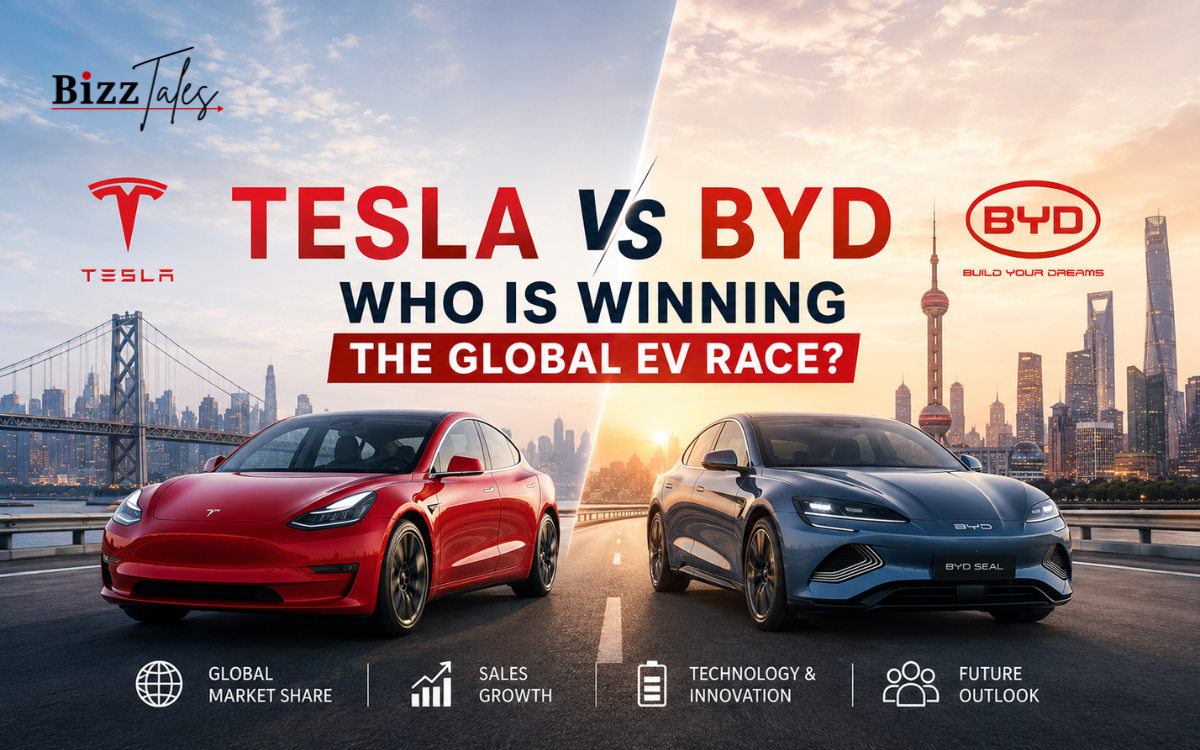
The world’s automotive industry is undergoing one of its most dramatic upheavals. Vehicles that ran on gasoline and Diesel engines have been around the world for more than a hundred years. The major car makers such as, Toyota, Volks Wagen, Ford, General Motors or Mercedes Benz built their empires on manufacturing, innovation and global distribution.
The advent of electric vehicles however has altered the competitive environment.’
What used to be a niche market has become one of the fastest growing industries in the world economy. Governments are promoting greener transportation, consumers are becoming environmentally aware and technological developments have made electric vehicles more viable than ever before.
Two companies have really benefited from this process. They sit at the epicentre of the change while leading the charge in the EV revolution: Tesla and BYD.
For long a time, Tesla was considered as the clear market leader in the EV industry. Initiated by entrepreneurs determined to challenge the traditional process of car manufacturing and driven by Elon Musk to become an electric car giant, Tesla has actually been a pioneer in the industry and exemplifies that electric vehicles are at least as much, if not better, than typical cars.
But a strong challenger has developed in China.
BYD, a once battery manufacturing company, has taken a drastic change and become arguably the largest electric vehicle company in the world. Its quick growth, relentless global expansion and strong hold of Chinese auto market have established BYD as the toughest competitor to Tesla.
The question everybody’s been talking about in the industry today is no longer if electric vehicles are going to get adopted. It is: who is winning the race of Electric Vehicles (EVs)-The Tesla or the BYD?
The answer, unsurprisingly, is a little more complicated than this.
The Origins of Two EV Giants
Tesla and BYD approached entering the EV market from vastly different angles.
Tesla was established in 2003 with the idea of “accelerating the advent of sustainable transport by bringing compelling mass-market electric cars to market as soon as possible”. At this point, most car manufactures had been experimenting with electric cars solely for amusement and evading the idea of mass market production. Tesla focus specifically on electric vehicles before any other company and introduced the world to electric vehicles. Recognized by their snazzy early models that defied our expectations of electric vehicles: slow, unattractive and with poor range.
The products was developed over time, with the introduction of the Model S, and the Model 3, Model X and the Model Y. Each new product strengthened Tesla’s mantle as the face of the electric car revolution.
This is not the same for BYD. It was a different story.
Back in 1995 the company was known for assembling batteries, so that was the first product that come into the car company. Needless to say, BATTERY business has led company into to car business…where a lot of American automaker tried on luxury EV..the Chinese company was aiming at all the segment of the market “first”.
Its battery know-how became one of its most significant competitive edges. Eventually, BYD diversified into electric and hybrid cars, mini and large buses, trucks, and power storage.
Vs, while Tesla was creating a global brand, BYD was creating an industrial superpower.
Tesla’s Role in Creating the EV Industry
Any discussion of the new era of the EV industry would be incomplete without mentioning what Tesla has done to enable its growth.
Prior to Tesla, there’s the general perception that electric vehicles were truly niche vehicles with very little mass-market appeal. Most big traditional car manufacturers viewed EVs just as compliance vehicles, with no intention for mass-market success.
And then Tesla comes and turns that around.
Tesla not only proved that EVs can have great performance, great range and cutting technological features, but in fact they made EV life to be more than that.
Innovations like OTA (over the air) software updates, smarter driving instruction, simple cabin interior, and a large network of chargers all set the Tesla apart from the rest.
With the Model 3 Tesla finally reached a much wider audience of mainstream consumers, rather than just the luxury buyers they had been for the Model S.
Tesla demonstrated the importance of electric cars, essentially forcing the rest of the car industry to shift gears.
The EV market without Tesla would probably be very different today.
How BYD Quietly Built an EV Empire
Meanwhile, while Tesla was attracting attention, BYD was was. It was focused on expansion and improving existing factories.
Electric vehicles as the future of transport, started to be sold and had the world’s largest market. BYD saw the opportunity, and know the heart and soul of the world market.
One of the companies’ greatest strengths is vertical integration.
Making most parts by itself is something an automaker would love to do, but most of the automotive manufacturers were relying on suppliers. Comparing to competitors, BYD is manufacturing many parts like batteries all by themselves. It balances its costs, supply chains, and production.
BYD’s Blade Battery was also introduced which helped to strengthen the position.
The safety, longevity and price benefits of the battery made it a real selling point. With battery costs representing one of the greatest impediments to EV adoption, BYD’s battery expertise offered a distinct advantage.
The company also had a more comprehensive product strategy than Tesla.
Although Tesla deals only with cars aimed at people, BYD has a very broad variety of Hybrid and Electric cars in any number of price ranges.
Diversified the product pages, resulted in BYD gaining a wider group of people.
Sales Numbers Tell an Interesting Story
Tesla has been comfortably ahead of the pack in EVs for many years.
The trend, however, has dramatically changed over the last few years:
With growing demand in China and an expanding international business, BYD has continued to increase vehicle deliveries, becoming one of the world’s largest manufacturers of new energy vehicles.
Tesla has remained a leader in sales volume, especially in North America and Europe. However, BYD is broad enough in China to take pole position in total delivery numbers.
The contest has grown tougher.
However, isv reporting that BYD has overtaken Tesla in total EV sales, some other sectors of the pure battery-electric market have not!
It is no longer a one-sided fight.
Instead, it has become a rivalry that is so closely observed it serves as a reflection of the wider changes taking place in the global automotive industry.
Technology and Innovation
Technology is still one of Tesla’s key strength.
The company is well known for is software aspects, ambitious ‘autonomous driving’ plans and integrated ecosystem approach.
Tesla motors are more software platform than car. Recurring software updates continually improve pace, optimize function and introduce new features. This innovative approach has earned Tesla a reputation for innovation.
The endeavor known as Tesla’s Full Self-Driving (or FSD) continues to be at the forefront of the most audacious and groundbreaking ideas in the American car industry.
Despite ongoing regulatory and technical challenges, the autonomous technology is expected to remain the company’s competitive differentiator.
BYD has their own approach to innovation.
Instead, BYD put more concentration on manufacturing efficiency, battery technology and low cost instead of nearsoftware.
Its Blade Battery is a huge breakthrough in safety and performance of battery.
Furthermore, the speed with which new models are launched makes the company very flexible to market changes in consumer demand.
While both companies innovate, they focus on different drives of the electric vehicle.
Global Expansion Strategies
The company’s overall international plans of action include the American, Chinese, and European markets.
The factory’s offer is now focused on Giga factories. These are big manufacturing factories which permit to Tesla to produce cars more near to customers and shrink the logistics costs.
One of Tesla most valuable assets is its Brand Awareness. In most Countries,Tesla is currently the reference point regarding electric cars.
It is BYD and others that have aggressively ventured abroad from home.
The firm has penetrated markets in Europe, Asia, and LAM. The firm pursued a low cost strategy, by providing low prices aided by its large scale of manufacturing.
With global governments supporting the adoption of EVs, BYD views these opportunities as major markets to win.:
The company’s foreign tendancies are starting to show.
Pricing Could Decide the Winner
As always, affordability among the biggest reasons for consumers opting for an EV; and is a key battleground in the race to dominate the electric vehicle industry.
Tesla, ever by the brand positioning premium. It launched more affordable models, but the aspirational element of the brand remains.
BYD’s Way.
The company carries a wider selection of cars within various price ranges. It therefore has the ability to appeal to those customers who couldn’t afford to buy a Tesla.
As they become more widespread, cars are likely to become even more affordable.
Much of the industry believes that winning will go to the company that can best balance technology, quality and cost.
The strength of BYD seems to be significant here.
The China Factor
The game will be decided ultimately by China, it’s vitally important for China to be successful.
The country is the worlds largest automotive market with the largest market for electric vehicles.
BYD has significant exposure to local customers and has large fully integrated domestic operations.
Tesla’s depth in China is still well maintained through the Shanghai Gigafactory. On the other hand, the fierce competition from domestic Chinese brands hits tighter than ever.
It is essential to their long term race that Renault succeeds in China.
What Investors Are Watching
Investors see Tesla and BYD in the opposite lights.
Tesla is typically measured as more than just an auto manufacturer. Its robotics, artificial intelligence, self-driving car technology, and energy market projections influence its market expectations.
BYD continues to be known as a fab machining powerhouse with superb operation capabilities.
Its capability to appropriately scale the production line, while reducing costs to a competitive level has gained the interest of investors.
They both tell very interesting growth stories, but they represent 2 very different ways of looking at the investment story.
Who Is Winning the EV Race?
It depends upon how you’re going about defining success and.
If brand awareness, software innovation, and technology disruption are prioritized, Tesla continues to be a power to reckon with.
If the emphasis is on production scale, price, battery know how, and market penetration BYD has made great strides and might have advantages in many fields.
The truth is, they are both winning in different ways.
Tesla is pioneering the next era of cars.
BYD still hit the ability of manufacturing and strategic execution.
Instead of one single winner, the EV revolution could:
Conclusion
The Tesla vs. BYD rivalry is one of the most significant business stories about the auto industry in recent years.
Tesla was the pioneer of electric vehicles, altering consumer perception globally. BYD focused on battery capability, manufacturing world market share, and international expansion to emerge as perhaps the most significant challenger to Tesla.
Both have contributed significantly to the evolution to environmentally friendly transit.
With in increasing push by governments for cleaner energy, by more and more consumers getting into electric transportation and technology continuing to evolve, the race between Tesla and BYD is bound to heat up.
It’s too early to tell if Tesla will forgo its technological advantage or BYD’s manufacturing capability will eventually win out.
No doubt, the big EV competition has much more to deliver, with Tesla and BYD quite dominating it still for a while.
FAQs
Is BYD bigger than Tesla?
BYD has overtaken Tesla in some vehicle delivery statistics, especially when there is a combined sell of the hybrid car and electric car. Nevertheless, Tesla is still one of the most precious automotive companies in the world and still maintains leading in certain tech fields.
Why is BYD growing so fast?
BYD pays due to its significant battery knowhow, vertical integration, competitive price as well as its undeniable domination market inChina. Led to its acceleration growth.
What makes Tesla different from BYD?
Tesla is focused on software, autonomous technology, and innovation in the technology space – BYD is focused on production, batteries, and price.
Which company sells more electric vehicles?
What is the answer? It depends on the timeframe and inclusion of hybrids. The answer is both automakers have been two of the leading EV sellers in the world.
Who is likely to win the EV race?
There won’t be a single winner. Tesla and BYD are strong in different ways and the two are likely to be long lasting players.