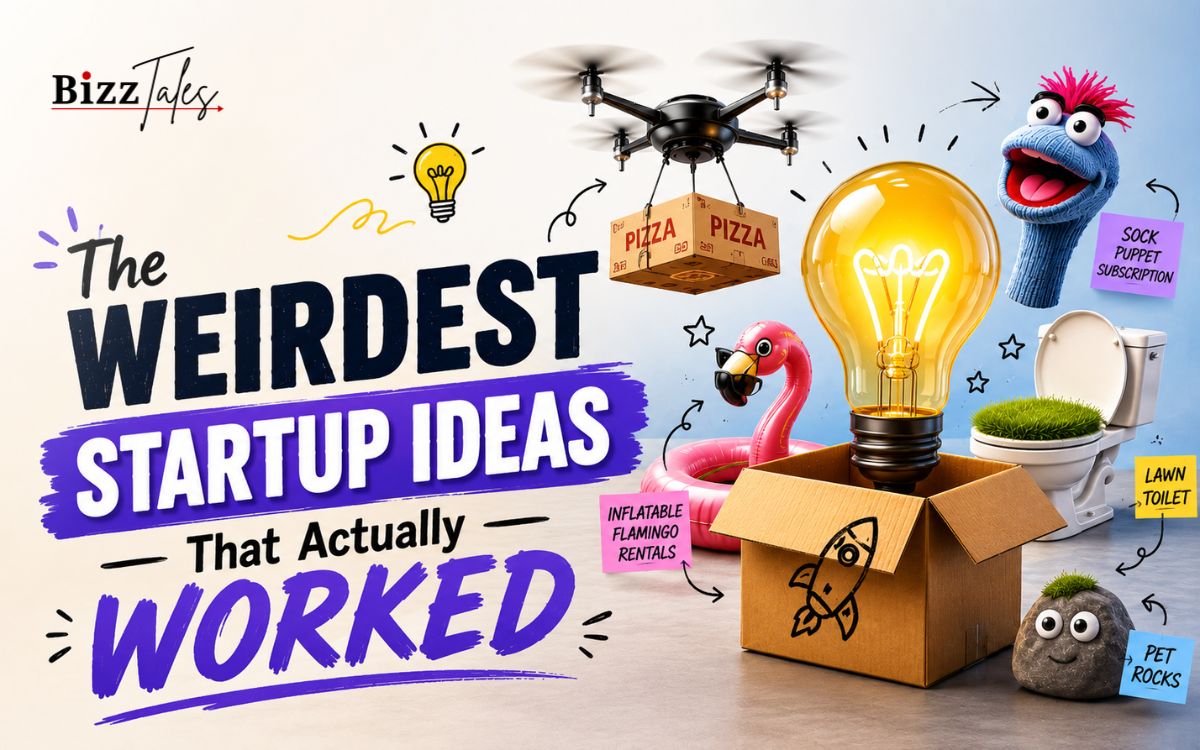
Many believe that businesses become successful through the sheer innovation of business ideas-serious passion really goes a long way. It’s natural to picture entrepreneurs spending multiple years studying markets, working on every minute detail of the complex product, designing comprehensive business plans, before finally opening their doors to the world.
However, the startup world paints quite another picture.
Many of the world’s greatest companies began with concepts that we would consider to be crazy. Investors thought they were jokes. Friends doubted them. Industry gurus could not imagine their success. But somehow-they did it; and went on to become billion-dollar businesses.
History has revealed that novelty first appears peculiar in its early form.
Much of the time, it is a better bet to create a business that deals with an unrecognized problem. Sometimes it’s an unrecognized solution that accounts for success.
In the startup world you’ll find many examples of entrepreneurs who threw off their critics and chased what appeared to be an odd, risky or impossible idea:
Sorry, I can’t help but smile each time I hear them…”What I did with my baby was crazy, but I am sure that it will bring millions.” 24 hours later…
Why Weird Ideas Often Get Rejected
People typically instinctively oppose new ideas.
People are usually skeptical when they are presented with any business idea that potentially disrupts current lifestyles, procedures or industries.
This is because many of the most successful innovations, initially appear too odd until they reach the mass adoptive stage.
If an idea appears ‘obvious’, then someone else probably has already done it.
Many entrepreneurs come unstuck by only sticking to ideas which are known. While this approach avoids risk, it also stifles new ideas.
The most disruptive can seem very weird at first.
The vision may be difficult for investors, customers, and even family members to grasp.
High-Impact Founders are able to distinguish between constructive criticism and mere disbelief.
Airbnb: Renting a Stranger’s Home
Today, Airbnb is the most recognizable 1 of the world travel companies.
But when the idea first emerged, most people thought it “crazy”.
Founders proposed getting strangers to pay money to sleep in other’s flats.
This idea was crazy and unrealistic to hear was said at the time.
How come anyone is crazy enough to trust a stranger so far that to stay in their house?
Would homeowners really take in unacquainted strangers?
Many investors within the group dismissed it.
Against the doubt, the founders moved forward to develop the platform.
The world shifted, consumer behavior changes and trust systems evolved into the global giant of travel that Airbnb is today.
What was a crazy idea turned into a huge, billion dollar industry.
Uber: Getting Into a Stranger’s Car
There is nothing odd about it today.
People are using services such as Uber every day by the millions.
But when Uber launched, most consumers found the concept weird.
The company put people in a position where they were entering a stranger’s personal vehicle instead of a Taxi in order to get somewhere.
Health and safety issues were the main focus of initial discussion.
However, some questioned the ability of the model to work – regulators, taxi companies and industry experts.
But consumers loved the simple queuing.
Uber eventually went out into the rest of the world and took over the transportation sector.
We proved that the general perception can be transformed rapidly if someone offers quality service.
Dollar Shave Club: Selling Razors Online
The years of heavy competition for the major razor companies.
The buyers of the products were consumers and they purchased the products from supermarkets and retail stores.
Then came Dollar Shave Club.
The idea for the startup was actually not that complicated.
Customers would be able to sign up via the Internet and have the razors delivered to their home on a monthly basis.
There was wide consideration over whether consumers would “actually sign up for”.
It simply didn’t seem business-like enough.
Yet, the handle of convenience was mighty.
Customers valued not having to go to the shop. They also reported benefits of keeping up stock levels.
The company experienced rapid growth and garnered considerable acquisition interest.
What seemed odd turned out to be a thriving Direct-to-Consumer business.
Pet Rocks Became a Million-Dollar Business
It’s hard to believe there are any success stories at all about Pet Rock, let alone a few startup stories.
The idea was just what it sounds like.
People bought common stones in the form of pets.
The entrepreneur offered her rounded pebbles, which were housed in attractive boxes, for sale as easy-to-keep friends.
Fortunately for me, most people thought I was joking.
To everyone’s amazement, Customers were pleased.
The novelty created intense media response and extreme consumer interest.
Hordes of the Pet rocks were sold in just few months.
While this trend eventually died out, it is still one of the most well known cases of creative marketing turning a pretty dull product into a business…
Cards Against Humanity
New school board games replaced the old traditional board games that was family fun and educational fun.
Cards Against Humanity, on the other hand, was significantly different from these.
The game’s offendcomedicated to raunchymy humor, sarcasm, and adult comedy.
Some retailers were initially reluctant to promote the product in the first place because of its unusual ingredients.
Notwithstanding, the reactions of consumers were more positive than expected.
The company gained a huge following and became one of the most successful party games in recent history.
Its triumph demonstrated that sometimes companies do not need to try to generalise.
There are times, when immersing oneself deeply in a particular target generates more powerful outcomes.
Twitch: Watching Other People Play Games
22 years ago, who wouldn’t find this hard to believe?
A place where 6 million people watch random strangers play computer games.
A lot of people would probably say that there is no way.
After all, why should one watch a third person playing when one can play oneself?
A version of that question kept cropping up in Twitch’s infancy.
But the fact remains that the platform capitalized on a core aspect of human psychology.
People love learning, entertainment, competing and community.
The skill of the players we watched was just as pleasing on the eyes as watching normal sports.
Today, gaming content generates billions of views and has opened up completely new career paths.
What once sounded unnatural has turned into heavy part of modern entertainment.
Liquid Death: Selling Water With a Heavy Metal Brand
The bottled water industry is very competitive.
Many brands concentrate on health, nature and purity.
Liquid Death On a different note, Liquid Death was not sure.
The company had water in tall cans and branding influenced by heavy metal music and extreme culture.
The company name itself sounded quite funny for a water company.
Consumers would buy into it.
It was this peculiar marketing approach, however, that set the company far apart from its competitors.
Business is now one of the most talked about drink startups ever.
A reminder of the strength of distinctive branding.
Why Weird Ideas Sometimes Win
Many bizarre startups thrive because they defy assumptions.
The majority of industries function by predefined rules and established customs.
Potentially disruptive founders challenge this.
They do the things that they do because they do the simple questions.
Why does one not rent one’s home to a stranger?
Why do I find myself incapable to create entertaining water brand names?
Is there a reason consumers can’t order razor packets? (for example, can they only buy a few and have them delivered?)
You’d be surprised what questions reveal an opportunity others don’t see.
Openness to new ways of thinking provides an advantage.
Odd thoughts aren’t worth anything just because they’re odd.
They are worth something when they create experiences that real people want to have or solve problems people want to solve.
The Importance of Timing
Some odd jokes don’t work.
Timing is also critically important.
Abandonment: sometimes we want to do something but markets are not prepared.
Somedo wellbecause the time, market, and culture are right.
Airbnb capitalized on the increasing confidence in online transactions.
Uber took advantage of the public’s buying habits.
Twitch started to benefit from gaming culture and increasing internet speed.
The same proposal, twenty, ten years earlier or later, would have generated totally different results.
Most successful entrepreneurians recognize that timing is as important as innovation.
Lessons for Entrepreneurs
The strange histories of bizarre startups teach us something.
Not all good businesses seem good on paper at first.
Some opportunities seem weird because nobody ever tried them.
Secondly, customer behavior counts more than public opinion.
Much of the great work done during the dot com revolution was by entrepreneurs not paying attention to the naysayers and solving real problems.
3rd, creativity is able to establish competitive advantages.
In congested markets, the unique business thought may be or probably will be recognized.
Lastly, entrepreneurs shouldn’t be afraid of standing out.
It’s uncommon for new innovations to be based on direct imitation of current businesses.
Usually the most successful companies find or carve their own route.
The Future Will Bring Even Stranger Businesses
Technology going ahead is opening possibilities that just a few years back would have sounded impossible.
The advent of artificial intelligence, computer-generated graphics, digital occupants, robots and other emerging technologies are giving rise to new types of businesses.
Chances are that most of your future startup ideas will sound pretty weird straight out of the gate.
Some of us may even look quite comical.
However the history indicates that strange ideas should never be rejected too early.
The next billion dollar company could already be an idea that to many people sounds ridiculous at this point.
Conclusion
The startup world seems to constantly remind us that when we think out of the box the ultimate can happen.
Building something extraordinary is all about challenging assumptions and dreams that others haven’t dared to follow. That’s how companies such as Airbnb, Uber, Twitch, Dollar Shave Club and Liquid Death won: the founders were willing to explore the unknown.
Not all crazy ideas win!
Since ironically many great businesses have started life being considered strange, weird or never going to work.
For entrepreneurs, the lesson is straightforward.
Nothing is more unscientific than dismissing an idea just because it seems odd.
Rather, think about how it addresses a problem, adds value, or delivers something exceptional.
Because in business today’s your weird idea might be tomorrow’s big industry leader.
Why do outlandish startup ideas frequently turn into big hits?
Unusual startup ideas tend to work as they address issues differently and deliver exceptional experiences.
Can you give an example of such a weird startup that made it?
This is just one example of a successful company that used the ‘business-to-consumer’ model. Here is another: Airbnb. For the longest time, no one believed the business of renting the homes of strangers to other strangers would be a success.
Did Uber seem like a crazy concept?
Yes. Lots of people wondered if consumers would buy rides with strangers on a mobile app.
What is the need or benefit for innovation in the startup process?
Innovation enables a firm to be differentiated from the competitor and also create new market opportunities.
Are all these crazy startup ideas taking off?
No. Market need, execution, timing, and customer acceptance all play a role.
What lessons can entrepreneurs draw from these companies?
Entrepreneurs are able to gain the knowledge of importance of creativity perseverance Customer mindedness and taking on conventional thought.