Technology is evolving faster than ever before. Computers that once filled entire rooms now fit inside pockets. Artificial intelligence is transforming businesses, automation is replacing repetitive work, and data is becoming the foundation of modern society.
But while the world is still adapting to today’s technology, another revolution is already beginning in the background: quantum computing.
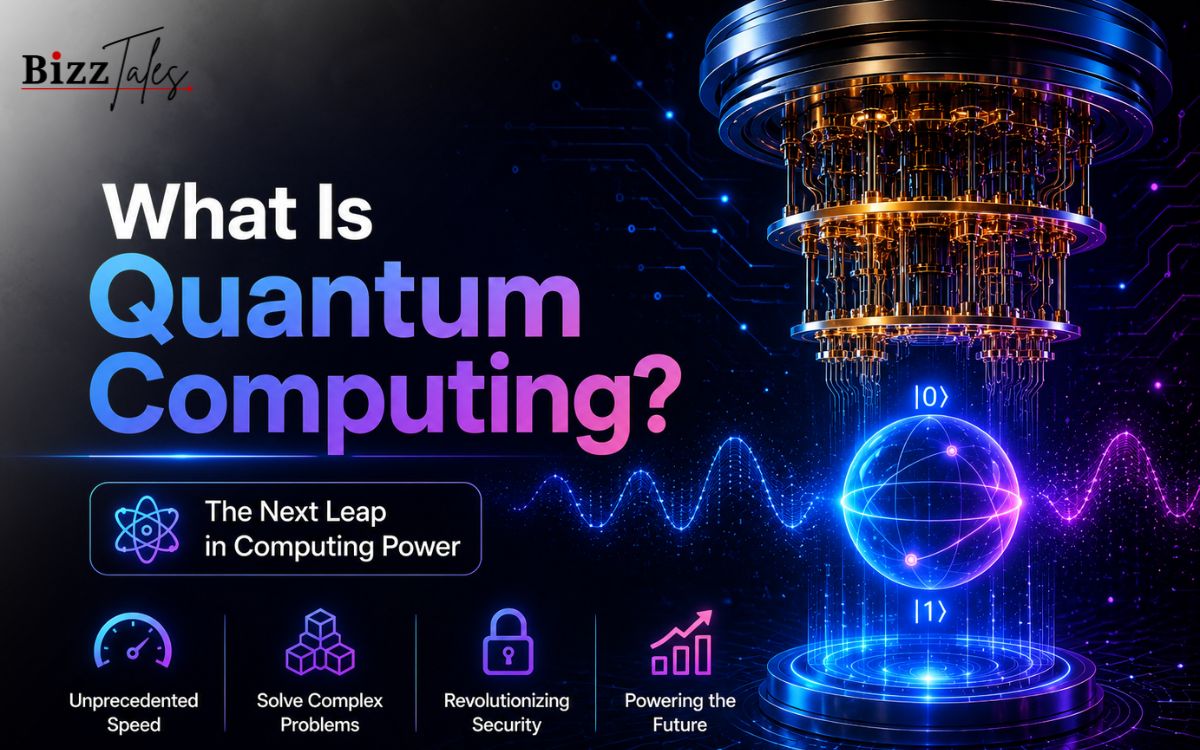
Quantum computing is considered one of the most powerful technological advancements of the modern era. Scientists, governments, and major tech companies are investing billions into this field because quantum computers could solve problems that traditional computers cannot handle efficiently.
Many experts believe quantum computing may transform industries such as medicine, cybersecurity, finance, artificial intelligence, climate science, and space research.
Despite all the excitement, quantum computing still feels confusing to many people. Terms like qubits, superposition, and quantum mechanics sound highly technical and difficult to understand.
The reality is simpler than it seems.
Quantum computing is essentially a new way of processing information using the laws of quantum physics instead of traditional computing logic.
To understand quantum computing properly, it is important to first understand how normal computers work.
- This is where quantum computing comes in.
- What Is Superposition?
- What Is Entanglement?
- Why Does Quantum Computing Matter?
- Quantum Computing and AI
- The Largest Companies investing in Quantum Computing
- Is Quantum Computing Dangerous?
- Why is Quantum Computing So Difficult?
- Will Quantum Computers replace normal computers?
- The Future of Quantum Computing
- FAQs
This is where quantum computing comes in.
What is Different with Quantum Computer?
Instead of bits, quantum computers use “qubits” as its smallest unit of information. This is what make it different from classical computer.
With quantum principle “superposition”, qubit can be in a state of more than two values at a time:
=0+1
As for now, the classical computer checks each path in a time to find the solution while a quantum computer can search in many possibilities at the same time, leading to dramatically higher computation power in particular types of problems. For example, if there is a large maze and you need to find the exit. A classical computer can try to solve this by checking each path in turn whereas a quantum computer can explore in all directions at once to find the exit.
This is the reason that many experts predicted quantum computer will change the world, and many great scientists and company poured billions of dollars into its research.
What Is Superposition?
Superposition is a crucial term in the world of quantum computing.
In classical computing, a bit has only two possible values: 0 or 1.
In quantum computing, a qubit can have more than two possible values until you “measure” it, then it collapses to a single classical value of 0 or 1.
This is a very strange phenomenon that allows us to have a number of calculations at the same time, thus enabling quantum computers to overcome limitation of classical computers. The phenomena of superposition can be explain using an equation like the one above. Its existence can be attributed to quantum mechanics which study behaviors of particle at microscopic scale. Quantum physics looks completely different from the reality and sounds weird but has been proven by numerous of scientific experiments many times.
What Is Entanglement?
Another key term is “quantum entanglement”. When two or more qubits link together in such a way that they are instantaneously affected each other regardless of how far apart they are, then we say that the qubits are entangled. Albert Einstein famously describes this as ‘spooky action at a distance”. Quantum entanglement is important for allowing quantum computer to complete calculations more rapidly; it enables massive parallel computation, making quantum computing possible. Without the power of quantum entanglement, the power of quantum computing cannot be reached to such a remarkable extend.
Why Does Quantum Computing Matter?
As stated before, some tasks are just too much for normal computer. Our daily life produce enormous amount of information and calculation every day, quantum computing can possibly find solutions for:
Drug discovery
Weather forecast
Financial modeling
Supply Chain optimization
Artificial intelligence
Materials Science
Climate modeling
Cyber Security
Space Research
Take medicine for an example, creating new drugs involves researching many different combinations of molecules. Classical computers may take extremely long time to conduct this huge number of calculations, while the quantum computers may significantly reduce the time for scientists to create new medication and cure human diseases.
Quantum Computing and AI
Quantum computer and AI can be the most powerful team in the future.
AI systems can take the advantage of quantum computers’ computation power to process huge amount of information quickly and efficiently. The current research is studying on applying quantum AI into:
faster model training
better optimization
more complex simulation
improve prediction capability
Currently quantum AI technology is still immature, however it may have potential in greatly transforming industries in the future.
The Largest Companies investing in Quantum Computing
Some of the biggest technology companies in the world are making huge investments in quantum computing research.
IBM have been a leader in quantum research, offering quantum computing in the cloud for people who wish to experiment with the technology.
Google, for instance, announced a “quantum supremacy” with a quantum computer, meaning it solved an incredibly difficult problem much faster than any conventional supercomputer ever could.
Microsoft are also making developments in the field of quantum computing within their Azure ecosystem.
Amazon and start-ups alike, not forgetting universities and Governments across the world, are pumping Billions into this field. These countries, and a number of powerful corporations across the globe, see quantum computing as an area that could determine national and global power through technological dominance and by extension, economics and national security.
Is Quantum Computing Dangerous?
While this new era of computing offers revolutionary solutions, it also brings serious challenges to the fore.
One of the most prominent is its impact on cybersecurity. Our digital communications, including our banking systems, passwords, and electronic transactions are all secured using current, classical encryption methods, all of which depend upon mathematical problems which conventional supercomputers cannot compute for many years. However, with a large-enough quantum computer, these systems could potentially be hacked in a matter of seconds, meaning new quantum-resistant encryption must be developed in order to protect future infrastructure, making quantum computing a challenge of the cybersecurity era.
Why is Quantum Computing So Difficult?
Despite the promising leaps being made in quantum computing, building these machines is incredibly difficult. Qubits (see above) are highly sensitive to even minor interference from environmental factors, which include;
Heat
Vibrations
Radiation
Electromagnetic interference
Such disturbance can cause any calculation to come unstuck resulting in errors, this is known as ‘quantum decoherence’. Due to the fact that most conventional quantum computers work best at temperatures colder than deep space, there are a number of technologically advanced cooling systems that need to be built, Engineers are also working hard on developing powerful error correction systems, a necessity if quantum computers are to be usable on a large scale; all these factors combined mean it is unlikely we’ll be seeing the dawn of the large scale quantum computing era anytime in the near future despite significant investment.
Will Quantum Computers replace normal computers?
No is the likely answer; instead, it is theorized that these new computers will only perform specific tasks which they’re more capable of than a conventional, normal computer, and traditional computers will continue to be used for standard internet use, watching videos, playing games, social media, writing reports etc., this suggests a future where conventional and quantum computers work in conjunction, a sort of Hybrid Computer.
The Future of Quantum Computing
Despite all the difficulties mentioned, progress in the field is rapid; researches are working hard to develop more stable qubits, improve error correction systems, increase scalability and further developments in quantum networking and quantum software are already being made.Many experts are convinced that there will be “practical quantum leaps” that will have major impacts on entire industries within the next ten years, though of course, the pace of these changes might prove slower than predicted. This is arguably one of the most promising fields in science right now, with the nations and companies who manage to harness this power could gain a technological advantage like no other.
Final Thoughts
Quantum computing is a seismic change in how humanity computes, as this technology takes advantage of the strange laws of quantum physics to solve the complex problems our conventional computers struggle to compute with; rather than the reliance of a binary system alone this new computation allows us to benefit from quantum physics. It may be some time before quantum computers have a direct impact on our lives but the future potential is tremendous, and the benefits range from medicinal advancements, AI and financial security to many more that we cannot predict right now. For now, quantum computing is still very much a field of research and development. However, what cannot be denied is that quantum computing has the potential to become a part of our lives like the internet did when it was first invented.
FAQs
What is quantum computing in simple words?
Quantum computing is a new type of computing that uses quantum physics principles to process information much faster for certain complex problems.
What is a qubit?
A qubit is the basic unit of quantum computing. Unlike normal bits, qubits can exist in multiple states simultaneously.
Is quantum computing real?
Yes, quantum computing is real and actively being developed by major technology companies and research organizations worldwide.
Can quantum computers replace normal computers?
No, quantum computers are designed for specialized calculations and will likely work alongside traditional computers rather than replacing them.
Why is quantum computing important?
Quantum computing could solve highly complex problems in medicine, AI, finance, cybersecurity, and scientific research much faster than classical computers.
Which companies are leading in quantum computing?
Major companies like IBM, Google, Microsoft, and Amazon are among the leading organizations investing in quantum computing technology.