When we talk about companies that are defining the future, we primarily think of Apple, NVIDIA, Microsoft, Google, Amazon, and Tesla. Their products are used by billions of people daily, and so they are easily the most familiar brands in the world. But behind each one of those products-be it an iPhone, a chatbot, a cloud storage server, a games console, or a state-of-the-art CPU-is a hidden company with which most people are unfamiliar. That company is ASML.
A quick note that ASML isn’t selling to the general public like Apple or Samsung does; you can’t order an ASML machine straight from their website and you certainly aren’t walking into a store and buying one. In fact most of us won’t ever get to see an ASML machine in our lifetime. But the truth is, they are responsible for developing a large proportion of the technologies we all rely on today. The chips in a phone, the streaming of a film, the training of a neural network, the delivery of your cloud computer are all most likely ASML-made.
In the past twenty years, the Netherlands based ASML has largely been obscure, but has become one of the most significant companies on the globe. The company is at the heart of the world’s semiconductor industry and some experts view it as one of the most strategically important businesses in the world. Governments watch its every move, search technology players covet its equipment and chip manufacturers can not produce the world’s most advanced chips without its breakthroughs. Sure the average television consumer might long for an NVIDIA or Apple computer, but many in the industry are aware of the simple fact that the 21st century technology industry without the breakthroughs produced by ASML would be a very different place.
The story of ASML is not really about semiconductors. It is a story about long-term vision, engineering greatness, innovation and how a fairly obscure company grew into becoming one of the biggest entities in history.
The Small Dutch Company That Dreamed Big
Founded in 1984 in the Netherlands as a joint venture between Philips and ASM International, not many could have imagined ASML becoming a one of the key ventures in the technology industry. But the semiconductors business was already saturated with its competitors.
In the beginning, ASML was a small company. It had many obstacles, such as lack of resources, hard competitive environment and the huge technical difficulties to make the semiconductors manufacturing equipment. Some companies could have just cared about surviving. However, ASML decided to take another way.
From the outset, the firm was tackling one of the toughest issues in technology: helping chip makers develop ever more powerful semiconductors. Where consumer tech firms were selling products, ASML was building the machines that made them.
This was a decision that would shape the company’s history forever.
Instead of going head to head with the tech giants, ASML decided to be a key supplier for the whole industry. It poured a huge sum into R&D, often for long periods developing technologies that bore no revenue for years to come. However, it is this long-term approach that would give it an advantage that few firms in history have ever enjoyed.
The Race to Make Chips Smaller
To understand what makes ASML such a crucial company, we first have to understand how semiconductors are produced.
Today, a single chip can have billions of microscopic transistors in amazing small places. These transistors work as the brain of the work (hand) (phone) (computer) (AI) devices, providing calculations needed. Since years here the semiconductor business was based on a trend, trend known as;)
This was the trend for the advancement in technology. A smaller transistor would lead to higher speed processor, improve performance, advanced device and reduced power consumption.
But making smaller transistors was proving more and more difficult.
Manufacturing features recorded in nanometers can be incredibly precise. So, for example: human hair has a width of approximately 80,000-100,000nm. The minimum size of current chip features can be a single digit nm.
Engaging in the formation of structures this tiny is only a task that extremely sophisticated manufacturing tools can accomplish.
That is where they saw a big opportunity.
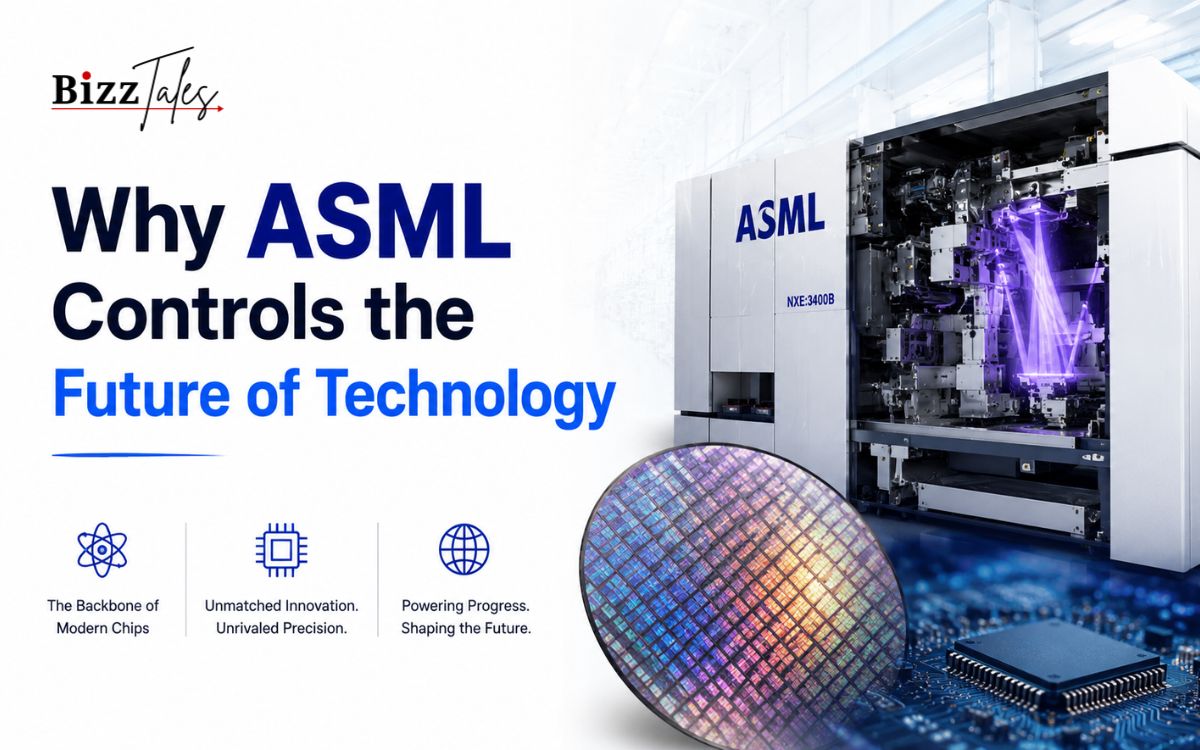
The firm’s focus was lithography systems, tools used to print tiny circuit patterns on silicon wafers-these are the chips used in today’s technology that eventually transform into personal computers, cell phones, and the like.
As the chips developed themselves, lithography became one of the most important steps in the production of the chips.
ASML’s future depended more and more on the ability to solve problems that few others could.
The Billion-Dollar Gamble That Changed Everything
By the late 1990s and early 2000s, semiconductor industry had a huge problem.
Lithography technology was quickly reaching the physical limits of capability. Current systems could no longer produce the complex chip designs needed for the next generations of processors.
They did it-they really cracked it!
ASML thought the answer was some new pioneering technology called Extreme Ultraviolet Lithography (EUV).
EUV was one of the most complex engineering endeavors in recent technological history. “A design that utilized wavelengths of light that were, at the time, tremendously short, and encoding very fine, microscopic images on silicon wafers.”
It was a good idea.
The harsh truth was overwhelming.
Engineers encountered very many technical problems. The technology demanded a completely new set of optical system, super-specialized highly-powered mirrors, source of illumination, and precision never done commercially before.
Time went on without a breakthrough.
Costs kept increasing.
Several experts in the field speculated about the future and questioned whether EUV would ever be a commercially viable process.
Others simply never got off the ground, while a few companies simply scrapped similar proposals entirely.
The ASML team would not give up.
The company plowed billions of dollars into research and development, gambling the company’s future on a technology many thought might never work.
It was one of the riskiest decisions in the history of the organization.
In the end, the risk was worth it.
ASML, standed out for its own causality.
It was the firm that established EUV as a viable, commercial fabrication tool capable of delivering the world’s most sophisticated semiconductors.
That was a total paradigm shift.
How ASML Became Irreplaceable
This breakthrough innovation in EUV technology has transformed the position of ASML within the wider semiconductor industry.
And all of a sudden,the world’s biggest chip manufacturers needed ASML machines to have a future.
Examples from top EUV investors show us that they believed systems from this technology were the only way forward in order to be able to manufacture the future generation of chips. In a list of respondents, companies such as TSMC, Samsung and Intel have heavily invested in EUV.
Even the machines themselves became such engineering wonders.
Each EUV system comprises hundreds of thousands of parts, is hundreds of tons in weight and costs hundreds of millions of dollars. Some of ASML’s most advanced systems are even more expensive.
The manufacturing of all these machines is an enormous technical challenge, and requires highly skilled knowledge in (amongst others) Physic, Optic,s Software engineering, advanced manufacturing, material science.
Achieving a similar effect is extremely hard.
Therefore, by doing this, ASML has turned itself into the only provider of the most advanced EUV lithography systems.
This resulted in a highly powerful positioning in modern business.
Many companies find themselves in situations of fierce competition,ASML’s positioned where there is practically no real competition.
Its market share isn’t a result of branding or advertising.
It has built upon hundreds of years of innovation for technology and leadership.
Why NVIDIA, Apple, and AI Depend on ASML
With this recent explosion of AI, ASML has become even more important.
These companies, like NVIDIA, are now household names because their processors drive AI systems to work all over the globe. In today’s AI age, everything from ChatGPT (and other AIs), self-driving cars, cloud computing, and machine learning applications push rely on high-tech semiconductors Chips.
But NVIDIA designs chips.
It doesn’t produce them.
Most manufacturing is to be done by TSMC.
And TSMC is so much dependent on ASML.
A very dynamic and exciting hierarchy can be observed in this relationship within the technology industry:
Buyers observe AI instruments.
AI startups’ requirements: needs very high end chips.
Designers can’t do without their factories.
Manufactures rely on ASML.
In many respects, ASML remains close to a key part of the entire AI revolution.
As demand for artificial intelligence infrastructure, big data centers, emerging cloud computers, and advanced processors rises, so does the demand for the latest and greatest on the semiconductor manufacturing front.
And this seems to just add to ASML’s already strong position.
And the company does not benefit from the success of any one AI company, but from the growing AI-machine.
Why Governments Care About ASML
No other firm seems to draw as much geopolitical interest as ASML.
Today, because semiconductors have become critical for economic development, military power, and the technological edge, governments are treating the manufacturing of chips as a matter of strategic concern.
As a result, ASML has ended up at the heart of global technology politics.
The US and China are competing in the technology race, focusing on high-tech industries like artificial intelligence and supercomputers.
As ASML makes the equipment needed for producing the latest chips, access to its technology has become an extremely sensitive geographical issue.
Export restrictions have limited the sales of some of the more advanced ASML equipment to other geographical markets.
Semiconductor supply chains and the involvement of ASML in them are often a matter for governments, lawmakers, and national security specialists.
This is incredibly impactful.
Most companies are in an industry.
ASML is helping design the future of whole economies.
Can Anyone Replace ASML?
The most argued question regarding ASML is whether it will be succeeded by another player in the future.
Yes, in theory.
In reality it would be extremely hard.
Replicating an EUV lithography business would take decades of R&D, billions of dollars of investment, access to highly specialized knowledge, and a complex supply chain spread around the world.
The combined management of the whole company of the ASML’s management creates a result of many years of innovation (almost 40 years).
The machines that combine decades worth of field research and mutual, collaborative experimentation.
Even by virtue of a huge company like the largest technology companies in the world, they would have difficulty reproducing this ability so fast.
This is a huge barrier to entry.
The long run may always be competitive, but today ASML has one of the greatest technological moats in corporate life.
The Future of ASML
As ai grows, intrinsic demand for high end semiconductors is likely to grow quite a lot.
AI models demand a huge amount of computing.
Data Centers keep growing.
The cloud infrastructure is constantly growing and developing every year.
New advancements in technology include augmented reality, autonomous transportation, new healthcare systems, next-generation robotics, and the evolution of new electronics.
Furthermore, we can conclude that: all of these developments are advantageous for ASML.
Already in progress are the company’s new future lithography techniques in end form fab production.
Future systems will have smaller transistor sizes, increased processing power, and improvements in AI.
As far as people keep asking for improving technologies, I think ASML will stay one of the most important companies to support it.
Conclusion
ASML doesn’t enjoy the same label recognition as Apple, nor does it grab the same headlines as NVIDIA, yet the impact the company has over today’s world is perhaps just as great.
For more than 25 years, the company has been developing technologies to make the world’s most complex semiconductors. Its EUV lithography solutions are one of the key enablers for the future of computing, AI, cloud services, and many other fields.
What astonishes me about ASML is not only the technological breakthrough. It is the strategic position in the world. The world relies on it. It works in the background while driving numerous revolutions in our everyday life.
With increased pace of artificial intelligence increase along with global need for advance chips to meet delivery, ASML’s role is expected to grow even further.
Semiconductors is still the lifeblood and will be in the future of technology.
Semiconductors’ future is according to-–ASML.
And that is how a company most people have never heard of can, in the end, turn out to be one of the most powerful corporations in the world.
FAQs
What does ASML do?
ASML creates sophisticated lithography machines that are employed by chip manufacturers to make computer chips.
Why is ASML important?
ASML offers the ability to be part of manufacturing the most advanced processors in the world used in AI, smart phones, data centers, and computing.
What is EUV technology?
Utilizing a relatively new process known as Extreme Ultraviolet Lithography, chipmakers are able to produce smaller, faster semiconductor designs.
Which companies use ASML machines?
ASML’s tools are used in the manufacturing of microchips by several large semiconductors makers, including TSMC, Samsung, and Intel.
Why is ASML important for artificial intelligence?
ASML’s processing power is so immense that all AI systems rely on the most powerful chips. And that processing power is often created on wafers, by the very machines who make those chips.