Within startup culture, venture capital has become the gold standard of success. Entrepreneurs will spend years pitching investors in hope of raising rounds of funding worth billions of dollars and achieving massive valuations. For many entrepreneurs, venture capital is nearly equivalent to success.
However, occasionally another company pops up that this argument doesn’t seem to apply to.
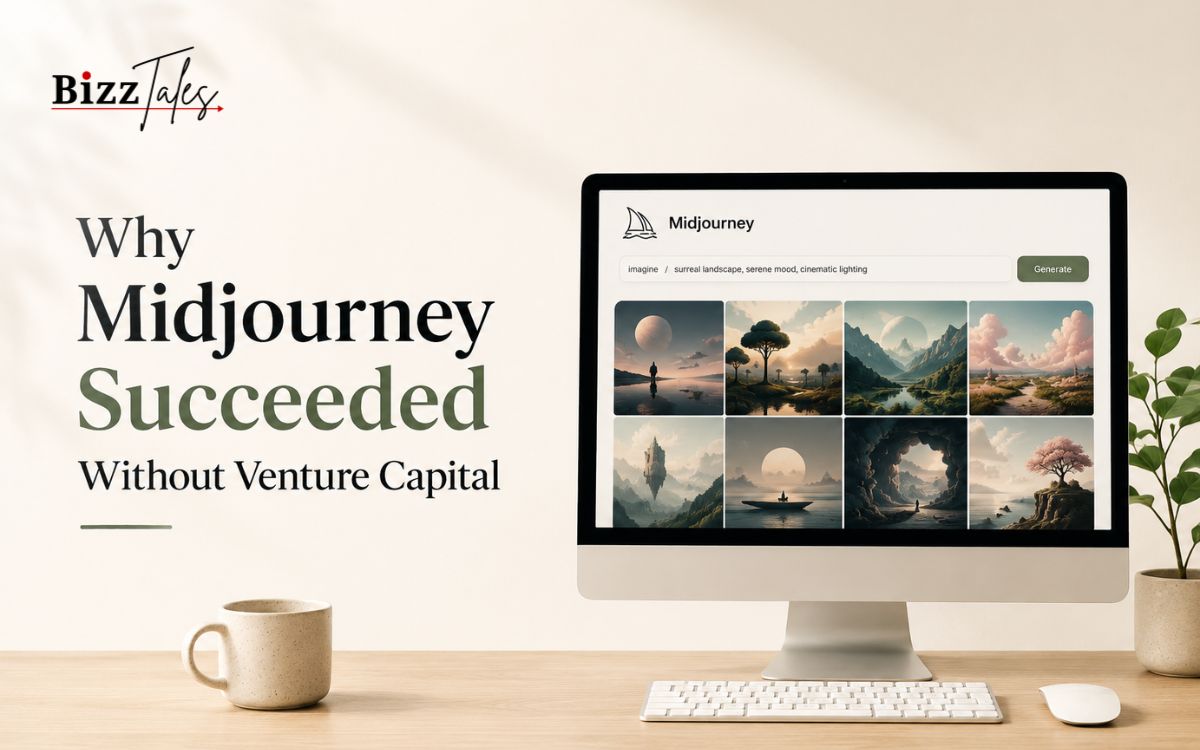
Midjourney is indeed one of those companies.
Unlike many AI startups that aimed for hundreds of millions of dollars during the AI boom, in practice Midjourney did not engage in fierce fundraising but instead relied on its great product, community and paid customers to generate income.
And then the outcome was incredible.
It only took few years for Midjourney to turn into one of the most renowned AI image generating platform around. Simply using a piece of text as instruction, its technology appealed artists, designers, marketers, content creators, and companies wanting to produce amazing visual outputs.
More significant is the fact that, what many other start ups won’t achieve, the company was profitable.
While many venture-backed companies were burning cash for growth, Midjourney has built a frugal business with the help of its users.
Its story is not only about AI, image generator. It is also about refuting standard startup saw, and showing that it is possible to make it without getting VC.
The Rise of AI Image Generation
Before we get into knowing how Midjourney made it to where it is, let us understand the market forces that allowed Midjourney to grow:
Artificial intelligence had started to revolutionize a wide range of industries including software development, marketing, writing… Yet visual content was still one of the most difficult problems for artificial intelligence.
It used to be easier to make professional work. Many software platforms and skills are very advanced, and it took a great deal of experience to use them.
Graphic designers work for hours on end. They often spend a long time designing pictures.
The artists spent years working at their artform.
In most cases, companies hired agencies or freelancers to create the marketing images.
Then generative AI emerged and the landscape started to change.
All of a sudden, you could genarate detailed images just by describing what you require.
What if I said .” Such as for example, “a futuristic city at sunset in a cinema style”.
Winner of the Breakthrough Award: This milestone gained international fame.
There was a ballooning demand for images created by AI overnight.
Within the forefront of this revolution were companies like Midjourney as they proved in a very short time their superiority in image quality and style, but also and above all, in the user experience.
The Vision Behind Midjourney
Midjourney was originally created by David Holz, a successful businessperson and technological pioneer.
While most startup founders think only of markets and investors, Holz had a different take on Midjourney.
He was not trying to birth another tech-company.
He tried to enhance human creativity.
The company did not see artificial intelligence as a threat to artists. For the company, the AI was a tool that would enable people to better express their ideas.
Intended philosophy impact the product and the company culture.
By contrast, what Midjourney emphasizes is, contrary to automation, sense of the imagination.
Users were motivated and inspired to innovate, investigate and invent.
This focus on creativity first was one of the high level tenants of the platform and a conscious distinction from competitors.
Why Midjourney Avoided Venture Capital
AI startups generally demand a large amount of capital.
Training the models, maintaining the infrastructure, and recruiting the best engineering talent are all costly.
Consequently, lots of entrepreneurs go after the venture capitalists early- when they are just getting started-rather than wait until they are more ready.
Midjourney puzzled out a different path.
The company did not use classic venture capital funding, but instead developed a product that people would pay for right now.
This mode of figuring the problem was advantageous in many ways.
Midjourney always had total authority over its vision.
In absence of pressures from investors, the firm would likely set their focus on long-term product excellence over that of short-term growth index.
Second, The second feature was related to the profitability that had to be achieved constantly from day one.
Would not have to depend on subsequent investments, the firm required sustainable income.
Third, the sense of independence freed Midjourney to move rapidly.
Investors’ responses may differ from product requirements.
This freedom was a huge competitive advantage.
Building a Product People Loved
Numerous startups invest heavily in acquiring customers through marketing.
X (Midjourney) was long driven by good product and community energy.
Manyusers were quite amazed at how artistic the images were.
A large number of early competitors seemed to produce images that were all over the place in terms of quality; Midjourney always created more refined, creative, and artful images.
This brought about this enormous word-of-mouth that became a strong factor.
Artists posted their work online.
Designers talked about the use of workflows in communities online.
Video-makers and tutorial makers shared works produced through AI.
Ultimately, each image served as advertising material for the firm.
And more and more people made Midjourney art, and fear…
The product itself has become the dominant growth engine.
The Discord Strategy That Changed Everything
One of the most innovative decisions Midjourney made was for platforming.
They began by almost exclusively operating as a Discord bot rather than by launching as normal Web application.
They might learn how to fire prompts, exchangeconcepts, providefeedbackand explore new opportunities.
This helped us to set up a “co-operative” atmosphere that accelerated the engagement.
It changed the business of creating images from something you do alone at home to something you do with friends.
‘Community residency’ was definitely an important factor in retaining users as people stayed in the community for longer periods of time.
This created an extremely interactive community of users who grew the site exponentially.
How Midjourney Monetized Its Product
A big factor for the success of midjourney without access to venture capital is that it can start making money from the word go.
Further, the company began to provide subscriptions offering more image generations rather than unlimited free images.
The following did this model.
- It built a recurring revenue stream.
- It will be already filtered for serious users.
- It kept the infrastructural costs under control.
- It certainly proved to be the school’s best marketing tool to date. It definitely confirmed there was a demand.
Customers Paid in return that therewas tangible value to the service.
This revenue-first approach differs greatly from those venture-backed tech startups that focus on building a large user base first, and worry about monetization later.
Midjourney proved that growth can be financed for free by customers instead of external investors.
Why Users Preferred Midjourney Over Competitors
The market for AI image generation became more competitive with several new entrants.
Midjourney was able to command a lot of user loyalty, even as competition increased.
This was one of the major reasons.
The platform always would turn out very beautiful and eye-catching results. Which looks well around artists.
A second factor was use easy of.
Creating great images did not require complex design skills.
Transformed these simple text inputs into very professional looking images.
Furthermore, the community aspect was also influential in.
Team cohesion established via Discord, generated a feeling of inclusion that many competitors failed to attain.
To a lot of people Midjourney didn’t even seem like a software, but a creative universe.
Challenges Midjourney Faced
There were issues along the way, however.
The expansion of generative AI crashed the copyright, intellectual property and ethical use of AI discussions.
Concerns were also raised about training data, ownership rights of the artists and rights to artificially-generated content, to name a few.
Just like any other company working on AI, Midjourney faced the challenge of a complex and fast-changing set of laws and regulations,
There was a growth in competitiveness too.
Big tech companies and megarich startups launched to the market AI image generators.
The necessity to sustain technical leadership has been de-emphasized to greater extent.
However, while the costs of infrastructure continued to increase. As the demand for image generation increased.
Striking a balance among growth, earnings and innovation was something we had to approach with prudence.
The Business Lessons Behind Midjourney’s Success
The story of Midjourney is full of stories to teach aspiring entrepreneurs.
What we have learned is that there really is no substitute for being profitable.
And in a time ruled by headlines about venture capital, Midjourney proved that there are sustainable business can succeed without eight-figure funded rounds.
The company put forward the issue of product quality.
Instead of depending excessively on marketing, Midjourney created a product that users were truly excited to share.
Another lesson is community building.
This approach made the customers an integral part of the ecosystem and with ability to play an active role in it by adopting the Discord-first1 strategy.
Finally, Midjourney demonstrated that independence can be a competitive advantage.
In the absence of external pressures from investors, the business remained set on its long-term goal.
What Midjourney Means for the Future of Startups
Midjourney’s attainments g against many of our presupposed ideas on how startups gain traction.
For a long time, entrepreneurs were led to believe that you could only grow tech companies by raising capital.
Midjourney showed us there are other ways.
Perhaps its history indicates that upcoming entrepreneurs will be hyper-focused on profit-making, happy customers, and continuous growth.
That doesn’t imply that venture capital isn’t required.
A lot of businesses still need lots of funding to be a success.
But Midjourney shows that founders can use a different playbook than the typical startup story.
The company is a reminder that when you have amazing products and amazing communities you sometimes can do what huge financing rounds can’t.
Conclusion
Midjourney fascinates as a startup success story of theAIera.
The company was able to build one of the world’s most prominent ai image generation platforms by emphasizing product quality, community, and sustainable revenue methods instead of venture capital funding.
Its growth proves that innovation don’t necessarily need of huge investments.
The strongest competitive advantages at times will come from having a better understanding of a user, a great solving of important issues, and a clear vision.
As AI revolutionizes creative fields, Midjourney remains a strong reminder of what occurs when founders choose to build for product instead of headline-fueling fundraiser.
Mike and his team created a lot more than an AI image generator.
It broke the rules of the startup growth game and showed that independence can lead to success.
FAQs
What is Midjourney?
Midjourney is a tool that uses artificial intelligence to generate images. It takes in descriptive text prompts and produces images in response.
Who was it that established Midjourney?
Midjourney was established by David Holz-a self-professed “computer geek” and technology innovator. Holz is an entrepreneur with a background in hardware and software production.
Midjourney has raised venture funding?
No. Midjourney didn’t have to go this route to grow one of the most successful AI startups without any VC funding.
What is it that makes Midjourney so popular?
Its popularity is due to high quality image generation, active community, simplicity of use, and continual innovation.
How does Midjourney, for example, earn money?
Midjourney makes money using subscription plans which allows users to generate images and additional features.