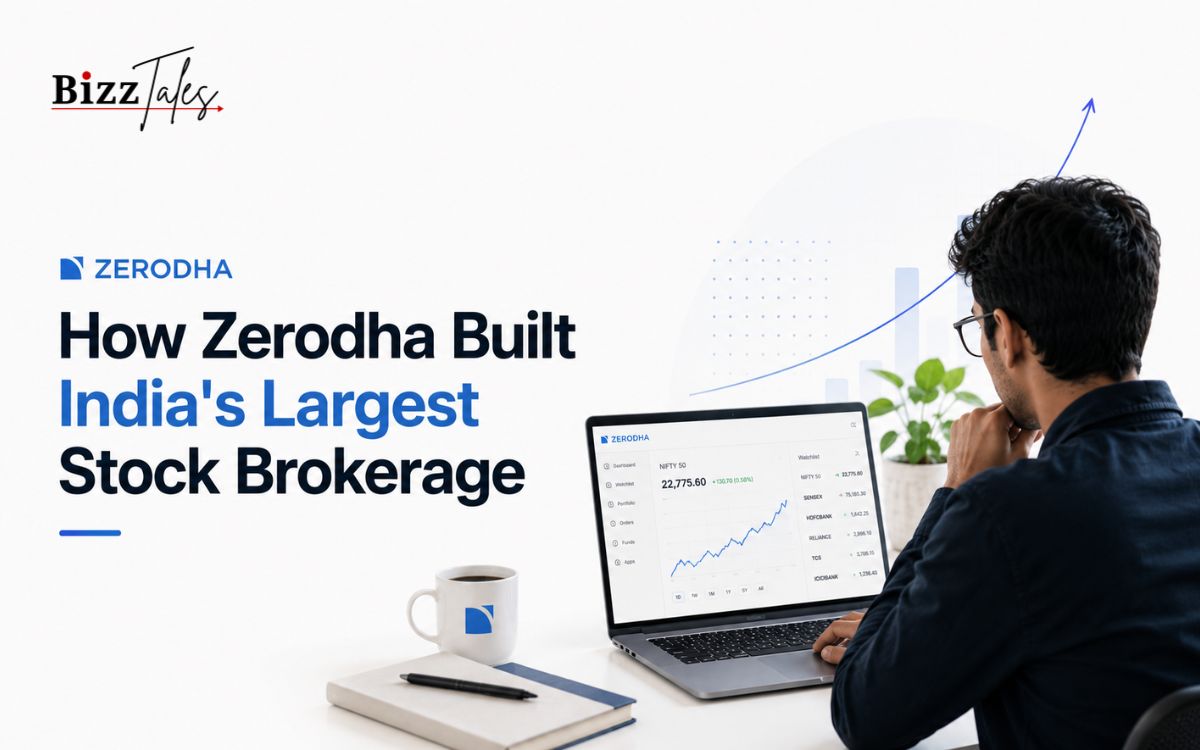
In a startup world obsessed with venture capital funding, high valuations of unicorn companies and rapid scaling/ growth, Zerodha is one of India’s most unique success stories as an enterprise. While several tech startups raised millions of dollars from equity investors for capturing market share, Zerodha took an entirely different approach.
V.S. Did not obtain any venture capital funding.
Every company was flat: no billion-dollar funded rounds, no eye catching investor announcements, no macho cash burn to take over the world at any expense.
However, the focus was on profitability, building customer confidence and providing innovative products while maintaining steady growth.
What occurred after was unbelievable.
Starting with just two brother brothers in a small brokerage startup, Zerodha grew to become the largest stock broker in India, with millions of investors-a section of every retail trade daily happening in India now.
Its journey is always quoted among one of the best bootstrapped startup stories from India.
It is however their decision of not being venture capital friendly which has worked for them. It is Zerodha’s decision of democratizing investment in the Indian capital markets. They significantly brought down the costs of trading and make investor’s life easy by digitizing most part of it.
Today, not only is Zerodha one of the biggest successful FinTech’s in India, it is also a demonstration of a long-term business building model winning on the world stage, beating capital-intensive players.
Zerodha’s journey provides many lessons for entrepreneurs, investors, and business owners:
The Indian Brokerage Industry Before Zerodha
In order to grasp the effect that Zerodha has had, the broker industry before Zerodha is essential to comprehend.
For years, investing in the stock market was seen as a costly, complex and exclusive activity.
Traditional brokerages used to rely on a branch network, relationship managers and commission-based incentives. Investors had to pay heavy brokerage commission to execute deals.
The procedures were all so rote that many of the steps could be awkward:
Getting a trading account was through lots of paperwork, red tape, delays and friction and the bank ‘did not use the latest’ technology compared to the rest of the world.
With increased internet penetration and growth of e-services in India, the voids in the brokerage industry also became evident.
New kinds of investors craved convenience, transparency and cost savings.
But very few companies were meeting these needs.
This provided for a chance to break the game.
The Founders Behind Zerodha
Zerodha was established by brothers Nithin Kamath and Nikhil Kamath in 2010.
Prior to starting the company, Nithin Kamath worked as a trader himself and was fully aware of the pain faced by retail investors.
Nothing handsome about it. His own encounter revealed to him the same recurring problem.
Higher brokerage charges tend to eat into profits for traders and discourage wider participation in the equity market.
Simultaneously, technological advances provided opportunities for more efficient provision of financial services.
They thought that brokerage services could be made simple enough to digitalize and at the same time substantially cheap.
All they saw were:
As an alternative, they would generate customer value by offering transparent yet cheap prices, rather than through maximum commissions.
Building upon this, the same idea led to creation of Zerodha.
The Meaning Behind Zerodha
In the very name of the company!
‘Zerodha’ is a combination of ‘Zero’ and Sanskrit word ‘Rodha’ which means barrier.
A name that reflects the company’s vision to eliminate the barriers that keep people away from the financial markets.
All aspects of the business were affected by this mission.
From pricing plans and technology development to educating customers and designing products, Zerodha was always trying to minimize friction.
And to make investing simpler, cheaper & more accessible.
And this customer-friendly process became one of the most powerful competitive advantage for them.
Disrupting Brokerage Fees
Pricing was perhaps Zerodha’s most significant innovation.
Back then, conventional brokers would charge commissions based on a percentage of the money traded which increased as the amount involved grew.
This model helped brokers but often annoyed traders.
First to bring in a discount brokerage.
The company offers substantially discounted flat fees instead of commission rates on the value of the trade.
Quite a few investors realized significant advantage in savings.
The effect was swift.
Active traders saw advantage in lower costs of trading quickly.
Customer acquisition was rapidly increasing as news circulated among trading communities.
The absurd pricing had the side effect of forcing competitors to look at their own fee structure.
Zerodha was instrumental in changing the playing field of India’s brokerage industry in many ways.
Technology as a Competitive Advantage
The initial attention was on low prices but the real growth occurred due to technology.
Zerodha realized that simply lowering costs would not lead to success.
It was vital that the company deliver a better user experience.
This resulted in huge investments in technology infrastructure.
The company’s most significant innovation, however, was-a combined trading system called Kite, which allowed trading across multiple platforms.
Kite had a contemporary, user-friendly interface to make the process of investing and trading much more simple.
The platform was noticeably faster, cleaner, and easier to use than many of the older legacy brokerage systems I’ve used.
Customers could be provided with a one-stop-shop to reach out to markets, track portfolios, analyze data and make trades in a seamless digital environment.
The impact was driven by the increasing popularity of the platform.
The technology driven nature of the firm enabled Zerodha to be groomed from a cheap broker to a popular broker.
Educating Investors Through Varsity
Most of financial firms are product centric.
But Zerodha found an another foothold.
Financial literacy levels were still quite low among many potential investors.
Zero in the sense of teaching. Therefore they adopted.57.
The company created Varsity, a free educational platform that addresses everything from the fundamentals of the stock market to more advanced trading techniques.
The program has assisted thousands of people to better their knowledge in financial markets.
Most certainly, the Varsity also managed to build trust.
Offering helpful, educational content while keeping sales pushy and aggressive rather than a trust-builder, strengthened Zerodha bonds with users.
The platform quickly gained a reputation for being one of the most trustworthy sources of finance education in India.
This also further emphasized the company’s vision for the future.
Growing Without Venture Capital
Perhaps the most amazing part of Zerodha’s is itself remaining bootstrapped.
Almost all startups experiencing fast growth try to fund their expansion from the outside.
Venture capital can supply the capital for hiring, marketing, expansion, and build new products.
Yet funding also brings a burden of burden.
Investors want growth, returns and eventually an exit.
However, Zerodha took a different route.
Revenue from customers was used to fund the company’s growth.
This was very advantageous as:
- All decisions on strategy were reserved with the management.
- The focus was on profitability rather than valuation.
- Resources were managed prudently as all investments had a direct impact on the company’s bottom line.
- It may have been slow to develop at first, but it was extremely sustainable.
- Gradually the benefits were more and more apparent.
Profitability in a Startup World
Most of us tend to overlook profitability when talking about startup.
Lots of technology companies follow a ‘growth first, profit second’ approach.
Zerodha took this assumption head-on.
Financial discipline was always the company directive.
It instead targeted the creation of a business that would provide profits over time.
This led to sturdiness.
When market conditions worsened once again, Zerodha relied less on outside funding.
The company could have kept on developing the products, infrastructure and customer experience without being heavily funded by investors.
Its profitability also enhanced the credibility of the organization in the eyes of costumers and industry players.
The firm proved that fintech companies had the potential to grow quickly and stay prosperous.
The Pandemic and Retail Investing Boom
The surge in the growth of Zerodha caught everyone by surprise amidst the COVID-19 pandemic.
Millions of people spent more time online and looking into investing options during the lockdowns.
Market trends like low interest rates, elevated digital engagement, and growing participation in the market led to a proliferation of retail investing.
Was in a prime position to take advantage.
Its purely digital model meant that users could open accounts, take advantage of educational and manage investments online.
The company’s reputation for honesty and affordability helped the company attract a huge volume of new customers.
Participation in Indian financial markets on the part of retailers soared during this period.
Zerodha was one of the biggest winners to this trend.
Further accelerated its leadership in the brokerage industry.
Challenges Along the Way
Zerodha’s success hasn’t come without struggles along the way.
Platforms involved in the execution of financial transactions have to deliver an extremely high standard of reliability and security.
Technical glitches and interruptions of the system can quickly generate negative feedback.
The company has also experienced a growing level of competition.
There has been an influx of various new fintech startups as well as traditional financial companies venturing into this new digital brokerage model.
You therefore need to think of innovation and differentiation in an ongoing way.
Regulation changes are another continuing one.
Financial services operate under many layers of regulation that have evolved over the years.
To still stay current here in the twenty-first century is formidable but Vital to not lose faith of the customers.
That said, Zerodha has continually been able to withstand the tough environment of the industry.
The Legacy of Zerodha
Zerodha’s influence is so much that.
Has changed the way investors think about the company.
Today’s consumers are accustomed to low-cost brokerage services, cutting-edge technology, educational materials and pricing that is clear and upfront.
By observing the other competitors, many organizations have implemented strategies similar of Zerodha.
Thus, the influences of the company are integrated into a much bigger financial environment.
In this sense, the company’s influences are part of a much larger financial environment.
It has even inspired to entrepreneurs.
Startups can be very successful without venture capital, if one looks at Zerodha. Online share broker Zerodha became India’s largest stock broker in 2015 with only Rs 414 crore in assets.
Its journey redefined how a technology company was expected to grow.
The effects of these lessons go on shaping founders from various industries.
Conclusion
Zerodha’s story is one of the most successful startup stories in India.
Through an intense focus on customer value, technological innovation, financial literacy and sustainable growth, the company evolved from a small brokerage startup to become India’s largest stock brokerage platform.
Being bootstrapped makes it different from many other tech ventures which are over reliant on outside capital.
Most crucially, Zerodha demonstrated that you can be profitable and grow simultaneously.
The reality is a fortunate one where the company’s greatness is an everyday trade-off between addressing real customer needs and adhering to long-term discipline.
As the financial markets in India keep growing, Zerodha is a great example about the possibility to build long-term business successfully through bringing freshness, earning the customers’ trust and maintaining a tight focus.
Its growth is not simply a story about the fintech revolution.
It’s about challenging the usual startup ways of thinking and creating a business that is actually designed to last.
FAQs
Who founded Zerodha?
Zerodha was established by brothers Nithin Kamath and Nikhil Kamath in the year 2010.
Why is Zerodha famous?
Zerodha was the first discount broker in India which pioneered the concept of low cost trading, technology led platforms and educating investors.
Did Zerodha raise venture capital funding?
No. Zerodha is one of the most successful bootstrapped startups and has grown without any venture capital funding.
What is Kite by Zerodha?
Kite- Kite is the flagship trading platform of the company through which the client can invest, trade, watch the portfolios and do the market analysis on a modern digital platform.
Why is Zerodha considered a startup success story?
With zero money raising and zero deadlines, created a profitable enterprise (market leader), with a huge customer base and through relentless focused effort.