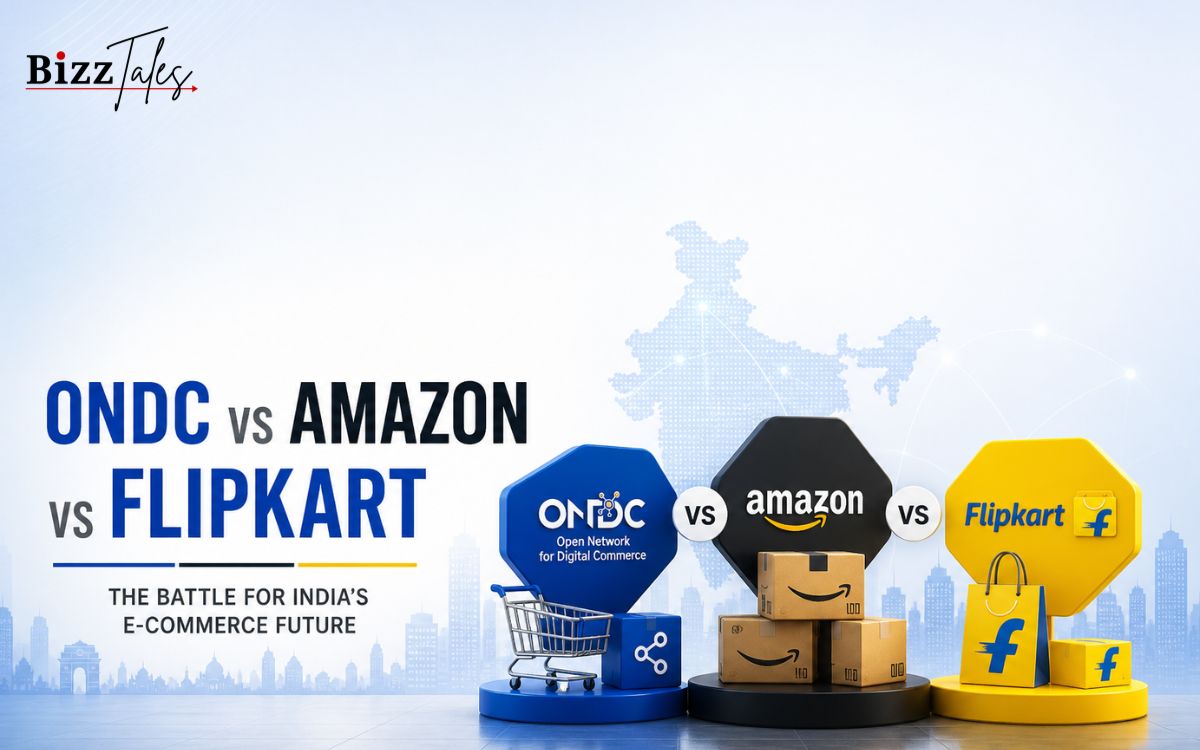
India’s e-commerce is a fast-growing industry and it seems that in 2026 the competition will be greater than ever. For years now large players such as Amazon and Flipkart have been ruling the online shopping world of India. However, now there is a new player who is trying to turn everything upside down.
The Open Network for Digital Commerce (ONDC) is attempting to change the way the e-commerce business in India is functioning and it is causing many people (sellers and buyers) to wonder about the future and who will be the leading player in the e-commerce market of India in the coming years-Amazon, Flipkart or ONDC.
Understanding the Platforms
To truly comprehend the level of competition it is important to understand how each platform operates. Both Amazon and Flipkart run a similar operation- they are both centralized platforms where businesses have to follow their set of rules to list products, get services of logistic and also visibility regarding the prices of products. In order to gain profit and sell items through these large players, sellers are required to pay commissions for the items sold.
On the other hand, ONDC does not work as a platform rather as a decentralized one, which will connect both the buyers and the sellers via various apps. Businesses selling goods will be able to sell them without being completely dependent on the service providers.
Understanding the above it is understandable why this type of competition would become one to watch.
The Strength of Amazon
Amazon has already acquired a significant number of market share for the online selling industry in India, primarily because of its advanced logistics as well as speed in the deliveries of products ordered. Other than this they are known for their vast product range and have also established a large consumer base and trust by the common man, which means you can count on Amazon for their reliability and also ease of making returns on their products.
Technology is the other key area where they excel by integrating it with their services to provide customers with the best possible recommendations and also personal touch. For the sellers, Amazon is the largest platform where you can reach out to customers with ease however there is a high commission charge to be paid by the sellers on their products sold and strict regulations that they are expected to follow.
The Strength of Flipkart
Flipkart has been a long-standing Indian player in the e-commerce market and has an excellent understanding of what the Indian consumers need and want. The platform has developed a strong presence throughout urban and semi-urban India, a feat that many large companies struggle with. Their understanding of the Indian consumer, emphasis on affordability and great festive sale schemes have really helped them rival with Amazon closely.
They also have the unique selling proposition of heavily promoting Indian sellers and brands on their platform which they do well. But similar to Amazon, Flipkart also has a model which requires sellers to pay high commissions.
What Makes ONDC Unique
Instead of competing directly against the large established players of India, ONDC is aiming to revolutionize the entire online trading model. This model will enable businesses of all sizes to reach out to their consumers through various apps, thus reducing the over dependence on massive companies and placing more power in the hands of businesses themselves.
Small companies would also greatly benefit as they would not be subject to higher commissions on the sale of their products and also be able to work on more favorable terms concerning their business operations and the price at which they can sell their products. In addition to all this, it would enable both large brands and small businesses to level the playing field.
Impact on Small Businesses
For smaller businesses throughout India ONDC is being seen as a fresh opportunity. Small business owners have often had to rely on larger, well-established platforms to sell their products, forcing them to pay substantial commissions and adhere to strict rules and regulations imposed on them by the service providers. But with ONDC business owners can connect directly to buyers via a diverse range of apps without having to go through a central hub which can reduce margins and business dependence significantly.
For ONDC to be truly effective for small businesses it has to be easily understandable, simple to use and reach out to as many potential customers as possible.
Challenges for ONDC
Despite the advantages, ONDC is not without its share of challenges. For instance, acquiring customer trust is a significant obstacle, considering how accustomed and reliant people are on companies like Amazon and Flipkart. Building trust and changing customer behavior is a difficult process.
Logistics and delivery networks also need to be strong, a task which takes time to establish as the competitors Amazon and Flipkart have had a decade or so to build their respective infrastructures. Ease of use is another important area for an open network where user experience could easily become complicated for customers.
Competition and Market Dynamics
The race to leading the e-commerce market in India cannot solely be about which player can push others out. Rather, it is about how the market itself will continue to evolve and change with the entry of new players like ONDC.
Amazon will likely continue to dominate due to its large customer base, strong brand recognition, and advanced technology. On the other hand, ONDC could thrive by focusing on bringing value to smaller sellers by allowing them more control over their businesses and making the market more democratic.
The future may just bring an ecosystem where all these players and their varying models coexist and contribute to the ever-growing e-commerce market in India.
What it Means for Consumers
For customers, competition means benefits all the way around. They stand to gain from better prices, better customer service and also increased product variety. Small businesses who were previously unable to connect to customers might finally have their products visible on online platforms which means a variety of new products at lower costs for the consumer.
At the same time, customers will expect the same levels of service and ease as they currently get from Amazon and Flipkart.
Future Outlook
India’s e-commerce market is expected to continue growing at an exponential rate and over the next couple of years we can expect Amazon and Flipkart to enhance their service by incorporating more logistics and better technology into their business.
ONDC will undoubtedly have its work cut out for them, and growth is predicted to be at a much slower pace, but it is hoped that it will eventually overcome obstacles in terms of building trust, a strong logistics network and user friendly interfaces. A mixture of open networks and centralized platforms is likely in store for the future.
Conclusion
The race to dominate the Indian e-commerce sector among Amazon, Flipkart and ONDC will truly determine the future of the market in India. While Amazon and Flipkart are at a significant advantage with their well-established infrastructures and large customer bases, ONDC is set to shake up the industry with its focus on enabling businesses with greater flexibility and opportunities.
Rather than a single dominant player, the market could potentially end up being home to a variety of successful businesses that are operating with diverse models.
For businesses, it is crucial to understand each of these platforms thoroughly and decide on the best strategy that would suit them in this evolving landscape; adapting to new, disruptive models like ONDC early on may provide a decisive advantage. The e-commerce market of India is in constant motion and it will be very interesting to see what the coming years hold.