Paytm is the most well-known startup story of India. It revolutionized the way Indians deal with money, make payments, recharge phones and shop online. From a mere mobile recharge site, it grew into one of the largest fintech companies in India.
Paytm’s journey to was one filled with achievement, rapid acceleration, rivalry, underperformance, reproach and redemption. It is not merely a startup story. It is the story of digital payments infection in Indian day to day life.
Paytm 2026 however still continues to be one of the biggest names in the Indian fintech industry. Despite the huge challenge the company faced, it is constantly dynamic and persisting.
- The Beginning of Paytm
- Early Struggles
- Growth Through Mobile Recharges
- Demonetization Changed Everything
- Becoming India's Digital Payment Leader
- Massive Investments and Expansion
- Competition in the Fintech Industry
- The IPO and Market Shock
- Why Paytm Faced Problems
- Vijay Shekhar Sharma's Leadership
- The Comeback Strategy
- Business Lessons from Paytm
- Future of Paytm
The Beginning of Paytm
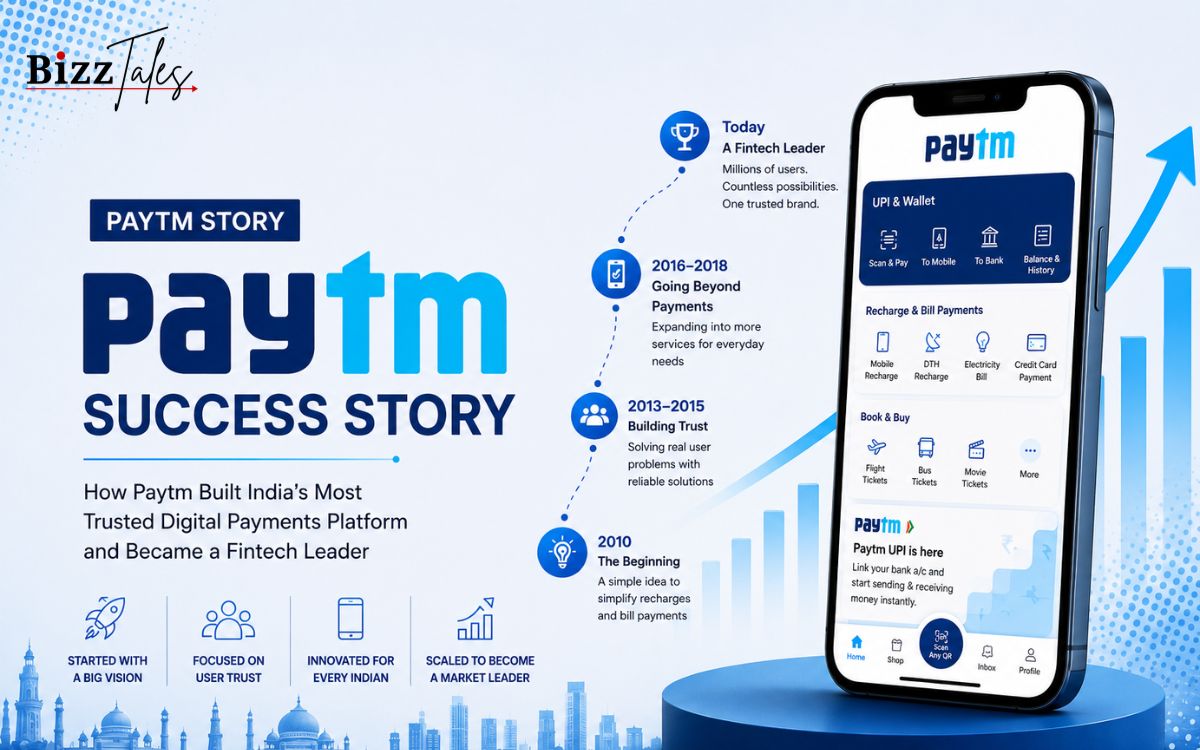
The Paytm was established in 2010 by Mr. Vijay Shekhar Sharma.
The company began with a simple idea – offering online mobile recharge in India. Back then, online payment was not widely adopted in India and most of the people mostly opted for cash transactions. The online payment modes were still emerging.
Vijay Shekhar Sharma was convinced that the mobile internet and the smartphone would reshape the definition of consumer behavior in the future. And this was the beginning of Paytm.
Early Struggles
Things weren’t initially smooth.
Launching a digital payments business in India was challenging given the low number of internet users and lack of trust. (References?
Furthermore, the company was under financial constraints and charged by competitors such as conventional recharge operators.
However, Vijay Shekhar Sharma was undeterred. He was convinced that digital payments would soon be adopted widely across the country.
Growth Through Mobile Recharges
Paytm gained popularity with mobile recharge and bill payment.
Simple, user friendly, and convenient platform. More usage of mobile has led usage of Paytm for transactions online.
The firm gradually began offering services such as booking tickets, shopping and payments using the wallet.
Demonetization Changed Everything
The event that can be considered as one of the milestone events for Paytm perhaps happened during demonetisation in India in the year 2016.
With the banning of high value currency notes, millions of people suddenly required digital options for payment.
Which has gained popularity rapidly as everything can be paid using paytm. Became used by the people to make cashless transactions.
This escalation in advertising helped the company to grow even more rapidly.
Small shopowners, local vendors and businesses began acknowledging Paytm’s mode of payments. The company eventually became a household name in India.
Becoming India’s Digital Payment Leader
Following the demonetization that happened in the country, Paytm emerged as one of the largest digital payment platforms.
The company expanded into multiple services such as:
UPI payments
- Banking
- Insurance
- Wealth management
- Online shopping
- Ticket booking
Paytm was not a wallet app anymore. It had the panache of a fintech ecosystem.
Massive Investments and Expansion
Major investors from world wide poured into from PayTM.
The ‘big guns’ investments facilitated the company for aggressive expansion and technological improvements.
You ran a heavy customer acquisition engine, secured merchant partnerships, and built digital infrastructure.
Paytm at one point was India’s most valued startup.
Competition in the Fintech Industry
As a result of popularity of digital payments, the now highly competitive market emerged.
Market entrants: Phone Pe, Google Pay, etc.
UPI revolutionized digital payments because it simplified and speeded up the proceedings.
It had an impact on Paytm’s wallet-based business model as well.
The IPO and Market Shock
Paytm came out with one of the largest IPOs in India, which put a spotlight on the company.
But post listing, the major challenge for the company occurred in the stock market.
The share value plummeted and raised concerns among investors about the prospects of the business and its business strategy.
This in turn turned out to be the most shocking incidents to have taken place in India’s startup eco system.
Why Paytm Faced Problems
There were key reasons why Paytm’s fell flat.
The company expended heavily on growth and new client acquisition, growing its losses.
Competition grew fiercer, particularly in the UPI payments.
Additionally, investors all anticipated a relatively faster pay-back period, which was expected to increase the pressure on the firm.
Vijay Shekhar Sharma’s Leadership
Despite all, Sahani remain restless and passed the time the pressure off the new CEO by keeping improving the company.
His leadership style is highly aggressive, driven towards success through ambition and bent sharply towards future.
He will always have faith in digital transformation and keep in turn investing in tech and financial services.
The Comeback Strategy
Tired of receiving criticism as well as suffering from financial crunch Paytm again shifted its focus on profitability and efficiency.
The company eliminated un necessary expenses and it emphasized a sustainable growth.
It also ventured into the financial segment of lending and merchant services.
This benefit helped the organization on course for stabilization.
Business Lessons from Paytm
Following are the lessons one can learn from the journey of PayTm:
The one lesson I have learned is really in the timing. Demonetization accelerated Paytm s growth because the company was ready for this opportunity.
The second lesson is adaptability. Having a rapidly changing industry like fintech, businesses need to adapt constantly.
There’s also a lesson in there on the drawbacks of growth without profit. You can be too big too soon…
Impact on India’s Digital Economy
- PayTM: 17% of the digital payments in India can be attributed to PayTM.
It facilitated the shift to digital transactions for small enterprises and neighborhood outlets.
The company further created positive awareness towards cashless payments, nationally.
Future of Paytm
By 2026, Paytm still centering itself on the financial services, merchant payments, lending and financial products.
The company attempting to achieve a form of balance between growth and profits in a highly competitive industry.
Conclusion
The success and, after that, the fear of failure, followed by the comeback: this may well describe the PayTm story.
‘Surviving as a small recharge platform to becoming one of India’s top five fintech companies has been a far cry.’
Company helped India and its people to make the transition to digital.
The story of the company demonstrates that there is chaos in business. There are a trend of ups and downs but the survival is highly depended on one’s self’s persistency.