Artificial Intelligence is now one of the most effective technology in today’s business world. Enterprises throughout the entire world are adopting AI applications to be able to improve productivity, automate processes, produce content, analyze data, and be able to make faster decisions. More and more staff members are starting to use AI applications to gain time and be more efficient.
Although AI offers tremendous opportunities for businesses, it is also presenting a looming challenge that many companies are still coming to grips with. That challenge is called Shadow AI.
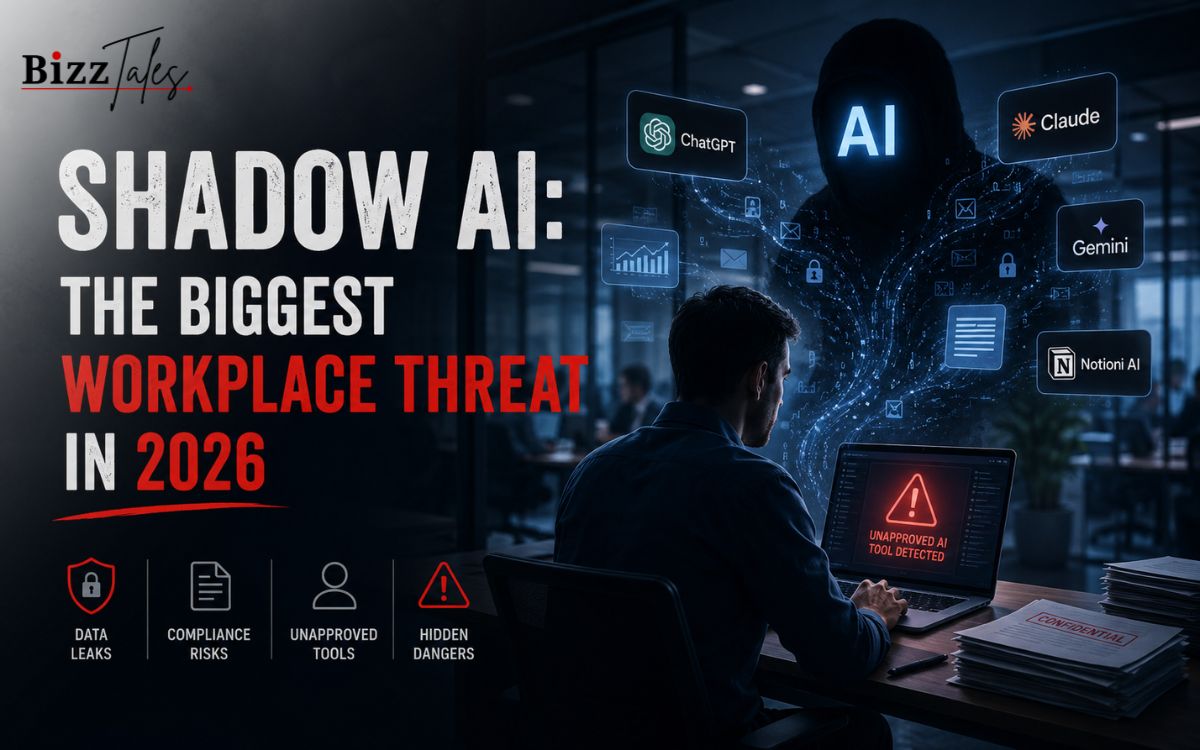
By 2026, Shadow AI is likely to be one of the greatest workplace dilemmas for organizations of any size. A large portion of employees are increasingly resorting to AI services for workplace purposes, while not obtaining explicit permission to do so. Employees may be uploading sensitive corporate data, customer information, internal memos, financial documents, confidential files to AI platforms.
On initial inspection this looks relatively innocuous. Employees are merely looking for increased efficiency and reduced workloads. However, once applied outside organizational policies and security systems, significant dangers start to become apparent.
For business, Shadow AI is not only a technological matter. It is a security matter, a compliance matter and a management matter. Comprehending this emerging phenomenon is starting to become fundamental for leadership managers, business owners and workers.
What Is Shadow AI?
Business shadow AI businessshadow AI. This describes the “use of AI tools by employees for work-related endeavors without the knowledge, consent, or supervision of its organization.
This is similar to “Shadow IT”, which is when employees purchase or adopt a product or service without consulting or seeking approval from the IT department.
With Shadow AI, employees can utilize a range of AI chatbots, content generators, programming assistants, image generators, data analysis software, or automation tools without notifying management.
A lot of them are willingly doing this for good reasons: to save time, to be more productive and to get things done more quickly. Unfortunately the obscurity introduces some risks which organizations are unable to observe or regulate.
What if an employee were to enter sensitive client information into an AI tool accessible in the public domain? The employee could just want to work efficiently, but the company would not know that assets had been disclosed to a third party.
This is where Shadow AI is starting out.
Why Shadow AI Is Growing Rapidly
The primary leading factor to the growth of Shadow AI is access.
Nowadays, everyone can get access to AI tools as much as they want instantly. Most of them just need the internet and their accounts. Even workers are not even asked for management approval before they are allowed to use such AI.
AI tools are often instantly available unlike usual software implementations that go through the approval, training and procurement steps.
An additional reason is the pressure of productivity.
Workers are being asked to produce more faster. AI allows workers to take over the routine aspects of their jobs-drafting routine emails, designing slide decks, crunching numbers, or brainstorming ideas. Consequently, employees begin to adopt AI applications themselves until companies develop formal guidelines.
The emergence ofShadow AIhas also been driven by the shift to remote work and hybrid work.
When employees work alone, companies have fewer insights into the kind of tools they use on a regular basis.
The Productivity Trap
Another factor that makes Shadow AI so hard to combated is that it actually enhances productivity.
For workers, the advantages are more immediately apparent. Jobs that for years took hours away from their days can now be finished in minutes.
Marketing teams want to use AI to come up with content ideas. Development teams want to use AI to help with coding. Sales teams want to use AI to create proposals. Customer support teams want to use AI to be more effective communicators.
Since these results are so often positive, workers do not even think about paying attention to the long-term risks.
This leads to a distributional trap.
The “more useful” for employees to use they AI, the more they became integrated into business process so acquiesced.
Data Privacy Risks
Data is often considered the biggest concern with Shadow AI.
Platforms like AI often prompt users for input. Not laborers, thinking they are ASKING the machine for something, but yes laborers, who while making the request are giving the AI subtle business background and sensitive information.
This information may include:
- customer details
- financial data
- confidential contracts
- product roadmaps
- legal documents
- internal communications
By uploading sensitive data to AI external to the organization, companies might get unaware of the management through the data.
For a company working within a regulated industry such as healthcare, finance, legal services or government the above types of risks can become very serious.
Compliance Challenges
Numerous institutions have to adhere to complicated rules about managing data and confidentiality.
Using unapproved AI software could lead to your company breaking existing industry regulations or compliance mandates.
The problem is even bigger when management is unaware that such activities are taking place.
Your company can only protect information if you know it is being sent; otherwise it will be defenseless.
Expect a huge spike in compliance issues as new AI legislations are brought in around the world.
Security Threats
Experts in security are worried about Shadow AI.
Unapproved AI applications might open up security loopholes that can be utilized by attackers.
There are risks that employees may unintentionally reveal credencials, system information or sensitive data when using AI platforms.
In addition, some applications of AI may not have robust security controls which make systems vulnerable to attack.
As more and more businesses rely on technology, the smallest of security errors can have huge ramifications.
Accuracy Problems and Misinformation
One more workplace hazard is errors driven by AI.
AI built-in can generate very convincing answers which are often false.
Employees who unfailingly trust AI might then generate presentations, reports, or even business decisions that are based on flawed, biased, or incomplete data.
It becomes especially hazardous when AI outputs are taken at face value-without validation.
An error caused by AI may quickly propagate within the department and end up impact a key business decision.
The Hidden Nature of Shadow AI
One reason why Shadow AI can be challenging to control is the fact that it’s often undiscoverable.
Unlike traditional softwares which you install on your computer, many of AI tools work in web browser cloud environments.
Employees can quietly initiate the use of them without any alerts or procurement whatever.
Thus, management could believe all is normal, even though illicit use of the AIs continues unseen.
Its clandestine qualities make a Shadow AI risk far more difficult than most other technological risks,
Why Banning AI Is Not the Solution
Some organizations try to ban ai altogether as a first reaction.
But more often than not it doesn’t.
Workers are aware of the productivity benefits of AI and might do so covertly if no formal substitute is provided.
There has been evidence that an outright ban on AI make the entire Shadow AI set even higher.
Rather, companies require balanced strategies that promote responsible AI uptake.
Creating Responsible AI Policies
Leading organizations are creating effective AI governance policies.
These policies explain:
- which AI tools are approved
- what information can be shared
- what information must remain private
- How the outputs of AI should be confirmed.
- employee responsibilities when using AI
Clarityand guidelines enable employees to understand expectations but still make use of the AI technology.
Training Employees About AI Risks
The management of Shadow AI relies heavily upon education.
Many employees are simply unaware of the risks that exist.
They do not view AI as a security concern; they consider AI to be exclusively a productivity enabler.
Basing all employment decisions, including training, hiring, and compensation, on AI can be detrimental for organizations; however, investing in AI training can help employees learn to make wiser informed choices in their behavior regarding data, privacy, and usage.
Furthermore, training can also attenuate the fear and uncertainties towards using AI.
The Future of Workplace AI
The use of AI is only going to increase in the way it is used in business.
It should not involve getting rid of AI but controlling it in a safe way.
Organizations that adeptly manage the coexistence of innovation and security will be best positioned to prosper.
Businesses that overlook the threat of Shadow AI will have to deal with security breaches, compliance failures and operational issues down the line.
The successful businesses of 2026 and beyond will probably be businesses that adopt AI with appropriate controls to underpin it.
Conclusion
According to a recently published report, Shadow AI is threatened to be the top workplace challenge that dominates 2026.
Intelligent tools are being quickly adopted and empowering employees to be more productive than they have ever been. But, unmanaged use of these technologies also exposes organizations to critical security, privacy, compliance and data protection issues.
The problem is not AI, the problem is unregulated AI use.
Companies can’t deny that most of their employees will keep trying to find more effective ways to get work done, faster, smarter. Instead of opposing AI development, companies would be better off establishing well-known policies, carrying out training, and implementing in workplace governance.
Shadow AI is cautionary and hopeful.
Businesses that tackle the problem sooner rather than later will be able to harness the opportunities of AI and at the same time be able to handle the risks. Business that fail to do so will enjoy the opportunities only the delay until problems are discovered.
In today’s workplace, Shadow AI understanding has become inseparable from business.
FAQs
What is Shadow AI?
Shadow AI refers to the use of artificial intelligence tools by employees without official approval or oversight from their organization.
Why is Shadow AI considered a workplace threat?
Shadow AI can create risks related to data privacy, cybersecurity, compliance violations, and inaccurate information.
Is Shadow AI illegal?
Not necessarily. However, it can violate company policies, industry regulations, or data protection requirements depending on how it is used.
Why are employees using Shadow AI?
Employees often use AI tools to save time, improve productivity, automate tasks, and complete work more efficiently.
How can companies reduce Shadow AI risks?
Companies can reduce risks by creating AI policies, providing employee training, approving trusted AI tools, and implementing strong governance practices.