
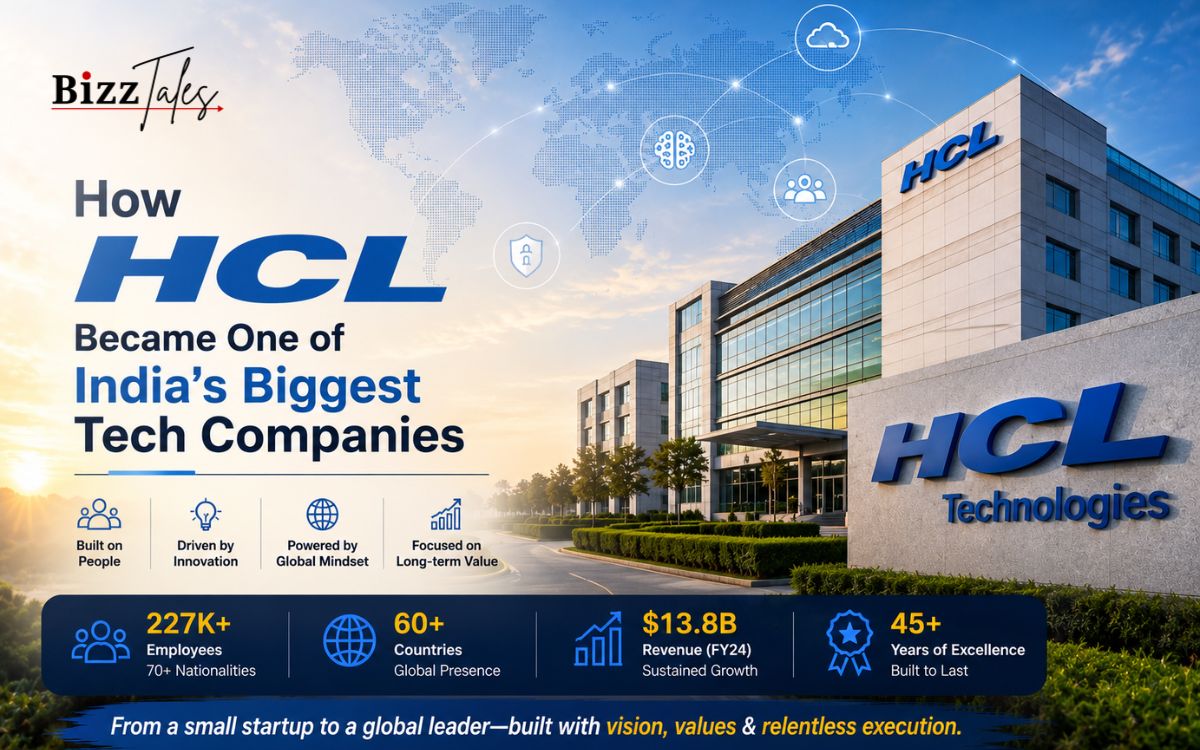
The India information technology industry has pioneered many of the world’s mega companies.India based companies like TCS, Infosys, Wipro, HCL have made India a power house in the field of technology. One of the pioneers in this group is HCL.
Currently, HCL Technologies is a major Global technology leader and provider of IT services to some of the world’s largest companies. It has a footprint in more than 60 countries and a work force of over 22,000 digital transformation, cloud computing, cybersecurity, artificial intelligence, engineering and software development comprises HCL’s wide array of services.
HCL’s story is not without its struggles. What started out as a modest startup’s attempt to manufacture computers in India went on to become one of the country’s most successful technology companies. It can be partly credited to founder Shiv Nadar’s obsession, vision and leadership that helped make HCL one of the biggest global brands.
Here is the exhaustive story of what made HCL one of India’ largest technology companies and the lessons it offers to businesses.
The Birth of HCL
HCL’s journey started in 1976 when some highly motivated professionals led by no other then said Shiv Nadar started the enterprise in the IT industry.
Back then, the Indian technology scene was a far cry from where we are today. Computers were so expensive, that only the very rich could afford them. Outside government institutions, access to technology was virtually nonexistent and, very few Indian companies were involved in hardware manufacturing.
All attempts to establish indigenous systems for the majority of the firms were of little avail. Most were heavily reliant on imported equipment making technology acquisition costly and difficult.
Shiv Nadar has recognized opportunities that others have not.
He thought India would be able to produce their own computers and join in the booming IT industry.
Founded as Hindustan Computers Limited HCL with an initial investment of roughly 1.87 lakh.
The aim was simple and ambitious: Build indigenous computing solutions for India.
Eventually leading to what was to become the genesis of India’s largest tech venture.
India’s First Steps Toward Computing
The period from 35 to 36 was quite significant inglobal technology.
A new era of personal computing was starting to come into being. Businesses of all nationalities were venturing into computing.
We see that HCL entered the market quite late.
The company first focused on a hardware innovation rather than a software service.
HCL introduced one of the first indigenous computers in India in 1978.
This was a major achievement, given that the country didn’t have a maturing technology ecosystem then.
The company’s capacity to develop computing solutions locally proved Indian companies could innovate instead of merely bringing in foreign innovation.
This early triumph added to HCL’s credibility and established it as one of the pioneering technology companies to emerge from the country.
The Leadership of Shiv Nadar
Pass aureos inspire better institutions.
… was none other than this leader of HCL.
In contrast to many entrepreneurs, who were primarily interested in immediate gains, Nadar was interested in innovation and growth:
He thought that technological advancement would change manufacturing and business, economies and societies.
This conviction was the motivation for HCL to invest heavily in research and development and building a leader ship.
One of Nadar’s greatest strengths was his openness to evolutions.
Throughout the growth of the technology industry, he continuously adjusted HCL’s approach to stay ahead in the market.
Such adaptability would have been critical as the world economy moved from hardware to software and services.
Nadar’s leadership focused on employee empowerment and knowledge development, fostering a culture of innovation.
Today, the impact of his first vision stills.
The Shift from Hardware to IT Services
The recognition by HCL of the increased significance of software and IT services was one of the most defining moments of the company’s history.
The demand for technology services around the world sky-rocketed during the 80s and 90s.
Software development, IT consulting, infrastructure, and digital solutions were essential to them.
HCL realized that the future had to go beyond just making hardware.
The company slowly ventured into software development and IT services.
This way, HCL was able to go abroad and establish relationship with leading companies in other countries.
While the hardware remained critical, the services began to be the dominant engines of growth.
This transition mark the transition of HCL from a domestic Technology company to a globally recognized IT services company.
The ability to adapt itself according to market trends managed to become one of the hallmarks of HCL.
Capitalizing on India’s IT Boom
India’s IT industry grew rapidly during the late 1990’s and through much of the early 2000’s.
The world wide companies have been outsourcing software development and technology services to India because of availability of skilled resources and reduction in prices.
This led to phenomenal opportunity for Indian technology firms.
HCL was in a strong position to take advantage of this trend.
They broadened their range of services and focused heavily on nurturing and investing in their people.
With the multinational corporations in need of a dependable technology provider, HCL was established as one.
International clients awarded big contracts to the company in view of its emphasis on quality, up-to-date delivery performance and customer satisfaction.
The international expansion was a major factor that led to a rapid rise in revenue and increased its position within the tech industry.
Building a Global Presence
Due to global rise in demand for technology services, HCL moved out of India.
There was offices, delivery centers and innovation centers in NorthAmerica,Europe, Asia-Pacific and Middle East by the organization.
With the international teams client processes could be delivered better and the needs of the regional markets better understood
Another benefit of the global expansion, was the diversification of the revenue sources.
HCL used to generate a major part of its business from foreign customers rather than relying completely on the Indian market.
In the 21st century..,today HCL is to rely on for a vast array of technology services among many other 500. Fortune 20 companies.
Today, the company’s ability to operate globally while maintaining operation eficience has been one of the company’s strategic strengths.
Innovation as a Core Strategy
You can’t thrive in high-tech if you don’t innovate.
HCL was always aware from the beginning.
It committed substantial resources to research, engineering and new and developing technologies.
Instead of providing just a traditional service back office, HCL was concentrating on assisting enterprises in accessing these new digital capabilities.
Its investment in the areas of cloud computing, security, artificial intelligence, data analytics, and automation set the company’s foundations for future growth.
Another benefit of innovation was that HCL was able topos itself apart.
Through delivering high-end technological service, the company develops strong relations with its clients and provides them with enduring value.
Today, innovation is obviously an important part of the HCL’s business strategy.
HCL’s Unique Employee-First Philosophy
HCL is well known for an unusual, perhaps unpopular, management concept is “Employees first Customers Second”.
This seems a bit bizarre at first.
Almost all companies build their strategy around customers.
HCL differs.
The belief was that staff would inherently provide a superior customer experience when their staffs were empowered and motivated.
This philosophy centered on transparency, accountability and employees involvement.
In this way, by focusing on employees and making them feel important, HCL was able to increase productivity, innovation and customer delight.
In Western countries, it received worldwide recognition and was used as example in modern management.
Showed that the advantages gained to a company’s bottom line by making investment in its people can be significant.
Strategic Acquisitions and Expansion
Another key contributory factor has been HCL’s acquisition strategy.
It bought companies fitting with its competence and that would broaden its market.
Served to enhance our knowledge of software products, engineering services, cloud solutions and digital transformation.
Instead of acquisitions for scale, HCL looked at strategic fit.
Those acquisitions were made to add value to customers and drive growth.
This strategy proved to be successful in allowing the company to grow without sacrificing the company’s day to day stability.
Eventually, acquisitions became a significant element of HCL’s international growth strategy.
HCL in the Age of Digital Transformation
Digital transformation is transforming the world of business and we’ll look at this concept in a future section.
In fact, to meet their goals organizations from different sectors are investing in technology in order to meet their objectives regarding:
Efficiency – Customer experience – Competitiveness
The above solutions position HCL as a strategic partner in this transformation.
The company provides solutions in:
- Cloud computing
- Artificial intelligence
- Cybersecurity
- Data analytics
- Digital engineering
- Enterprise software
- Infrastructure management
These features help HCL to assist business update their operations and to change according to the dynamic environment.
With the pace of digital transformation quickening across the globe, demand for HCL’s services is also increasing.
Financial Growth and Global Recognition
Hcl has been able to generate tremendous financial gains over the years.
The company, which started as a mere one man band in a small startup with such limited resources, grew into a multi-billion Dollar enterprise.
Its revenues have steadily increased over the years by means of innovation, global expansion, customer relationships and strategic investments.
Today,HCLis among India’s largest IT companies and competed with world’s largest technology service providers.
The company’s accomplishments have received recognition from industry analysts, clients, and investors around the world.
Its success is a result of Boardroom discipline over many years and leadership.
Lessons Entrepreneurs Can Learn from HCL
Here are some take-aways from the HCL story for entrepreneurs and business heads.
The most important lesson I have gained is how worth for the ability of adapting.
Hcl managed by knowing market opportunity change over hardware to IT service successfully.
A further reason that is identified by critics is the discussion over long-term vision.
Shiv Nadar had invested in innovation and people before the payoff was there.
Employee-centric approach of the company shows how people are considered to be the most valuable resource for business.
HCL also emphasizes the value of thinking globally.
Through international expansion, the company opened up a new world of prospects and put itself on the path of more accumulation.
As the industry leader, HCL also shows how to achieve and sustain success through disciplines of ongoing learning, relentless innovativeness and right execution.
The Future of HCL
HCL has bright prospects for the future as technology advances.
As AI, cloud computing, automation, cybersecurity and digital engineering will continue to be key for growth.
All around the globe organizations are investing more and more in technology to stay competitive.
HCL’s strength in these fields will put it in a good stead for the future.
Growth was considered very probable as expansion in digital channel, relationship with customer and IP was swifter2, due to the nature of the business.
Ever more businesses will take the plunge from investing in innovative technology to actually deploying next generation products and services and HCL will be one of the major players.
Conclusion
This is a story of how, under inspired leadership, HCL rose to become one of India’s largest technology firms.
HCL – Starting from 1976, HCL has ambitiously grown to be on of the world’s biggest technical giants. Paths pioneered by long-term chairman Shiv Nadar has turned HCL to be one of the top reputed organizations not only in the country India but also worldwide.
Its path showcases the strength of being future oriented, flexible and investing in human resources. Having moved from hardware manufacturing to an international IT services leader, HCL India showed that it is the groundbreaking understanding of a way forward that pays off.
Today, HCL is a representative of India’s technological prowess and budding entrepreneurial spirit. Its awe inspiring journey of growth is an inspiration for entrepreneurs, startups and business leaders across the globe.
Who is/are the founder(s) of HCl?
HCL was created in India in 1976 by Shiv Nadar, to develop indigenous computers.
What is HCL?
HCL stands for Hindustan Computers Limited.
How did HCL succeed?
HCL’s success was driven by innovation, expansion, global service delivery, its people, and flexibility to changing trends in technology.
Today, what is known as HCL?
HCL: IT services, digital transformation, cloud computing, cybersecurity, engineering services, and software.
What is HCL’s Employees First philosophy?
It is a strategy whereby organizations treat their employees as their greatest assets; take, work with and value their employees to be the core of their operational strategy. It is a human resource strategy based on the premise that satisfied employees will result in satisfied customers.
What is the significance of HCL to the IT industry of India?
HCL is one of the earliest players in India’s technology industry and was pivotal in making India a global technology and IT services center.