
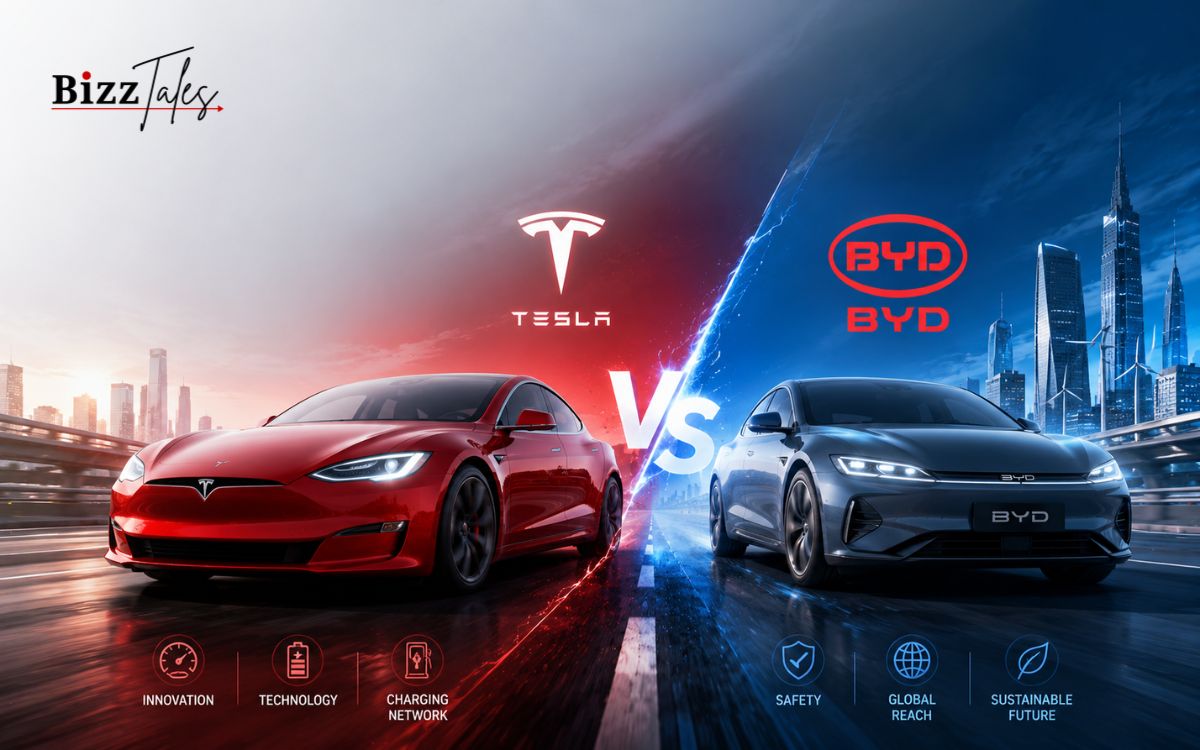
The leading automotive industry in the world is experiencing the biggest revolution ever: for more than a century, gasoline-based cars have been permeating the world’s roads, economies, industries, and consumer preferences. Now, thanks to electric vehicles, everything is changing at an accelerated rate. Countries push for cleaner and greener kind of transportation, consumers are adopting electric cars, and car producers are pumping billions of dollars into these new vehicles, with two names being corporate icons of the new approaching era of electric mobility: Tesla and BYD.
For a long time, Tesla was the undisputed champion in electric vehicles. It shifted how people think about electric cars-breaking the stereotype of them as slow and ugly vehicles and turning them into desirable, high-performance products. While Tesla was building its brand on the world stage, however, a Chinese company called BYD was expanding its manufacturing capacity, investing in proprietary cell technology, and establishing a of the largest EVscircuits anywhere in the world.
Nowadays, Tesla versus BYD has turned into one of the most intriguing business wars of contemporary times. Both enterprises are offering millions of cars, pouring amazing sums of money into evolution and struggling for control of a market that may shape the innovator of transportation. Although Tesla is still one of the most popular EV trademarks worldwide BYD has stood up to firmly challenge this status quo.
All the investors, analysts, and consumers are asking a simple question: who is going to lead the next generation of electric cars?
The Rise of Tesla and the Beginning of the EV Revolution
Tesla is a name highly associated with the current electric vehicle movement. At the time when Tesla entered the automotive industry, electric vehicles were widely seen as clumsy and unglamorous. The range issues, the slow charging, and the poor performance made the electric vehicles unacceptable in the automotive market.
Tesla managed to shift this mindset entirely. With innovation in battery tech., a futuristic design, integrated software and stellar engineering the automaker was able to engineer EVs that people desired to keep. The Model S, Model 3, Model X and the Model Y brought auto makers to the cutting edge of innovation and made Tesla a trillion dollar company.
Much of Tesla’s success is due to its approach of trying to be about far more than just the car. When marketing itself Tesla attempts to point out how it is a technology company with a focus on energy, software, artificial intelligence and sustainable transportation. This has helped attract a committed base of customers, investors and techgeek-like fans.
Tesla’s impact is evident across the automobile industry. It spurred global adoption of electric cars and compelled legacy automakers to spend billions of dollars on electric vehicle research and development. The EV industry as we know it would probably be unrecognizable without its trailblazing success.
How BYD Became Tesla’s Biggest Competitor
As Tesla was grabbing all the headlines while leading the world, BYD was creating a different sort of competitive edge. BYD was a Chinese company and at first it had been working on batteries before turning his focus to vehicles. This history endowed the company with an unparalleled strength.
In contrast to many other car manufacturers who depend on numerous outside suppliers, BYD produces for itself a substantial range of parts. The company itself builds batteries, semi-conductors and most of the car’s components.
China: BYD Large domestic market China became the world’s biggest electric vehicle market over recent years was a main factor for this growth. This also aided BYD to grow at a quick pace due to high domestic demand, state policy towards green transportation and the company’s range of low cost electric vehicles in different price segments.
What should be re-tooled is that, BYD’s ability to service the premium segments of the market as well as the mass-market segments gives it an advantage over the only other competitive player in the market, Tesla. Contrary to the fact that Tesla mainly produces higher priced cars, that the BYD sells across multiple income levels has enabled the company to bag excellent sales figures and penetrate other countries quickly.
Today, BYD is not a regional producer anymore. It has become a global EV giant with goals to compete head-to-head against Tesla in various markets.
The Importance of Battery Technology
Battery technology continues to be a defining factor for companies in the electric vehicle industry. Competition is driven by performance factors such as range, acceleration, charging time, safety, and cost, which all are directly affected by the battery technology present.
For years, Tesla has been identified with benefits associated with battery improvement and energy management. Through aggressive research and development programs, Tesla has excelled at providing a multitude of benefits to their vehicles including extensive drive times and impressive performance metrics.
BYD, on the other hand, has a different set of advantages. BYD is one of the world’s largest battery manufacturers and has created its own battery technologies that have safety, longevity and cost advantages. This level of control over a key component provides the company an excellent vantage point in the EV Market place.
As the EV market expands and advances, battery technology will be one of the most critical elements in determining market dominance. Faster, cheaper production of better batteries should give clear lead to those who succeed.
Tesla’s Strength in Brand and Technology
Another core strength of Tesla is its brand. Not many automotive manufacturers command the levels of excitement and attention now captured by Tesla. The firm has positioned itself as a cutting edge, forward-thinking, technologically advanced brand to epitomise the automobile of the future which, in turn, has greatly appealed to consumers globally.
Tesla’s software abilities are key to its strong competitive position. Some Tesla owners consider the cars as technology platforms, not just vehicles. Tesla distinguishes itself with capabilities like over-the-air software updates, sophisticated autonomous-driving features, and an all-encompassing digital experience.
Furthermore, the company has established a charging network across the globe to improve the convenience of customers. While access to dependable charging infrastructure still remains a key consideration for adoption of EVs, Tesla’s effort has paid off as another aspect which improved customer satisfaction.
These factors contribute to the sustained high demand for Tesla even as traditional manufacturers and new entrants enter the EV market.
BYD’s Cost Advantage and Manufacturing Scale
Although Tesla is undoubtedly leading the market in regards to branding and technology, BYD’s strongest point may be the scale of production-providing the vehicle at the lowest possible cost. Scale of manufacturing has become the key differentiating factor in the EV industry, as lower cost covers a broader market.
WOEWEM’s integrate business strategy minimizes the need to co-operate with outside suppliers as well as maintains the cost down by internal production, is able to develop the product more efficiently as well as fast to the changing requirement.
This cost advantage enables BYD to price more competitively as well as still being profitable. For many markets, cost is one of the biggest barriers to consumers purchasing electric vehicles. BYD will have gained access to a more extensive customer base.
When commercial drives more broadly across the world from early adopters and premium buyers, affordability could be the driver. This creates another possibility for BYD to increase share.
The Global Expansion Race
The decision about the future of electric Vehicles will not be taken in one country. Tesla and BYD are aware that to survive in the long term, they have to grow internationally.
Tesla has established a formidable global footprint with manufacturing centers, sales,supply chain and charging infrastructure across various regions. It has high brand awareness in North America,Europe and other parts of the world.
BYD has implemented a not dissimilar expansion strategy. It is entering Europe, Latin America, Southeast Asia, and similar markets where increasing demand exists. Using its mass production economy of scales and low prices, it intends to draw buyers looking for lower-cost options.
With both firms expanding globally, competition will intensify. The race for market penetration in developing regions is sure to be crucial for future industry leadership.
Challenges Facing Both Companies
But all in all, even though they have been successful, no one can be assured that Tesla and BYD will be powerful. The EV market is enormously competitive, as conventional cars manufacturers ramp up their EV position.
The level of electric mobility is expected to be due to the competition faced by companies such as Volkswagen, Hyundai, Ford, General Motors and many Chinese companies. It is expected that competition will exert pressure over prices, margins and market share.
Regulatory hurdles: Regulations are constantly increasing and changing. Governments across the globe are updating all sorts of new regulations on emissions, trade, subsidies and manufacturing standards that companies will have to adapt to.
Disruption within supply chains, shortage of raw materials and geopolitics could cause additional hurdles for growth strategies. Both Tesla and BYD will need to maneuver through it as they seek ways to grow globally.
Who Is Better Positioned for the Future?
It is not a matter of who will be king in the long term, as the picture is more complex as these two companies both have their considerable advantages.
Tesla remains its position as the world’s most recognized brand, most innovative software, and most influential technology. The thrill of the dream has now been realized and the name “Tesla” remains world famous for representing the EV revolution and for maintaining a growing customer base of excitement, innovation, and luxury.
BYD, on the other hand, has a solid base with a focus on operational excellence, battery technology and affordability. Its diverse offering allows it to reach a broader customer segment, providing the company with opportunities for growth.
New energy vehicles are also forecasted to grow significantly within the next ten years. The market is not anticipated to support only one winner, but could also enable other players to flourish at the same time. Tesla might remain the leader for high-end, luxury, electric cars and BYD for the broad-based market.
After all, the future might rest on the one that can better adapt to the ever-changing consumer demand, technological progress, and international market environment.
Conclusion
The Tesla vs. BYD war was about more than just rivalry between two car manufacturers. It was a preview of the in the global transportation sector, as electric vehicles replaced conventional gas-powered models.
Tesla disrupted the EV segment and built itself as a technology powerhouse. BYD used their manufacturing leadership, battery tech and operational efficiency to build one of the fastest growing electric vehicle company in the world.
With all levels of society adopting greener ways of driving, both companies will profit from fast expanding electric vehicle Industry. In a race for victory between Tesla and BYD, whoever emerges first will undoubtedly help redefine our way of getting around.
FAQs
Is BYD more extensive than Tesla to buy electric vehicles?
Sometimes BYD sells more total EV than Tesla (includes plug-in hybrid vehicles). The two remain the world’s biggest EV seller.
What makes BYD gaining so quickly?
BYD has the ability to leverage its strong battery know-how and vertical integration through to manufacturing intensity and competitiveness to keep the costs low as well as having access to the largest EV market (China).
What sets Tesla apart from all the other EV companies?
Tesla is an automaker-or a tech company-that sells the combination of electric vehicles, software and artificial intelligence functionalities, over-the-air updates, and a world-renowned brand.
Considering all the above factors which one has the better battery technology?
Both companies are good at battery technology. Tesla’s is intended for efficiency and performance and BYD emphasize safety, price and to achieve mass battery production.
Who will own the future EV market?
Maybe there won’t be just one winner. Tesla and BYD have diverse competitive advantages and are likely to be both strong players in the realm of global EV market development.