History has rarely seen so much existing and emerging technology excitement and worry about artificial intelligence, or AI. AI- which now helps automate mundane office activities, creates content, develops computer programs, big data analysis and supports detailed decisionmaking- is becoming a regular feature of routine business in many different fields of work. With some business sectors investing billions of dollars in AI-based tools and solutions, the topic of employment prospects in the era of artificial intelligence remains at the top of the agenda for employees, enterprises, elected representatives, industrial economists and state authorities alike.
Two narratives dominate the current debate. The first is a human versus machine war. Headline after headline proclaims that AI will lead to mass displacement, wipe out entire sectors, and reshape the future of work. The counter-narrative sees AI as a force for good-creating new jobs, enabling innovators and workers alike to be more productive, and raising living standards much as past technological advancements have. Neither paints the full picture.
All these technologies have brought about a huge shift in the world of labor. The Industrial Revolution revolutionized manufacturing. The computer revolution restructured the nature of work in offices. And the Internet is creating new industries all its own. Every previous wave both displaced existing jobs and created new jobs and industries at an extraordinary pace. Now artificial intelligence looks to be shaping up as the next force of change, but in a way that will be faster, broader, and more powerful than anything that has come before.
No longer confined to research labs or fantasies of science fiction writers, AI is now being utilized by start-ups, large companies, governments, and entrepreneurs. Companies are turning to AI to replace customer service, streamline logistics, enhance marketing strategy, handle finances, and assist decision-making. As these systems continue to grow more complex, the effects on employment are starting to show-and they are raising significant questions about the future of work in a world of artificial intelligence.
How AI Is Transforming Jobs Across Industries
Artificial intelligence is transforming the nature of work across virtually all jobs in the economy. Unlike prior forms of automation that affected mostly manual work, AI can address several cognitive tasks that were considered to be mostly related to white-collar jobs.
In customer support, AI chatbots and virtual assistants solve millions of customer requests every day. Businesses get an around-the-clock customer service, with lower cost of human intervention and better response times. AI is used by financial institutions to probe various financial transactions, predict risk, and automate security procedures. Marketing teams are adopting AI systems at a fast pace, to develop content, examine customer behavior, and optimize online ads. Software firms incorporate more and more AI-based solutions into their products to help develop and debug applications.
The healthcare industry is another undergoing much change. AI can read X-rays and other images, recognize patient data trends, aid in diagnosis, and facilitate treatment planning. While physicians still have a crucial role, AI is a way to make physicians more powerful.
The industries of manufacturing and logistics have been using automation for a long time, but AI is taking these functions at an unprecedented leap forward. In smart manufacturing plants, AI systems forecast equipment breakdowns, plan production schedules, and enhance quality assurance. In logistics sector, AI algorithm are used to design routes, coordinate inventories, and lower operational expenses. Agriculture also moves into AI-powered systems for crop monitoring, yield prediction and efficiency increase.
Studies published by institutions such as the International Monetary Fund, the World Economic Forum and consulting firms such as McKinsey indicate that around 20-30% of the jobs we currently know could be threatened by AI over the next ten years. Threatened does not mean replaced. Often it means that AI will change the way the work is done rather that eliminate the worker themselves.
For example, as our accountants have already started using AI technologies to automate mundane data processing activities, such job functions do not become redundant but required our accountant to have the capability to work on more strategic financial planning and consultancy activities. Likewise, a cost accountant can employ AI agents to review and analyze long legal documents and carry out legal research work to contribute time for more advanced legal analysis and developing longer-term client relationship.
The increasing use of AI to automate parts of jobs reminds us of the very important fact that many jobs are made up of several tasks, and AI may only automate one specific task within a job. This may have to do with what we will see happen in the future in terms of job replacement or not.
The Jobs Most at Risk and the Opportunities Being Created
However, AI is not only bringing about new opportunities but is also posing threats to established working arrangements. Jobs that use monotonous, foreseeable and rule-guided work are more susceptible to being replaced than the ones that use innovation and creativity within their job responsibilities. Administrative and clerical jobs, entries, jobs in basic customer service and simple analysis are more under threat from automation.
Soon, however, this influence had spread into former bastions-areas where some of the world’s most talented would have believed their craft to be impenetrable to such encroachment-content generation, graphic design, programming, and even research. These professions are now beginning to be partially automated by tools based on generative AI-prompting many of those working in these fields to wonder whether they will remain employed in the distant future.
But solely emphasizing job displacement neglects a second, equally valid, perspective on technology: that of job creation. In the past, technological advances have led to the emergence of new industries and new types of jobs. No one predicted how fast food would spawn entire industries and job categories like fry cooks and inventory managers in the 1950s. We can’t be sure what new jobs AI will bring.
Job openings for AI engineers, ML specialists, data scientists, cybersecurity professionals, and automation consultants have skyrocketed already. Companies are craving for people who can build, deploy, operate, and oversee AI systems. Furthermore, companies need people who have both computing knowledge and strategizing skills to guide AI usage.
New positions are now appearing related to AI governance, ethics, compliance and risk management, as they will be increasingly called upon once regulations are in place and business adopters are looking for the responsible use of AI. Universities are also shifting course choices offering more in AI competencies and skills, including digital transformations.
Entrepreneurship: One of the greatest advantages that AI could bring about may be in the field of entrepreneurship; exemplarily, the creation of a successful company is usually only possible with large teams or a great amount of capital. However, artificial intelligence, can help a oneperson or a small company to do what in the past could only be achieved by much larger teams working with many man hours. For example, the growing abilities of tools such as AI are already perhaps making marketing, customer support, content generation, decision/tome analysis and accounting each more manageable.
So, it may not be a future with less jobs, but it will certainly be a future where jobs are very different from those existing today. Future workers who are able to adapt to the new realities created by AI, rapidly learn how to use new technologies and develop their skills accordingly will profit from the new opportunities generated by AI.
Why Humans Will Remain Essential in the AI Economy
There are many reasons to believe that human labor will remain necessary even as artificial intelligence continues to develop rapidly. While AI is great at information processing, pattern recognition, and certain kinds of automation, many other capacities of humans are not so easily imitated.
One such area is creativity. Even though a computer can generate content, ideas and designs based on the vast amount of information it has stored away, the ground-breaking innovators tend to be those with “imagination, insight and the ability to think divergently”. Many of the most important inventions, artistic masterpieces and business successes in history have been brought about through human creativity and this still provides a key edge.
There is also the issue of emotional intelligence. The skills of leading, negotiating, relating, mentoring and selling all depend on an understanding of human emotions and social interactions. At least some attributes of business success are not just down to efficiency but also to trust, care and communication. These are the qualities that will not be convincingly emulated by AI.
Human judgment is also part of ethical decision-making. AI can help identify options but actual moral choices must be made by people. For example, deciding how a new technology will be used involves societal and cultural factors that people must evaluate.
Complex problems are characterized by ambiguity, uncertainty, ill-defined parameters, and dynamic environments. AI systems work optimally in well-defined environments and parameters, but humans are more adept at handling situations with incomplete information or using more intuitive and creative adjustments in circumstances such as strategic planning, crisis management, and any unpredictable projection-based industry.
Humans won’t be totally displaced;computers will more likely be become a complement to human capacity.The employees who get used to on working with the AI device will be helpful to improve work efficiency and make better judgment and aoround more value with complement of human labor.
Conclusion
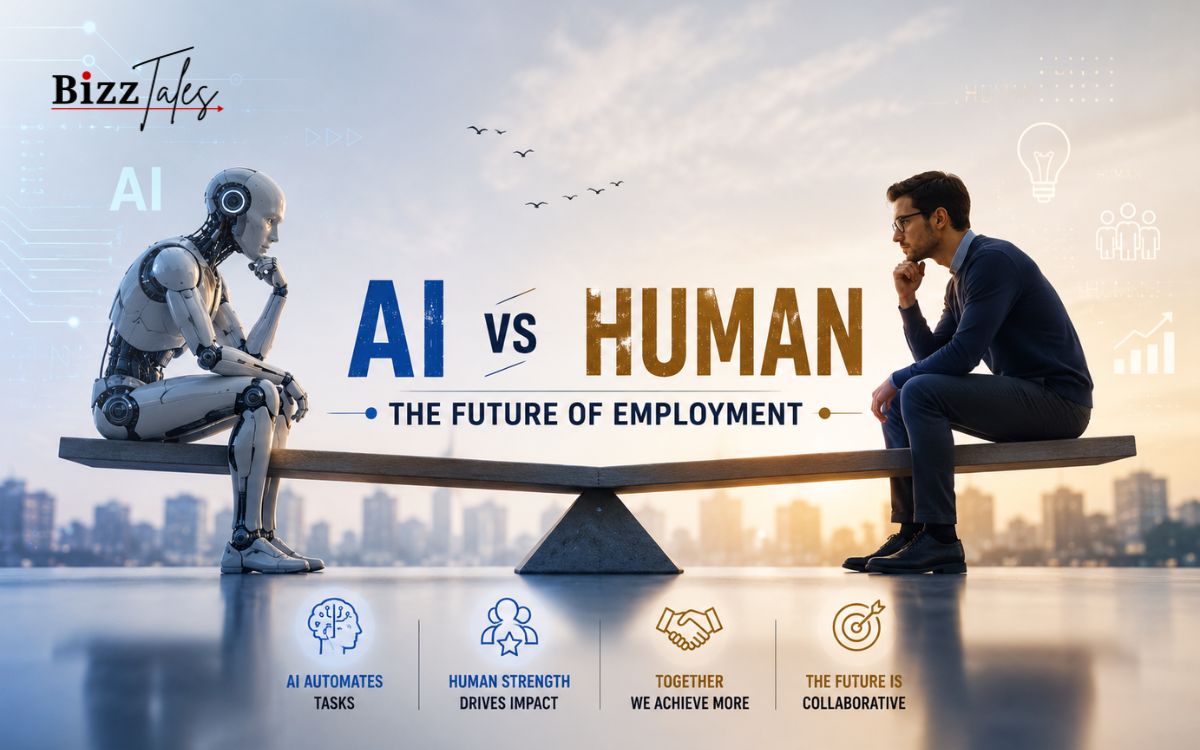
The AI versus humans debate often provides a false dichotomy. The future of work probably won’t be a battle of humans versus AI. It will be a battle of humans working with AI against other humans and machines that excel at producing new goods, ideas and economic output.
AI is already reshaping industries, automating tasks, and altering skill requirements in the workplace. Certain roles will will inevitably vanish or go through drastic transition. Yet at the same time, new fields, jobs and opportunities will be created as firms implement AI solutions and create new automation possibilities.
Those who will flourish in such a labor market will be prepared to adapt and to keep learning. They should develop a broad toolbox of skills, from technical background and digital skills to higher-level ones such as leadership, critical thinking, creativity and emotional intelligence, because even for these skills, technology can provide powerful tools that may supplement or substitute human abilities.
At the end of the day, the future of work isn’t about AI nabbing our jobs. It’s about changing how we view the role of technology in our lives and how it impacts our work. Although AI will revolutionize our workplaces, human resourcefulness, invention, management, and compassion will continue to be vital for economic development. The future is owned neither by us nor by machines. It belongs to the winners in the coming competition-those who reconcile these two factors of production.
FAQs
Will AI take over all jobs in the future?
No.AI is likely to automate some jobs and disrupt many more but most experts agree that the impact is likely to be a change to jobs, rather than the wiping out of all employment. Jobs will learn how to work withAI.
What jobs will be most affected by AI?
Positions that require performing a high volume of simple, repetitive and rule-based activities, like data inputting, lower-level clerical jobs and everyday customer services, are most vulnerable to automation.
What new jobs will AI bring?
AI is pushing the market to higher value skills like AI engineers, machine learning specialists, data scientists, cybersecurity experts, AI ethicists, and automation consultants.
Is it possible for AI to bestow human creativity?
The creative side of doing things is supported by the use of AI and its output. A human touch such as creativity, originality, intuition and innovation is not possible to superimpose.
What abilities will be most useful in the AI economy?
Key skills for the future workforce will include critical thinking, problem solving, emotional intelligence, adaptability, leadership, digital literacy, and working well with AI.