
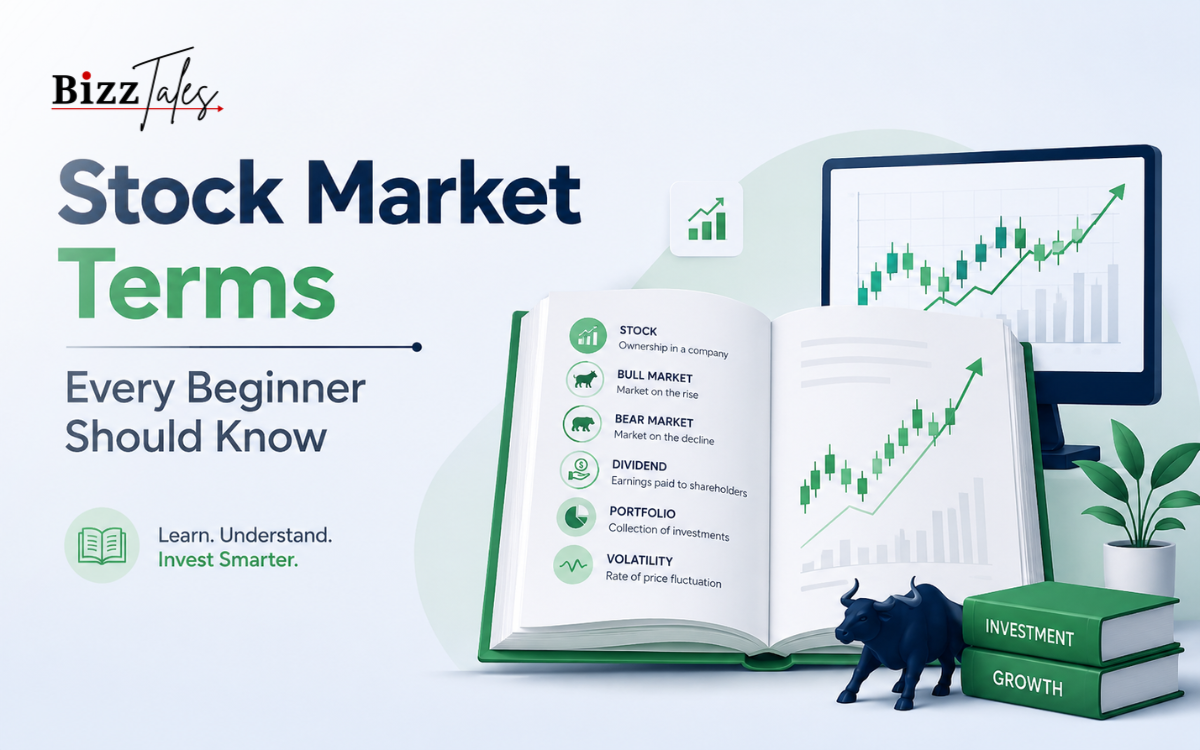
The stock market has become among one of the most talked about subjects in recent years. Whether it is web-influencers talking about investment tips or news channels talking about what is happening in the markets each passing day, more and more of us are getting interested in investing, than ever before. Millions of Demat accounts have been opened in India alone over the last 2-3 years by working professionals, students, retirees to keep their dollars working for them rather than be stored away in a locker. However, making investments simple for the beginners can take a while since there are numerous complicated terminologies and haughty financial jargons used by the experts.
If you are not familiar with investing, terms such as IPO, Market Capitalization, dividends, portfolios and blue-chip stocks all may not mean very much. Most people think that investing in the stock market is merely for professional accountants or seasoned investors. The truth is far from it. The stock market is not as daunting as it seems. Once you grasp a few critical phrases; everything will suddenly fall into place. Like learning the fundamental vocabulary of a new language, grasping investing lingo will give you a thorough insight into the world of investing.
Whatever your motivation- building wealth for the long-term, saving for retirement, earning passive income or just interpreting the financial news-learning the language of the stock market is the initial step. Read on to discover the key stock market words explained in plain English so you can understand investing even if you’re new to it.
What the Stock Market Really Is
Before looking into individual terms. First thing is to explain what is the stock market. A widely misconception of people is that the stock market is a strange place, where people just go trading randomly for stocks and hit riches in doing so. Actually, the stock market is a fundamental part of the economy.
The stock market is a place where companies gather funds from investors and in turn investors are provided with the option of gaining a small shareholding in those companies. If an organization requires funds for expansion, new projects, research and development, or growth programs then the company has the option of issuing stock to the general public. Whenever an investor invests in a company’s stock then the individual becomes a part owner of the company. As the company grows the investor too, tends to benefit by the increase in value of the stock as the overall business earn more profits
Furthermore, stock markets allow the buyers and sellers to quickly and conveniently trade their securities anytime during market hours. This easy access in trading is another factor which has built the popularity of stock markets as a way of investing around the world.
What Is a Stock or Share?
The most basic concept that every beginner should be familiar with is a stock (also known as a share). When you own a share in the company you are a shareholder which simply means you own part of the company.
What if a firm decided to split itself into a million equal bits? Each bit would then be a share and when you buy one share, you own a very tiny part of that firm. So your ownership will be extremely small but nonetheless you will own some part of the firm. Today the firm makes profits but if the firm performs well over the coming years and profit increases, then the value of your share may also increase.
The ownership aspect is what makes investing in stocks different from many of the other types of investments. Investors (equity investors in particular) are not just renting money, they’re also buying into the venture.
Who Is a Shareholder?
Shareholder is any individual or organization that owns shares in a corporation. Shareholders become partial owners of the business and can receive perks from the business’s performance in a number of ways. The most straightforward benefit occurs when the stock increases in value. As the share has risen from 100 to 200 an investor has gained 100 by selling.
In addition, shareholders can also profit through the payment of dividends. Successful companies often distribute part of their profits to shareholders as dividend payments. Moreover, in most companies, shareholders can vote on significant issues.
Although shareholders, as individual investors, usually own a very small share in a company, but investors together is more powerful to corporate governance as well as business development.
Why a Demat Account Is Essential for Investing
All the people who wish to invest in the Indian stock markets should have an idea about Demat account. The full form of Demat account is Dematerialized Account, which is the account where people will store the shares and securities electronically.
In the past, shares were the form of paper certificate and investors had to keep the large documents safely and fill out long d forms when it came time to sell or buy shares. Now, all trades are in digital form with the use of Demat accounts.
Having a Demat account is crucial in order to trade shares on Indian stock exchanges. It is the cornerstone of modern investing and makes it so much easier for first time investors as well as veterans.
Understanding Stock Exchanges
A stock exchange is a place where investors can purchase or sell shares. The main stock exchanges in India are the National Stock Exchange (NSE) and the Bombay Stock Exchange (BSE). They are the places where buying and selling of stocks are taking place under controlled environment.
Buy and sell orders by investors are matched at a stock exchange when sent via broker. Prices change constantly according to supply and demand. When there are more buyers wanting to buy the shares than there are sellers wanting to sell the price will tend to increase. If there are more sellers than buyers the price will tend to fall.
Stock exchanges are the backbone of financial market by providing fair trading practices and providing Confidence of investor.
What Is an IPO and Why Does It Generate So Much Excitement?
One of the most common terms used in the financial jargon is IPO. It is an abbreviation of Initial Public Offering. When a private company dabbles its shares on the market for the first time, the event is termed as an IPO. Prior to the IPO, ownership of a business was confined to the owners, the initial traders and private individuals. After an IPO, any general investor can become a part owner of the business by taking a stake in the company.
Initial public offerings [IPO] are much anticipated by investors because it offers investors the opportunity to be part of the company’s journey in the earlier stages. Investors have invested billions of dollars for a company’s growth using IPOs. Although not all IPOs have done well, an investor needs to assess a company’s finances and prospects properly before investing.
While high potential listing gains tend to grab the headlines, sustained success relies on strong growth and profitability on the part of the company.
What Does Market Capitalization Mean?
Market capis considered by many as one of the most significant indicators used to measure a company’s size. It is the total value of shares owned in a company, traditionally calculated by multiplying current share price by the number of shares currently issued.
Let’s take an example, if a firm has 100 million shares and each share gets traded at 100, it will have a market capitalization of 10,000 million. Market capitalization also facilitates the investors to compare the companies irrespective of their share prices.
Corporates are broadly classified into large-cap, mid-cap and small-cap. Large-cap corporates are usually stable and well-established firms. While mid-cap corporates are considered to be less risky, large and small-caps could be less matureand have a higher potential to grow.
It is a good helper for investors to determine which investment is matching investor risk bearing capacity and financier goal.
The Importance of Dividends in Investing
Many novices look solely to the stock price for increase, but dividend income is another potential step toward success. Dividends are the rewards paid to investors in a stock as part of a company’s profit-sharing arrangement. Firms with stable profits will often pay investors a share.
It has been seen that dollar injecting companies are easier to buy for the long-term investor. Being a dollar injecting company means the investor gets a steady flow of cash over and over again. As the stock price is not always going at the same rate as the dividends are being sent out, the cash payments can be a large part of total return. Re-Investing the cash dividends in stock can improve the return of a dollar injecting company even more.
Dividends on high dividend paying companies with long histories are generally one of the best indicators of strong and reliable companies, thus providing a popular investment for the cautious investor
Understanding Bull and Bear Markets
Bull markets and bear markets are common topics on financial news channels, however, many beginner investors do not understand what these terms actually refer to. A bull market is a period of time where share prices are increasing and people are confident about the economy. In most cases, economic growth occurs at this time, profits are good and people are optimistic about the market.
On the other hand, if the value of stock drops considerably over a considerable period of time then it is called as ‘bear market’. A bear market are
generally related to recession, slow down of economy and uncertainties arising in geopolitics and the market. Investors start feeling nervous and start feeling that the value of stock may further diminish.
Bear and bull markets are- part of investing, and both are natural phenomena. Wise investors have learned to accept it as a fact that markets will continuously go through these cycles and they keep their eyes on accumulating wealth for the future and not getting stranded in the emotion and unpredictability of short term market movements.
Why Diversification Matters
Diversification – uno of the fundamental principle in investing is diversification. Diversification is when you invest in different products, sectors or companies rather than concentrating on one.
The idea is straightforward. For example, if a single investment does badly, it is possible that other investment(s) within the portfolio might compensate for the losses. Diversification decreases investor’s risk and enables the investor to achieve a more balanced investment model.
Most seasoned investors, have more than just one stock in their portfolio. Through putting different types of investment into their portfolio in mind, they help investors to overcome the difficult time in difficult market.
What Is a Portfolio?
Portfolio is a set of investments owned by an individual or an institution. Portfolio can include shares, mutual funds, bonds, exchange traded funds (ETFs), gold and other financial assets.
Remember your portfolio is a collection of all of your investments. If your financial situation, attitude to risk and time horizon are taken into account then a properly structured portfolio should meet your needs. Such investors are more likely to succeed financially in the long run.
Learning the art of how to construct a portfolio and manage it is one of the most useful skills an investor can possess.
Conclusion
Initially, the world of the stock exchange can look rather intimidating. However, most of the world most successful investors have a good comprehension of the fundamentals and know the meaning of stock market terminology- stocks, stockholders, IPOs, market capitalization, dividends, portfolios, diversification, and so on. Once these elements are understood, keeping up with market developments, learning about investment opportunities and understanding the financial world becomes much more approachable.
Using stocks, trading, and investing is not about knowing the future either. It’s about remaining informed and patient. As you learn about the investment stock market terms in this guide, you’ll gain the confidence to get started toward wealth creation-and stay clear of early pitfalls.
FAQs
What is the first thing a beginner should learn about the stock market?
It’s better to begin by learning about SIP, stocks, shares, share market, stock exchanges, scrip, Demat accts, how a company works, ownership, and so on.
Can I start investing with a small amount of money?
Yes. Several investment sites offer the minimum amount to be as little as a few hundred rupees. This makes investing in stocks easily accessible to most of the public.
What is the difference between investing and trading?
Investing is more about building wealth in the long term, whereas trading is more about taking advantage of short term fluctuations in prices.
Why do stock prices change every day?
The supply and demand will affect the fluctuation of stock prices. For example, company performance, world events will affect the demand and supply of stocks.
Is diversification really important?
Yes. When you have many investments they are diversified; thus, reduces risk by not putting all your eggs in one basket.
How long should beginners stay invested in the stock market?
In general, the majority of financial experts advise thinking long term. When an asset is held so that companies and markets can grow over time.