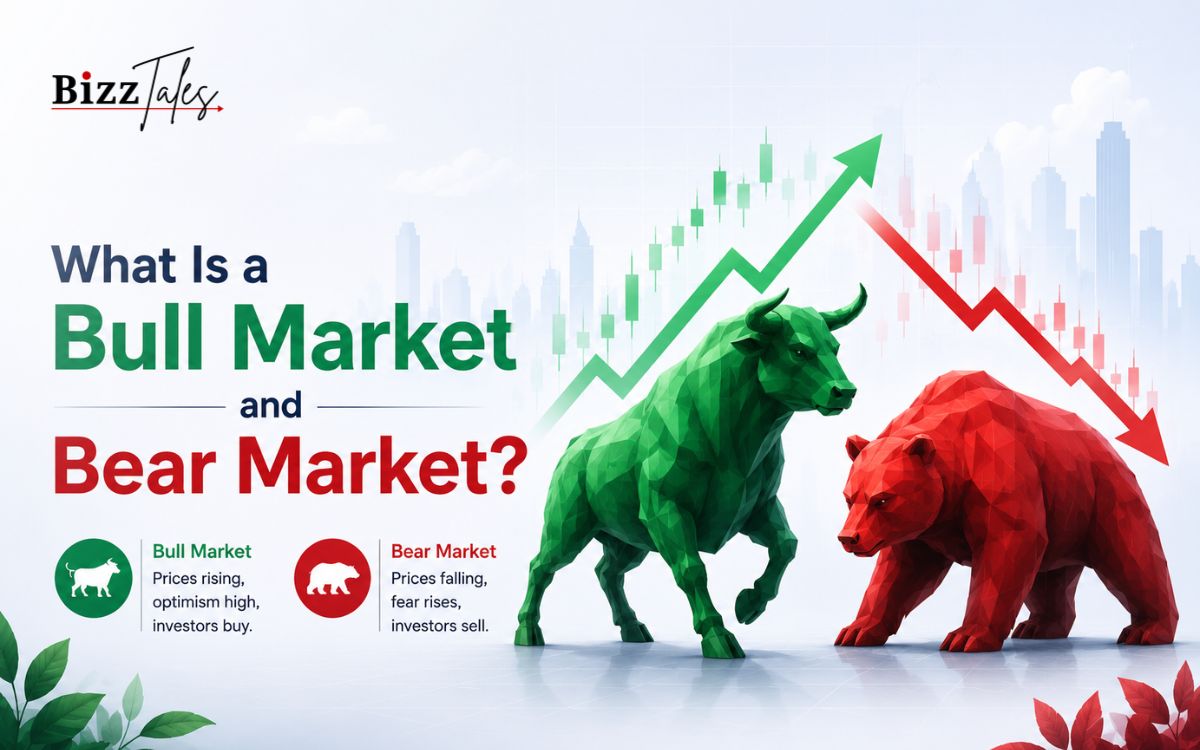
If you are someone who has ever watched business news, been on top of the stock exchange, had a chat with investors, you would have definitely come across two words ‘ Bull Market’ and ‘Bear Market’. These two words are one of the most referenced phrases in the global financial field. When stock prices skyrocket, it is called the Bull Market. When the stock is all set to nosedive and there is a wave of panic among investors, it is termed as the Bear Market.
These words may seem odd and unfamiliar to the novice investor. Where does the bull and bear market fit in when considering an investment? Bull and bear markets are terms used to market trends and market sentiment as a whole. They play a big role in deciding where to invest, business advancements, shopping, and the world economy.
All investors go through bouts of bull and bear markets at some time in their investing lives. Some investors make a foray into the market during the green shoots of growth and then think investing is a cakewalk. Conversely, others after embarking on their investment journey during a downturn feel worried about losing money. However, those who make money from investing know these are inevitable goings in an economy’s life.
Whether you are considering investing in stocks, mutual funds, ETFs or any other kind of asset class, knowing how bull markets and bear markets work will assist you not only in making informed investment decisions but also ensure that you avoid emotion-driven errors. This guide to bull and bear markets is written in plain English so that complete beginners will have a clear idea about how markets behave and how these cycles come about.
Why Are They Called Bull and Bear Markets?
Somebody might be asking where did all these strange name came from? There are some theories about the origin of each term but the one that is presented as the most common explanation goes along the attack of the animals.
The bull tosses its horns up (when attack). This is linked to an upward movement of the stock prices and therefore the economy. When a market moves in this way it is said to be in a bull market.
The attack that a bear does is swiping its paws downward. So this downward swiping of paw is thought of as fall in the stock prices and economy. So a market which falls heavily is called as bear market.
Eventually these images of animals became tied so closely to global financial markets; the moment an investor would hear these words, bullish and bearish, they would know how the market felt.
What Is a Bull Market?
What is a Bull market? A bull market is when stock prices are rising over a prolonged period of time. It is a time of increased investor confidence, booming businesses and healthy economies. People are more optimistic about the future of the economy and are more willing to invest.
A bull market is not just a day or a week when stock prices are rising. It can go on for months or even years. During those phases of the market, the main indexes keep making new highs as companies report revenues and profits getting higher. Investors think that businesses will keep growing and buying push up prices.
Bull markets can be self-perpetuating. As stock prices increase, investors gain confidence and invest more, which increases demand for stocks, causing prices to increase further. Other industries benefit too, companies see increasing capital value in its stocks, and it becomes cheaper to raise expansion capital. Bull markets are good news for consumers too, as they tend to spend money when they feel richer.
Many of the most powerful bull markets in history have created huge fortunes for investors and turned average individuals into multi-generational wealth creators.
Characteristics of a Bull Market
A general sense of optimism is one of the most prominent features of a bull market. Investors believe that the market will remain strong and stocks will grow even higher; optimistic economic news dominates the media and since the economy plays a big role in stock trading, the unemployment figures tend to be below average or stable and there are numerous [earning] reports from companies.
In Bull markets, new investors enter market as others earning money. The volumes of trade increase; for example the both leading sectors in the US – technology and banking growth over many other sectors including consumer goods, and manufacturing – are very strong. Business is more likely to invest in projects or expansion schemes, expecting future demand.
Another characteristic element of bull market is increased consumer confidence. When consumers feel more secure in their financial stability they spend more. With increased spending comes increased corporate profits. By the same token, people will expend more when they are feeling a bullish market.
What Causes a Bull Market?
Bull markets tend to occur when there are many favorable factors. One of the most significant is economic growth. When an economy grows, most of the companies will see an increase in revenues and profits.7 Investors observe this situation and more and more investors are eager to buy shares.
Decreasing interest rate is another factor of bull phase. It spurs companies togrow since they are more likely to invest in their growth. Additionally, consumers are more able tobuy, boosting the economy.
Government polices may matter as well. Tax cuts, monetary expenditure on infrastructure, deregulation, and investment incentives are all generally expected to have a positive impact on investor believing. Technological progress can exert the same influence. Innovations in communications-deregulation, Internet, artificial intelligence, smart mobile devices, and energy-renewable and otherwise-have helped lead to huge bull markets.
Often, bull markets tend to be the result of an overall strong economy, a strong profit foundation, a high level of investor confidence, and a friendly financial environment.
What Is a Bear Market?
A bear market is the reverse of a bull market. It is when the stock market falls by a relatively high level over a period of time. In most cases a bear market is defined by financial analysts as a fall of at least twenty percent from the recent market highs.
The confidence of investors during a bear market diminishes and investors are afraid. Investors become fearful of an economic slowdown, major companies’ earnings, inflation, geopolitical conflicts, or where the next financial crisis is happening. Rather than aiming to purchase stocks, investors are preoccupied with safeguarding their capital and lowering their risks.
A bear market is uncomfortable because your portfolio drops (and then continues to drop if you watch it) and financial headlines become more gloom and doom. But the lows of a bear market are simply part and parcel of investing. All major stock markets have had bear markets.
While bear markets can be difficult, they are also often a blessing for the long-term investors willing to be disciplined.
Characteristics of a Bear Market
Negative sentiment is also a key feature of a bear market. Investors worry about the future of the economy and believe stock prices will keep declining. The media floods with negative headlines and investors hold back from new investments.
However, corporate profits might decrease in bear markets. As economic grow slows; consumer spending may withhold, companies cut back on hiring and investment. Moreover economic fears can lead to natural decline in consumer confidence.
Volatility –During bear markets, market fluctuation has the tendency to rise sharply and volatility increases. Market prices may pop one day and crash down substantially the next, adding more emotion to investors which can result to some removing good assets at a point of crash.
What Causes a Bear Market?
A bear market can be caused by a variety of factors. One of the more typical causes is a recession. As economic output drops, companies are made to earn less and investors often become worried about their future earnings.
Similarly, high inflation can lead to bear markets. When inflation pushes prices up, consumers find their spending power diminished and business costs grow higher. To counter inflation, central banks tend to hike rates, which can dampen economic growth and overly affect stock prices.
Financial crises bring about some of the worst bear markets known in the financial history. Banking crises, debt crises, bubbles popping on equity markets, or even speculative bubbles bursting can initiate investor panics, and outflows of Equity prices. International incidents like wars, world pandemics or geopolitical crises can create a general feeling of uncertainty and therefore a bear-market climate on the sum of Equity markets.
Shortly, in most of the bear cycles financial markets react on decline because investor believe there will be no economic growth in future and they realize position.
Famous Bull Markets in History
Numerous significant bull markets are known to have taken place throughout history. A well-known example is the post-2008 financial crisis surge. After the rapid loss of value, the worldwide stock markets experienced an unprecedented bull run lasting over a decade.
During this time, the tech companies were growing at an unbelievable rate. Companies that were involved with cloud computing, E-commerce, Social Media and Artificial Intelligence were some of the most valuable companies in the world. Investors that were able to hang in there in the recovery were able to make large returns.
India has also seen a bull markets mostly during sustained periods of rapid economic growth with significant influx of investors. This helped create wealth for several million investors and also built confidence in the concept of long term investing.
Famous Bear Markets in History
Furthermore, bear markets are another significant aspect to have emerged throughout the history of the financial world. The 1929 Great Depression was perhaps the most damaging of any market crashes in history to date. Stock values fell, many companies went bankrupt and the economy was in turmoil in a considerable number of nations.
Increasingly, the latest bear market was initiated by the subprime mortgage crisis of 2008 which resulted in the collapse of banking institutions worldwide, significant loss of investment funds and slow economic recovery.
The 2020 bear market due to the COVID-19 pandemic was another significant one. Stock markets worldwide fell over a short span of time due to global uncertainty, but the subsequent recovery also showed how markets can recover even after a major disruption.
These past instances serve as a reminder to investors that market declines are usually short lived, but the long-term upward trend has generally persisted for decades.
How Investors Should Act During a Bull Market
Bull markets tend to generate enthusiasm, but enthusiasm is dangerous. As a bull market persists, many investors become overzealous, making outlandish bids or buying on margin with a false expectation that prices can only climb higher.
It might be wiser to keep eyes on the long-term horizon. Investors should stick to their investment strategy, keep well-diversified and not jumping onto few more pet speculation schemes, following the stampede of others’investors.
During times of an investing boom, traditional investing, diligent research, and adequate risk control and management are still very relevant.
How Investors Should Act During a Bear Market
As a natural part of the cycle, the bear can be very testing on both the patience and the resilience of an investor. It is uncomfortable watching one’s investments go south, particularly for new investors, but it can often be fatal if feared o/sell.
Those who are committed to investing over the long term tend to see bear markets as a gift. Good companies on sale can be found and a position can be built for the future. Long-term investors who do not stop investing through a bear market can see their average prices come down substantially.
The primary thing is to concentrate on the fundamentals rather than emotions. Every bear market in history has been followed by a rally. The only question is when.
Conclusion
Bull and bear markets are two phases of the same cycle. While bullish markets will have higher prices, bluer skies and carry-with-a-sigh confidence with them, the negative aspect of a bearish market is the opposite.
For novices, they are key to knowing which way the markets are heading. They are also useful in shaping investors portfolios and increasing their financial planning. You may benefit from the positive effects of a bull market but learn how to stay invested in a bear.
The world’s most profitable investors are those who do not invest based on everything they think, but who are vigilant on their long-term objectives and continue to invest during the best and worst of market conditions. As long as investors understand the operation of bull and bear markets, they can approach the stock market with increasing resolve and make prudent financial choices.
FAQs
What is the distinction between a bull market and a bear market?
A bull market-that is, a period in which stock prices increase-is distinguished from a bear market, in which stock prices fall sharply and investor confidence diminishes.
What is the duration of a bull run?
Bull markets may last months or even many years depending upon economic conditions corporate earnings and investor attitudes.
What is the formal definition of a bear market?
A bear market is, to some extent, regarded as a decline by 20% or more from recent market peaks.
Equals, Should getting started a buy during a bear market?
According to many financial experts, –these bear markets can be opportunities for finding great investments at lower prices–on long-term perspective.
Is it possible to go from a bull to a bear market quickly?
Yes. Markets can turn around due to shock events like economic shocks, financial crises, geopolitics, sudden shift in investor sentiment.
Analysis – Which is a preferable market environment for a long-term investor? A Bull Market or a Bear Market?
There are benefits to each, rising markets assist investments to grow and falling markets ofcten provide opportunities to buy good assets at a bargain price. However, the biggest long term benefit is not to jump in and out but remain invested through both.