
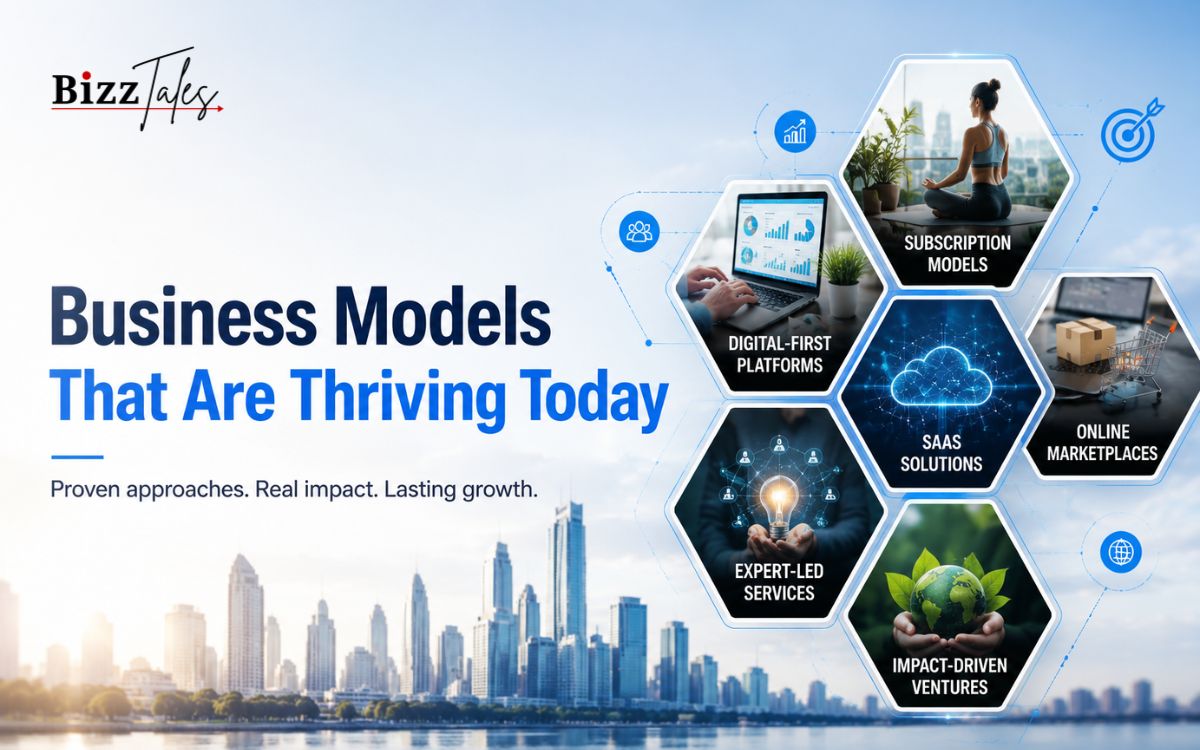
In the past 10 years, the business environment has transformed significantly. Breakthroughs in technology, shifting consumer behavior, digital revolution and borderless expansion have revolutionized the way companies do business and make money. Consequently, the conventional business models that had led certain industries become obsolete when faced with more flexible, extensible, customer-focused and re-occurring revenue recipes.
By 2026, the definition of successful businesses has evolved beyond just what they sell. In fact, many remain successful by simply structuring their business models so that they can deliver value to customers, profit repeatedly, and adapt rapidly.
The right business model can be the difference in the success or failure of your company. Nowadays, there are many business models out there that are working very well. Today, subscription driven, platform based, direct to consumer, software as a service (SaaS) and online marketplace models are all causing businesses to grow at a more rapid level at an unprecedented rate.
Knowing which business models are flourishing in today business environment will can guide entrepreneurs toward opportunities, guide investors to evaluate companies and inspire existing businesses to revise their strategies for success.
Why Business Models Matter More Than Ever
A business model is the heart of how a business runs. It describes how a business creates value, goes to market, attracts customers, and appropriates revenue. Products and services could be imitated, but a good business model persists as a sustainable competitive advantage.
Markets are more competitive today than at any point in history. Customers have access to a multitude of options and a new wave of technological disruption can redefine the industries they operate in within a matter of years. As a result, companies need to reflect constantly on the relevance of their business models.
The aim of a business is not only to attract customers but to keep the customers and maximize the lifetime value in order to generate a predictable revenue stream. Accordingly, the business model with recurring revenues, network effects, scalability and customer loyalty are spreading more and more.
In the changing environment, more flexible, innovation-driven business models will put the advantage to certain business environments.
The Subscription Business Model Continues to Dominate
The subscription model has been one of the most successful business models in the past few decades. Companies do not sell products on one time basis but they also retrieve revenues via monthly and yearly subscriptions.
The business benefits from a steady stream of revenue, customer retention and added financial planning. Consumers benefit from convenience, continuous access to services and reduced initial costs.
Streaming services, software companies, fitness apps, educational websites, digital publications, consumer product companies, and others are adopting subscription models.
People love subscriptions not just for digital content. Companies are thriving by selling subscription boxes, offering subscription-based maintenance services, delivering meal subscriptions, and introducing subscription memberships. With a growing demand for ease and wealth of resources, the subscription model shows no signs of slowing down.
In addition, the regularity of income associated with recurring revenue tends to lead to higher company valuation because investors prefer stable cash flows.
SaaS Remains a Powerful Growth Engine
Software-as-a-Service, commonly known as SaaS, has been one of the most successful business models in digital economy. SaaS companies do not sell software licenses, instead they sell cloud hosted software in subscription plans.
Entreprises like SaaS because they lower their capital expenditures (no installation required), make life easier with maintenance and upgrade tasks, are simple to implement and upgrade (continuous updates), and enable the customers to have access to their applications from any location available (any internet connection in my experience).
SaaS businesses have high scaleability, predictable recurring revenue, and high customer retention. In most cases a single SaaS product can be adopted by new customers with little incremental costs.
On a daily basis, SaaS solutions are used for CRM, project management, accounting, cyber security, marketing automation, HR, and every other type of business activity.
With digital transformation spreading worldwide, SaaS business model is still among the most profitable and scalable one.
Marketplace Platforms Are Creating Massive Value
The platform business is well suited to a variety of industries where the right digital ecosystem can connect buyers and sellers. A marketplace is an example of platform business. It links buyers and sellers using a digital platform. The platform business does not own goods and does not directly provide a service, instead it makes money by transaction and commissions or fees.
This has been a powerful model because of its scalability and “network effect”. The more users there are, the greater the value for each to participate.
A marketplace,also known as an online marketplace, provides a platform for transactions to occur. They link consumers with products, services, lodgings, transport, freelance workers and professional expertise. Marketplace businesses tend to grow rapidly due to their business model of facilitating transactions rather than manufacturing anything.
One of the major benefits of platform businesses is that they can quickly walk into new territories without much infrastructure.
As the world embraces digital a growing number of marketplace platforms draw users, investors, and entrepreneurs looking for scalable opportunities.
Direct-to-Consumer Brands Are Redefining Retail
The DTC model has boomed as it cut out the middlemen and it enables brands to sell directly to consumers.
Historically, companies depended on middlemen such as distributors, wholesalers and retailers to sell to consumers. With the advent of digital technology, however, they are now able to interact directly with consumers via their websites, apps and social media.
Direct selling allows companies to have more influence over pricing, branding, the overall experience with the customer and also gathered data. Moreover, it benefits the profit margin as it removes the reliance on third-party retailers.
Consumers are fond of DTC brands because they offer a close-to-home, customized feel, efficient customer service, and unique products.
The expanding role of e-commerce, digital marketing, and social commerce further has reinforced the direct-to-consumer approach, which now seems the most successful approach of any of today business models.
Freemium Models Continue to Attract Users
The freemium scheme has gained widespread popularity, especially among digital organizations and tech firms. Here, businesses provide a bet for free at the initial stage, asking their customers to pay for additional features, advanced services or enriched experience.
This approach reduces entry barriers and enables firms to quickly amass large user bases. Once the user discovers significant benefit offered for free, most of them opt for paid plan and become paid users.
The freemium model is especially effective for software applications, productivity tools, services that provide cloud storage, educational platforms, and digital communication tools.
A major strength of freemium business is the ability to achieve high market penetration and high user conversion without pre-dominance of customer acquisition costs.
Used successfully, the model builds a strong growth engine that transforms free users into loyal paying clients.
E-Commerce Business Models Continue Expanding
E-commerce is one of the most successful business models prevalent in the world today. It enables consumers to shop online the comforts that best suites them with an ease of selections, remarkable discounts and prompt delivery.
Today’s e-Commerce businesses have grown from just simple online stores to complex enterprises that heavily leverage technology innovations such as:
Several moneymaking revenue streams have to be integrated within a several enormous e-commerce sites such as:
Furthermore, social media channels are now regarded as an important sales channel, whereby businesses have the ability to directly engage with their customers and allow them to purchase through social commerce.
E-commerce business models are thriving. As worldwide internet take-up increases and online payment systems learn to adapt,
Creator-Led Businesses Are Growing Rapidly
In recent years, the creator economy has been a powerful business model. Content creators such as bloggers, video producers and podcasters are creating businesses around their knowledge, followers and personal image.
Instead of working for someone else, creators earn money by monetizing content, working with sponsorships, memberships, digital products and courses, consulting and sale of physical merchandise.
Technologies and platform have become key to enable individuals to overcome borders with ease at a tap of a button and connect with worldwide audiences leading to capitalistic pursuits. Creator-led businesses are thriving on communities of dedicated fans as trust continues to be a scarce resource in the digital marketplace.
Low-cost entry requirements and attractive growth opportunities are the main reasons why many entrepreneurs are drifting toward “creator-driven” approaches.
Growth of digital media will likely support continuous growth of this business model.
Licensing and Intellectual Property Models Generate Passive Revenue
Organizations that have developed bases off of intellectual property are flourishing, because they are able to sell products without physical production.
Licensing provides a way for companies to generate revenue from their patents, trademarks, technologies, software, content and brand assets through the permission granted to other organizations to use them.
This can be deemed as a highly profitable model since it can sometimes mean lower running costs, thereby generating a series of cash flows.
For technology companies, it is common to license technology, software and patents. For entertainment businesses, they license content, characters and other intellectual property, dispersed among a number of markets.
With the momentum of innovation shifting at an ever increasing pace, business models built upon intellectual property (IP) are turning more and more attractive.
Data-Driven Business Models Are Becoming More Valuable
Data has been established as one of the most important assets in the today economy. Enterprises which are able to collect, analyze and use data are competing at the forefront.
Data-centric businesses enable organizations to make better decisions, boost customer insights, streamline processes, and enhance insights.
A handful of the benefits of analytics services, market intelligence, customer insights, and business intelligence.
Data has become even more valuable thanks to artificial intelligence.
Despite the growing affordability of cloud infrastructure, the business models centered on data will continue to be very successful as companies keep investing in digital transformations.
Why These Business Models Are Succeeding
There are a few distinct reasons why these business models have become so prevalent. One important reason is that they offer extreme ease and flexibility to customers.
Secondly, many after-generating serious revenue went with the model where they didn’t take up on a transaction but rather continued providing services generating a regular income.
Third is the question of scalability. Online business model scale well and a new online business aimed to several million of customers without the need of adding new resources.
The advantage of technology gives business such as they can automate the process, lower costs, and access the international markets more effectively than ever.
Lastly, successful business models are versatile. They adapt and grow as consumers, technology, and markets shift.
How Businesses Can Adapt to Modern Models
All Companies that want to stay in business have to see what resembles of their current model is suitable for present-day market requirements and if its worth changing into a new one. Executing a total overhaul isn’t necessary for most but it should be reasonable to take those aspects of a good model which are applicable to your venture.
For Instance, instead of conventional ways of doing business traditional business can offer a variety of subscription packages, could develop digital offerings, or can introduce membership programs and online sales channels for easier and cost-effective distribution. Other options include better customer experience through data analytics.
Further organizations should give precedence to increase customer lifetime value rather than to boost the number of transactions in a short period of time.
The most successful companies continually experiment, innovate and respond to changing markets.
Conclusion
The business models flourishing today are a response to the new pace of the global economy. Subscription services, software as a service, marketplace ecosystems, direct to consumer brands, freemium offers, e-commerce businesses, creator led companies, licensing strategies, data driven firms-all continue to thrive and grow.
These models have prevailed because they create value for customers, harness technology, develop scale and replicability, and bring continuous revenue streams. With increased competition and consumer-specific demands, firms need to challenge their manner of value creation and capture.
Firms that adopt new models and are adaptable will be able to access opportunities for longer term success in an ever more digital and interconnected world.
FAQs
What is the Business Model of Business? Which business models are the most successful in 2026?
Subscription and Software-as-a-Service ()business models have been among the biggest success stories because they allow ongoing revenue streams, create increased customer lock-in and provide great scalability.
What makes subscription businesses models so common?
Subscription based models deliver the advantage of recurring revenue for providers and convenience and value-add for customers, providing benefits to both.
What are the key factors that ensure the success of marketplace platforms?
Marketplace platforms enjoy network effects; the more a marketplace has-users and sellers-the better is scaled economically.
Are DTC businesses still expanding?
Yes. DTC brands prosper because they enable companies to own the experience, drive better margins and personalize experiences.
In what ways can existing enterprises evolve into contemporary forms of business?
Existing businesses can also implement subscriptions, digital services, e-commerce channels, membership programs and data-driven approaches to stay competitive and adapt to evolving consumer demands.