
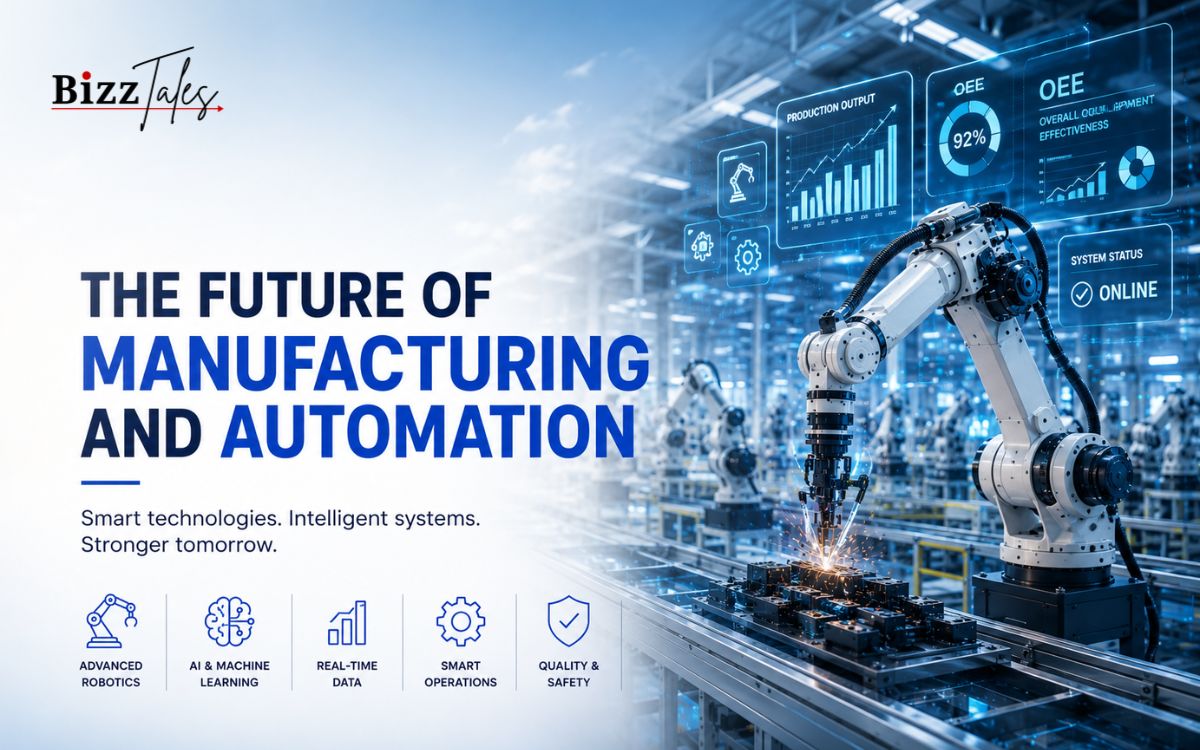
Manufacturing has been integral to economic advancement throughout history. Be it the Industrial Revolution or newer global distributed supply chains, the manufacturing landscape has always adapted to changing consumer trends and technology trends. Today we are venturing into a new manufacturing era powered by automation, AI and robotics.
While 2026 might be still some years ahead, manufacturers around the world are already living with the challenges and opportunities of the manufacturing environment of today. Growing labor shortages and escalating costs, the impact of high supply chain disruption, sustainability obligations, and ever increasing customer demands are all major reasons for choosing to reassess manufacturing principles.
Manufacturing is shifting from mass production to establishing intelligent and networked manufacturing systems that are flexible and can respond immediately to fluctuating market needs. This is where automation comes into play, and offers the opportunity for companies to reach new levels of automation, performance and accuracy.
With more industries adopting the digital revolution, manufacturing and automation are predicted to become an even closer part of the world’s economic scene that will look at new ways of designing and manufacturing products.
The Evolution of Manufacturing in the Digital Age
Manufacturing has experienced 3 significant revolutions, the first as the mechanical revolution with the advent of steam. The second was the mass production revolution. The third was the computer revolution with the 1st stage of automation.
Modern day world is going through what experts call Industry 4.0. It is the stage where digital technologies, smart machines, artificial intelligence, robots, cloud computing, data analytics, WWW connected devices etc. Are all integrated to form connected, intelligent, digital manufacturing networks.
Unlike any older factories, today’s manufacturing operations produce and process enormous quantities of data in real time. Equipment machines talk to each other, production lines refine processes on their own, and managers watch everything.
As the digital technologies mature, manufacturers are becoming more agile, responsive, and efficient for the transformation of future industrial production.
Automation Is Becoming a Competitive Necessity
Automate-it’s not a business luxury used only by huge businesses.automation is a business strategy you can’t afford not to have.
Shorter product life cycles and more domestic and commercial competition has lead companies to automate more and more time-consuming, mundane and laborious tasks. What automated systems do is ensure consistency, bring down human error, improve product quality and increase productivity.
Increasing wages and shortages in the work force are also prompting companies to spend more on automation. In a number of sectors it is getting harder and harder to find talented employees. Automated systems can leave firms short staffed while they increase added-value activities.
Besides, it enhances workplace safety and reduces the risk of employee exposure to dangerous environment and risky job. In a future where the access and affordability of the technological equipment become more available, automation will be even more widespread for all mechanical makers.
Artificial Intelligence Is Revolutionizing Production
Artificial Intelligence is transforming manufacturing at a fast pace. Machines equipped with intelligent algorithms can scrape huge details of data generated out of manufacturing facilities, find complex inefficiencies, foresee breakdowns and enhance productivity through optimisation.
Predictive maintenance is what I feel to be most beneficial use of AI. By applying an AI solution, we don’t have to wait until machines fail, we can be looking for the indicators that will prompt maintenance procedures before the failure becomes a burden.
The other way AI is being used is in quality control. Newly developed machine vision can check product quality with precision, detecting faults that humans might not see.
What is more, AI allows manufacturers to predict customer demand more precisely, manage stocks more efficiently and improve supply chain operation. With integration of more technical features in AI, manufacturing sector will have more chance of enjoying increased productivity and lesser operation costs.
Smart Factories Are Becoming the New Standard
- Smart factories are revolutionizing the way manufacturing is conducted across the globe.
- Smart factories refer to the utilization of integrated technologies which develop extremely smart and efficient manufacturing settings.
Sensors, machines, software platforms, and communication networks collect and exchange information in real time. This enables organizations to track how well their production is doing, identify issues, and respond more quickly by making better data-based decisions.
Compared with traditional factory, while and the like, Innovation, or smart, factory has many distinctive features that is nimble and adaptive to the changing markets. Production plan is flexible, automatically tweaking itself, equipment dynamically configuring, responding to market zeitgeist.
In addition, with smart manufacturing, it is easier for factories to achieve transparency along the whole operations, so as to spot issues that may arise. With ongoing development in connectivity solutions, the adoption of the smart manufacturing paradigm is projected to grow in the coming future.
Robotics Is Expanding Beyond Traditional Applications
For many years, robotics have been used in manufacturing circles, such as those involved in car production. Modern robotics, however, is far more powerful, flexible and efficient for industrial purposes.
Robots today are more precise and adaptable. They can put things together, move things around, check quality, bundle products, and work side-by-side with humans.
Collaborative robots which are also known as cobots are gaining significant traction. In contrast with traditional industrial robots that usually operate in separate environments, cobots operate directly alongside employees in support of mundane and strenuous activities.
Modern developments in the fields of artificial intelligence and machine learning are providing robots with increased flexibility and the ability to operate in unpredictable environments. The reduction in costs of robotics equipment is expected to lead to increased use in many fields.
The Internet of Things Is Connecting Manufacturing Systems
Finally, the IoT found place in manufacturing: it has become a key asset in the industry. IoT devices allow machines, devices, sensors or systems to ‘talk’ between themselves via interconnected networks.
This connectivity allows the manufacturers to get instant information about production, equipment, and operating condition. This means that managers are able to have an overview on plant at a distance, but they will only do that, when the data are accurate.
Manufacturers are also using IoT technology for predictive maintenance, energy management and process optimization. This makes it possible to quickly detect problems and possible performance bottlenecks, minimizing downtime and maximizing productivity.
As the growth of connected devices seems to be heading toward a rapidly expanding horizon, the importance of IoT within future manufacturing organizations is expected to increase significantly.
Digital Twins Are Transforming Industrial Planning
The digital twin technology is one of the most advanced ones being developed in the manufacturing field. Digital twin involves a virtual replica of a physical Asset, process or production system.
Manufacturers utilize digital twins to model how the product functions, to experiment with potential changes, and to envision what the outcomes might be ahead of actually making those changes. This helps to reduce risk and inform decision-making.
Modeling Allows companies to refine production design layout, equipment optimization, and minimize risk through simulation. Simulations allows companies to experiment with new business concepts before experimenting on real world operations.
In the future, digital twins are likely to be integrated into the information infrastructure of high-end manufacturing settings due to the continuous advances in processing capabilities and data analytics.
Sustainability Is Shaping Manufacturing Decisions
Sustainability is highly important to manufacturers across the world. Governments, investors, consumers and regulatory bodies demand businesses to be environmentally responsible.
Companies are incorporated cleaner technologies, minimized waste and exhaust, noted energy use and implemented circular economy model. The process sustainability is improved with better utilization and realization of recent automation and numerical data.
Capabilities of smart production systems include saving energy, reducing material usage, and reducing resource depletion. Renewable energy adoption is swiftly becoming a growing trend for manufacturing plants.
Businesses adhering to environmentally-sound production methods tend to have lower operating costs, higher brand value and more loyal consumers.
With increasing environmental awareness, sustainability will also be an increasingly important catalyst for manufacturing innovation.
Supply Chain Automation Is Increasing Resilience
Recent supply chain disruptions have underscored the need for robust supply chains. As a result, manufacturers are adopting automation technologies to provide supply chain visibility and enhance supply chain flexibility and responsiveness.
Automated inventory management systems assist organizations in tracking the availability of materials and goods in real time. Sophisticated analysis systems will allow better forecasting and planning for demands.
AI is capable of detecting potential threats in the supply chain and providing advanced suggestions and measures. Automated warehouses can further reduce storage space and expedite order execution.
These new technologies enable manufacturers to proactively address market fluctuations and unforeseen shocks. In an increasingly complex supply chain environment, automation will have an increasingly important role to play in safeguarding the stability of operations.
Workforce Transformation in the Age of Automation
Much is said about the effect that automation has on jobs, with most people worried that the use of technology to manufacture goods will make many more jobs obsolete. However, while some areas of work will shrink, new positions are already emerging that demand highly advanced levels of technical knowledge.
The new generation of manufacturing workforce will witness an increase in the importance of technology management, robots maintenance, data mining, software development, and system optimization.
Companies are spending billions on workforce training, upskilling programs and employee development initiatives to help prepare workers for the future of work. Humans still play a key role in innovation, strategic decision-making and complex problem solving.
Automation is not eliminating jobs but empowering workers to work on the higher end of the value chain.
Organizations that combine the latest technology with trained professionals will be much better off in the long run.
Challenges Facing Manufacturing Automation
However, there are drawbacks to automating the manufacturing process. The automation process often involves a large initial investment, which can be difficult for small and medium enterprises to afford.
The risks of cybersecurity are growing as connectivity expands in manufacturing systems. It is important for organizations to safeguard against cyber attack because information and infrastructure are at stake.
There may also be integration problems when a company tries to link the new technology and its legacy system. Workforce resistance to change might also be involved.
Impediements for the manufacturers that they have to face include regulatoeray requirements, technological complexity and rapidly changing market conditions, etc.
Addressing these issues effectively demands a well-thought-out strategy, strong leadership support and continuous investment in innovation.
The Role of Advanced Technologies Beyond 2030
Extending past 2030, there are many emerging technologies that will further revolutionize manufacturing, with Artificial Intelligence becoming more advanced can lead to autonomous production systems that can independently make complex decisions.
Quantum computing could transform manufacturing optimization as well as material sciences. Robotics would evolve to become more flexible, versatile and intelligent.
Additive manufacturing (or 3D printing) is likely to increase as companies will be able to use it to quickly make tailored products.
At the same time, developments in biotechnology, nanotechnology and novel materials might open up new manufacturing options:
In the meantime, these new advancements will keep on spurring productivity gains and bring new ways for industrial development.
Why Manufacturing Remains Essential to Economic Growth
While service economies continue to grow manufacturing continues to play an important role in the growth of national economies, generating innovation, supporting export, providing jobs, and increasing competitiveness.
Today’s production industry also boosts many other fields in the economy, most notably the transportation (both rail and road), the health sector, the construction business, and the high-tech and energy industries. Better production means better life.
Developing countries which later acquire industrial based technological and capital equipment will experience tremendous competitive advantages in the world market. As a result, government and business continued to undertake projects of industrial modernization.
Manufacturing’s future involves making things smarter, more sustainable and more flexible than we do now-to enable sustained economic growth over the long term.
Conclusion
The world of manufacturing and automation is currently evolving rapidly, driven by technological advancements, digital transformation initiatives and the change of business requirement of modern days. Utilisation of artificial intelligence & robotics, emerging trend of smart factory, IoT connections, digital twins and reduction in manufacturing’s carbon footprints are serving to revolutionize manufacturing globally.
The key to put ourselves on a competitive edge is a fast and reliable adoption of what technology may offer us. New tools allow us to optimize efficiency, increase the quality of our processes and reduce our costs, besides improving our ability to react quickly to the ever-changing customers needs.
Despite these issues, manufacturing’s future is extremely bright in the long term. Those companies who integrate automation and technology into their business and build the skills of the future will likely be the most successful in the ever-competitive environment of tomorrow.
FAQs
What’s next for manufacturing?
In the upcoming years manufacturing will take a step forward, involving smart factories, artificial intelligence, robotics, automation, connected systems (IOT), all these elements will lead to one result: sustainable manufacturing systems that increases the efficiency and the flexibility of the process.
Will Automation Take Over Jobs in Manufacturing?
Automation will alter various jobs, but it will generate job opportunities too, especially in the field of technological management, robotics, analytics and advanced manufacturing operations.
What are “smart factories”?
Smart factories making use of integrated technologies, sensor, software and automation systems help to improve the efficiency of manufacturing applications.
Why is AI relevant in the field of manufacturing?
AI can assist manufacturers with predictive maintenance, quality assurance and control, and production optimization. The following are some particular uses and benefits-(for the manufacturer):
In what ways does automation enhance manufacturing?
Automation eliminates manual errors, hastens production rates, increases uniformity, boosts safety in the work environment, and enables companies to function more effectively.