Throughout the course of business history, there are numerous examples of industries and companies that seemed unstoppable, yet later that Business Models became irrelevant and disappeared. Video rental stores, film cameras, printed directories, and travel agencies are all to name a few.
A similar dilemma faces companies today. Artificial intelligence, automation, the digital revolution, evolving customer needs, sustainability concerns and a profoundly more interconnected world, are constantly revolutionising markets. New opportunities are emerging, yet for many incumbents business has become destabilising.
We are entering a period of rapid change. Innovations that used to take 30 or 40 years to work their way through the industries, will now do so in a few years, completely turning types of markets upside down. Traditional companies that depend on moth-balled processes and distribution or falling consumer habits stand a good chance of going under.
By 2030, many of the existing business models may be less important than they are now or may have been replaced. Knowing how businesses might evolve will be crucial for entrepreneurs, investors, business owners, and others who wish to be ready for tomorrow’s economy.
In this article, we look at the types of business models that are most susceptible to disruption and the forces that are driving their falling the need to pass away.
Why Business Models Become Obsolete
Business models just don’t die (“blink out”) – they fade away over time with the erosion of their relevance to customers until they are eventually replaced with something more suitable.
Technology tends to be the biggest source of disruption. New technology can lower costs, offer greater convenience, enhanced efficiencies, or create a new experience for the customer altogether. Customers are inclined to flock to better solutions.
Consumer needs and preferences are also crucial. Today’s buyers need faster service, customization, openness, easy access and simplicity of use-businesses that can’t deliver will begin losing market power.
Gravity shifts business models faster, driven by economic crises, regulation reforms, related environmental issues, and globalization of world economy. Failures in adaptation may challenge the survival of weak firms against clearer firms.
The ones most likely to survive are the organizations that adapt, rather than those that rest on their laurels.
Traditional Retail-Only Models Face Increasing Pressure
Old-fashioned retail business based solely on bricks and mortar store is one of the most vulnerable business models heading for 2030.
Consumers now demand a one-stop shop from online to the high street. They enjoy the 24-hour shopping, choice of product, comparative pricing, and home delivery of e-commerce.
While brick-and-mortar locations won’t completely go away, those businesses that hinge solely on walk-in traffic and may lack an effective digital presence could find themselves in some serious trouble.
In today’s world where consumers increasingly browse and research products on the internet, shopping has to be quick, easy, and mobile optimized. Consumers want convenient delivery options and seamless customer service.
As consumer behaviors continue to shift more toward omnichannel experiences, retailers who do not undergo digital transformation will face the challenge of remaining relevant.
Commission-Based Travel Agencies Continue to Decline
Many years ago,travel agentsprimarily used to assist customers with bookings of flights, hotels and holiday packages. This has been affected with the influence of books and the internet.
We can now leverage the Internet to: compare prices, book hotels & car rental, read online reviews, quotes and levels from the comfort of our own home.
With travel recommendations becoming more and more intelligent and with booking systems becoming easier and easier to use, the model of the traditional commission-based travel agency is likely to disappear altogether.
Highly trained luxury, corporate or complex travel specialists are not going away. My concern is for the mass agencies that are fundamentally accounts and booking functions.
The benefits for consumers to have access to digital channels have allowed the travel industry to continue to revolutionize the sector.
Print-Dependent Media Models Are Losing Relevance
Print newspapers and magazines have seen declining circulation for years, with many consumers turning toward digital forms of information.
Although several of the more established publications have been able to switch to a more digital dominated bank of subscriptions and Advertising, businesses still reliant on old print revenue continue to face difficulties.
Today’s consumers need immediate access to information via mobile devices (smartphones and tablets), websites, podcasts, videos and social media.
The economics of online advertising have also changed since marketers can now be more target and more measurable.
While print media might still cater to specialized readerships, the business model dependent on the sale of physical copies is increasingly unsustainable.
Manual Data Entry and Administrative Services Are Being Automated
Most companies continue to perform paper-based work like entering data, managing documents, scheduling for meetings and doing other simple administrative work. This is about to change with new automation technologies and artificial intelligence.
This AI software is capable of handling various administrative tasks such as analyzing documents, scheduling appointments, maintaining data, and even creating reports, all with incredible efficiency and precision.
Firms are implementing automation, not just as a cost cutting measure but as a way to become more productive and to help remove error.
As these technologies grow more advanced and less expensive, business models mostly based on repetitive admin tasks may find less demand.
By 2030 organizations will still need humans, but many of the boring admin stuff will largely be taken care of by automation.
Traditional Call Centers Are Being Disrupted
For many years, customer service operations have depended on large call centers with human agents. But although there are still occasions where human contact is essential, the use of AI in customer service is beginning to change the way.
Conversational systems such as AI-driven chatbots or virtual assistants can already answer many common questions without involving a human. They are available 24/7, give instant answers and are scalable to huge number of requests.
Due to the increasing use of hybrid support models that integrate AI automation and human agents for complex cases.
With advances in natural language processing, the traditional business model of call center may be shaken up.
We will see the future of customer support be primarily less repetitive process calls from humans, and more automated intelligence.
Low-Cost Labor Arbitrage Models Face Challenges
For decades, a number of companies gained competitive advantage through outsourcing labor-intensive jobs to lower-wage countries. Though still significant in some industries, the power of job arbitrage is waning due to automation.
Robots, artificial intelligence, and complex software systems are often more effective performing mundane activities than human workers. In this regard, firms are more and more considering investing in them rather than simply choosing the cheapest option.
You can see this change quite clearly in manufacturing, customer service, logistics and admin.
Given a continuing decrease in the costs associated with technology, labor intensive business models might not be as competitive to automated ones.
Over the medium to long-term, competitiveness will be driven more by the adoption of innovation, technology and efficiency than by the cost of labor.
Traditional Advertising Models Are Being Replaced
The nature of advertising has changed significantly in the modern age. Conventional methods, defined by broad-based TV, radio, press and billboard advertising, are increasingly challenged by more precise targeted advertising campaigns.
We now demand that marketing be trackable, we segment the market place and every thing be tailored. The digital world affords the marketer what they do not have anywhere else, instant information about their effectiveness of campaigns.
AI is also impacting advertising in other ways:….implementing more effective targeting, more personalized content, and improving customer engagement.
All the traditional forms of advertising will remain, but if your business is built primarily on totally indiscriminate advertising, then this business model could soon find yourself in trouble.
The impact of marketing is becoming more about effectiveness than mere coverage.
Intermediary-Heavy Distribution Models Are Losing Efficiency
Just a few decades ago, these industries were built of multiple layers of distributors, wholesalers, brokers and middlemen. Now, thanks to digital technology, products are available for direct purchase.
The DTC model enables companies to improve margins, cement customer relationships and take valuable market insights.
Better pricing, quicker communication and personalized experience.
As online shopping, digital markets and internet communication means keep growing and developing, the intermediary-structured business models will be potential availability in many business fields.
However, the additional control over costs and service that these new business models offer should allow effective differentiation opportunities that can lead to competitive advantages. Businesses that streamline their distribution channels may realize competitive advantages by being more efficient and responsive.
Cash-Only Business Models Face a Digital Future
The adoption of digital payments has been speeding up globally. Technologies such as mobile wallets, contactless payments, online banking and digital financial services are revolutionising transaction processes for consumers and businesses alike.
Cash still plays a crucial role in some markets, although cash-only transactions are getting less and less feasible.
The shopper continues to demand a greater ease of payment options such as online purchases, subscriptions, online credit card payments, and mobile commerce.
Failing to implement up-to-date payment methods can lead to a business becoming less accessible to its customers and less efficient.
By 2030, digital payment integration will presumably be merely a de facto standard.
Why Artificial Intelligence Is Accelerating Change
The application of artificial intelligence technology is the most serious factor affecting business model innovation. AI is being used extensively to innovate and transform business processes; to automate business activities; to improve decision making; to gain a competitive advantage and to enhance customization to the customer.
Enterprises that succumb to AI generally operate faster and at a larger scale than their counterparts that stick to more conventional practices.
AI also contributes to democratization by making innovation easier as smaller firms gain the ability to tap into capabilities that only big companies could exist within a similar timeframe.
Business models relying on repetitive manual tasks will come under greater stress as AI develops in strength and availability.
It is fairly predictable that those firms who make good use of AI will earn significant competitive advantages that will bestow a dominant position in the years ahead.
Sustainability Is Changing Business Economics
Businesses are faced with approaching environmental issues. Key stakeholders such as governments, investors and consumers are expecting organizations to be sustainable.
Business models that are producing significant waste, are over consuming non-renewable resources, and do not think about their local environmental impacts will be increasingly challenged at the regulatory and market levels.
Sustainable solutions may also lead to economies of scale, enhanced brand reputation and customer loyalty.
As sustainability becomes a major business imperative, organizations need to take a new approach to their operations and revenue models.
The transition to green business practices will continue to influence competitive terrains through to 2030 and further.
Adaptation Will Determine Survival
While the model itself might die out, the available industry could still be alive and well. Where the model stays the same or similar, it’s the adaptation that is different.
Merchants could adopt the e-commerce model. Magazines and other media firms could work more toward electronic subscription schemes. Service providers could integrate artificial intelligence and automation.
It has been quite clear from the past that the businesses which have a mind and will to innovate will keep surviving in the decade to come even in the face of a moderate to severe technological upheaval. The groups among the latter who oppose changes will gain advantage only in the 20 years.
This change demands ongoing learning, investment in technology and overcoming our preconceptions.
Flexible organizations are best able to succeed in fast-changing markets.
New Business Models Are Replacing Old Ones
With the fall of the existing models, new models are arising. Subscription models, software-as-a-service platforms, direct-to-consumer brands, online marketplaces, creator led ventures and data driven businesses are seeing shoots in the recent times.
These models also tend to focus on recurring revenues, scalability, deep customer relationships and availability of the internet.
It opens markets to businesses, enables them to customize services and products, and helps them be more productive.
The move from archaic models to contemporary ones marks one of the most substantial economic changes in the 21 st century.
Early adopters of emerging trends have the opportunity to learn from their experiences and take advantage of them in the future.
Conclusion
A seismic shift is happening in the business landscape. The business world is experiencing a remarkable period of change brought on by AI, automation, online business tools, green considerations and evolving customer requirements.
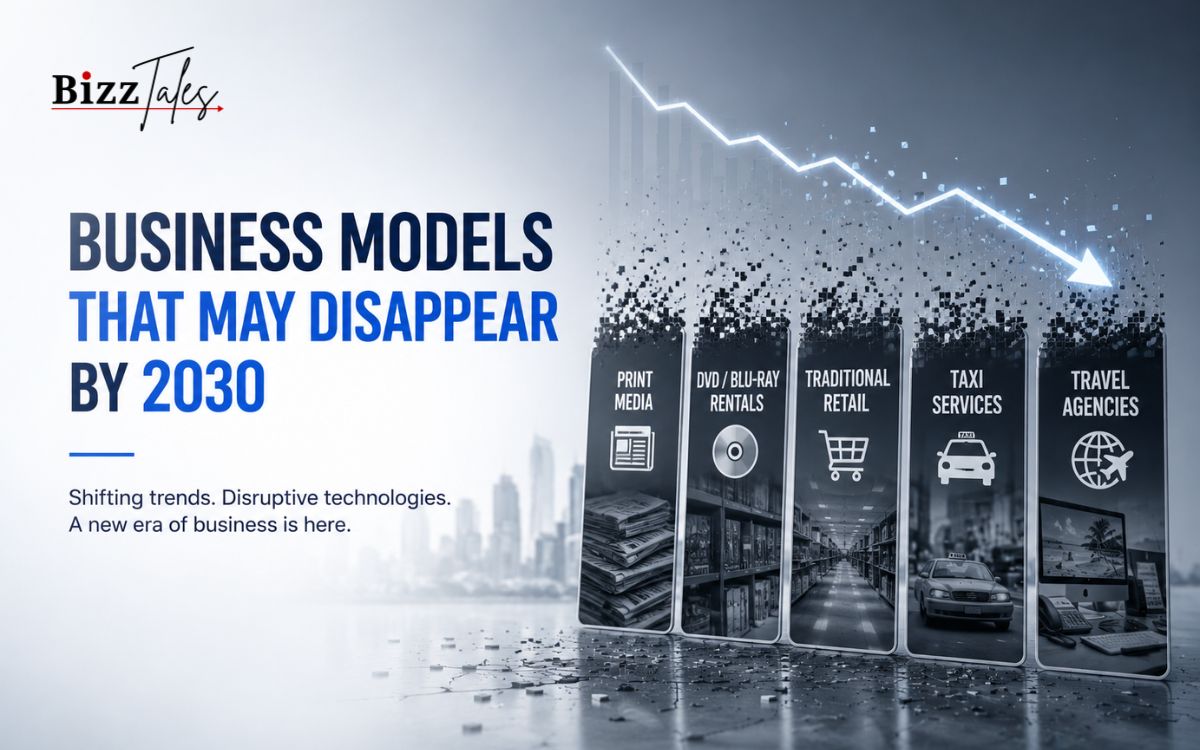
Physical-only retail business model, traditional travel booking, print-dependent media, manual administrative services, traditional call centers, labor arbitrage, proxy-heavy distribution channels, cash-only mode of payment and such other business models are under continuous challenges.
May not fell. But it does not need to; many firms may suffer from disruption, but the organizations themselves may not fall into near-term demise. Instead, the companies that ride the wave of innovation and shift their business models will be able to sustain value creation.
Ultimately, the most prosperous enterprises will be proactive and predict change — not responsive to it. Drawing on the knowledge of which business models are unlikely to survive into 2030 will help captains and their crews to develop good strategy, and grasp the new opportunities coming to light during the new era.
FAQs
What are the middle distorts? Which business models are under the biggest threat by 2030?
The traditional retail-only business models, print-dependent media businesses, paper-based administrative services and the conventional phone centers are some of the high-risk areas.
Will physical retail store be no longer existing?
No. Brick and mortar stores might still be here, but companies that conduct their entire sales operation through brick and mortar locations without any aspect of digital integration will find it hard to compete.
Let’s look at how the AIs are impacting the traditional various business models-PLC, VA, and IP.
AI replaces mundane tasks, increases efficiency, enhances customer experiences and reduces costs therefore many processes are becoming obsolete.
What is driving the increase of direct-to-consumer companies?
LP (distribution without intermediaries), increase the margin, build a new relationship with the customer, closer to his value as a customer and give access to more data on the customers.
Is it possible for traditional companies to make it through the disruption?
Absolutely. Companies who change with the times and whether they are in the midst of digital transformation or develop a new revenue model can compete and succeed.