
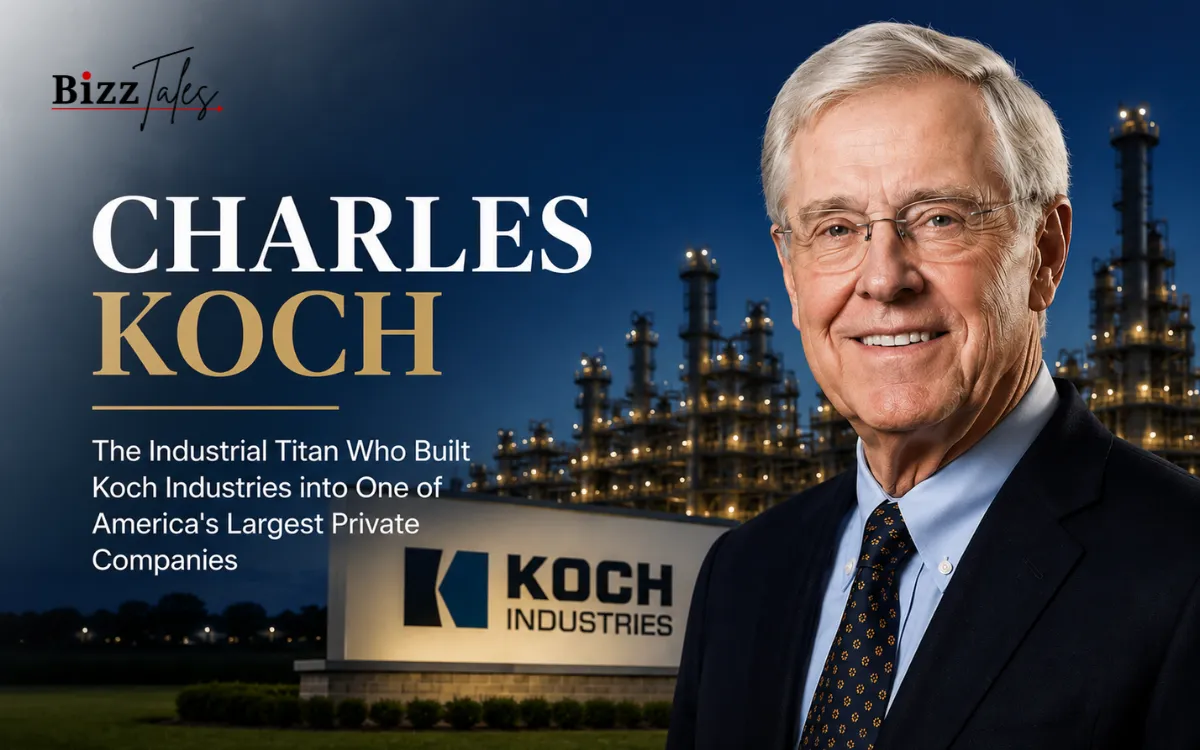
Charles Koch Charles Koch is among the most influential businessmen of all time in the United States. For years, as the chairman of the board, Koch steered Koch Industries from a regional fuel firm into a multinational personal holding that now does operations in several sectors, including vitality, petrochemicals, applied sciences, agriculture, farming, producers items and finance.
He did not achieve world fame with tech start ups, or through public stock companies. Instead, Charles Koch accumulated massive amounts of money operating businesses related to manufacturing industries, while thinking in terms of long-range value. He went on to formulate what became known as the core management strategy that Charles Koch championed, Market-Based Management.
Today Charles is known for his entrepreneurship, education, advocacy and public interest, in addition to being the business titan that he is. Kochs growth from an engineer in his family business to one of the worlds richest men should provide inspiration to entrepreneurs everywhere through diligent effort, inspired thinking and determined resolve.
Forbes Ranking & Net Worth History
| Year | Forbes Global Rank | Net Worth |
| 2026 | #25 | $73.8 Billion |
| 2025 | Top 25 Global Billionaires | $71.4 Billion |
| 2024 | Top 30 Global Billionaires | Approximately $64 Billion |
According to Forbes’ 2026 Billionaires List, Charles Koch and his family ranked #25 globally with an estimated net worth of $73.8 billion.
Early Life and Family Background
Born on November 1, 1935 in Wichita, Kansas, United States. Charles de Ganahl Koch is the son of Fred C. Koch, an engineer and businessman, the founder of the company that now controls the interests Koch Industries.
Being a child to a family engaged in business Charles acquired skills and know-how from the beginning, while engineering and operations are no foreign concepts to the young man.
From a young age, his father was instilling in Charles Charles lessons about responsibility and discipline that Charles’ own success will later shape into one’s leading principles. Contrary to many other family children in a well-off dynasty, Charles was to work for what is due, not to count on some privileged treatment. This first period of life formed his perspective of doing business and making wealth.
Education at MIT
Charles Koch did go to Massachusetts Institute of Technology, where he graduated as an engineer. His bachelor’s and master’s were both in engineering fields. This technological schooling built a solid analytical skill set and problem-solving framework.
Where other entrepreneurial founders were educated on the financial side or the marketing and sales side, Koch viewed the entrepreneurial endeavor as a challenge with solutions related to engineering, systems and efficiencies and learning curves and continuous improvement – a core advantage throughout his entrepreneurial life.
It also did a job to set him up for running a highly technical and industrial operation.
Joining the Family Business
Once Koch was educated, he entered his family’s business. At the time, his father’s corporation was just a small fraction of the corporation Charles, to this day, oversees, the large multinational Koch Industries. From entry level operational jobs, Koch gained hands-on insight to each functional area.
From this operational and, thus, empirical knowledge base, he developed an informed grasp of how an enterprise might overcome and leverage various operational impediments while cultivating its inherent advantage in order to succeed or grow in the market without leaning on familial designation and command and control type structure as a basis for operational input and control.
This early exposure to ground level experience was the basis to the business management styles he would employ later in his tenure.
Becoming Chairman of Koch Industries
In 1967, Charles Koch assumed the role of Chairman and CEO of Koch Industries. His assumption of control initiated an era of unprecedented expansion and transformation for the company. Far from simply staying in its core energy-focused industries, Charles expanded the business by implementing an ambitious program of acquisitions, operational enhancements, and diversification.
This brought Koch Industries into numerous new fields and created an extremely varied collection of businesses that made the company one of the world’s most successful private entities.
Building Koch Industries
One of the highlights of his career, at least in my opinion, was turning Koch Industries into a multifaceted industrial conglomerate.
The company’s operations eventually expanded into:
- Energy and pipelines
- Chemicals
- Manufacturing
- Agriculture
- Consumer products
- Commodity trading
- Technology
- Infrastructure
- Financial services
This diversification reduced dependence on any single industry and created multiple sources of growth.
Today, Koch Industries generates annual revenues comparable to many of the world’s largest public corporations while remaining privately owned.
The Market-Based Management Philosophy
Perhaps Charles Koch’s most significant intellectual contribution to business is his Market-Based Management (MBM) philosophy.
MBM applies principles derived from free-market economics to organizational management.
The framework emphasizes:
- Continuous learning
- Innovation
- Accountability
- Incentives
- Knowledge sharing
- Long-term value creation
Koch believes that organizations perform best when individuals are empowered to make decisions and create value.
The philosophy became deeply embedded within Koch Industries and played a major role in the company’s growth.
He later published several books explaining these concepts.
Acquisitions and Expansion
In his various ventures, Koch followed a strategy of making opportunistic acquisitions that could be fit in to bolster his existing position. Instead of chasing after the fleeting success, he was looking for those opportunities that would offer long-term sustainable profit over the years to come. Most of these investments he looked into he tried to get a share in and help with the efficiency and the integration of MBM principles.
With careful implementation of such measures, Koch was able to unlock quite a large value for its shareholders.
His efforts in the company’s expansion into the consumer goods, manufacturing, and industrial sectors increased the company size drastically and with it the profits of the company as well, and with the passage of time, Koch Industries became one of the largest private corporations in the USA.
Working with David Koch
Much of Charles Koch’s career was in tandem with that of his deceased brother, David Koch. They led their father’s business together for decades growing the business to one of the nation’s largest private companies. Charles as CEO led the strategy of the enterprise, and David as executive vice president, was more operations focused.
The Koch brothers’ synergy had the company booming with revenue by David Koch’s death in 2019.
He left behind his partner Charles Koch as the helm.
Challenges and Public Scrutiny
As Koch Industries expanded, it gained increased attention. Koch and his family increasingly figured in political controversy, political activism and media discussion. Much of the criticism aimed at the family centered around their support for and leadership of think tanks and activism organizations.
Yet Charles continued to operate the company effectively and consider future business opportunities, refusing to get caught up in the political arguments to the detriment of company operations.
Koch Industries expanded and thrived during this period, notwithstanding the external pressures.
Philanthropy and Educational Impact
Beyond business, Charles Koch has contributed billions of dollars to philanthropic initiatives.
His charitable efforts support:
- Education
- Entrepreneurship
- Economic opportunity
- Criminal justice reform
- Scientific research
- Community development
He has supported universities, research institutions, and educational programs throughout the United States.
His philanthropy reflects a belief in empowering individuals through knowledge, opportunity, and innovation.
These efforts have become an important component of his legacy.
Leadership Style
He possessed keen analytical skills, long-term strategic vision, and a rigorous discipline of execution. CharlesKoch prioritized operational and organizational excellence, opting to avoid the media limelight. Employees often characterize him as intellectually inquisitive, analytical and dedicated to constant learning and improvement.
His approach was on long-term value creation, not on hitting quarterly targets.
Such a philosophy was key to Koch Industries’ ability to flourish in disparate economic environments. Many leaders of industry emulate Koch’s operational principles and management skills.
Personal Life
Although immensely wealthy, Charles Koch has kept a fairly low profile for years. Charles Koch continues to be very active in business, philanthropy, and educational initiatives and is deeply invested in interests like economics, leadership, innovation, entrepreneurship and public policy.
Charles has spent decades proving that innovation and opportunities continue to sprout when learning, collaboration and freedom grow.
Official Social Media Presence
Charles Koch maintains limited personal social media activity.
Most public information about Charles Koch comes through Koch Industries, philanthropic organizations, interviews, and published works.
Lessons Entrepreneurs Can Learn from Charles Koch
One of the most important lessons from Koch’s journey is the power of long-term thinking.
Many of his most successful decisions required patience and years of execution.
His story also highlights the importance of organizational culture.
Market-Based Management demonstrates how effective systems and incentives can drive sustained success.
Entrepreneurs can learn from his focus on continuous learning, innovation, accountability, and value creation.
Most importantly, his career shows that extraordinary results often come from disciplined execution rather than short-term speculation.
Conclusion
Charles Koch’s transformation of Koch Industries into one of the largest private companies in the world stands as one of the most significant business achievements in modern American history. Through strategic leadership, disciplined management, and a commitment to innovation, he built a diversified industrial empire that spans numerous sectors and markets.
His influence extends beyond business into education, philanthropy, public policy, and organizational management.
For entrepreneurs, executives, and future business leaders, Charles Koch’s story offers valuable lessons about leadership, long-term thinking, operational excellence, and the importance of creating sustainable value.
His legacy continues to shape industries, institutions, and business practices around the world.
FAQs
Who is Charles Koch?
Charles Koch is the chairman of Koch Industries and one of the richest businessmen in the world.
What is Charles Koch’s net worth in 2026?
His estimated net worth is approximately $73.8 billion according to Forbes.
What is Koch Industries?
Koch Industries is one of the largest privately held companies in the world, operating across energy, manufacturing, chemicals, agriculture, and consumer products.
What is Market-Based Management?
Market-Based Management is Charles Koch’s business philosophy that applies free-market principles to organizational management.
Where did Charles Koch study?
He earned engineering degrees from MIT.
Is Charles Koch self-made?
He inherited part of the family business but dramatically expanded and transformed it into a global industrial empire.
What industries does Koch Industries operate in?
The company operates in energy, chemicals, manufacturing, agriculture, technology, infrastructure, and consumer products.
Is Charles Koch involved in philanthropy?
Yes. He supports education, entrepreneurship, scientific research, and economic opportunity initiatives.
Is Charles Koch active on social media?
He maintains a limited public social media presence.
What can entrepreneurs learn from Charles Koch?
Entrepreneurs can learn long-term thinking, organizational culture development, continuous learning, innovation, and disciplined value creation.